

Yields on 10-year Japanese government bonds rose to their highest level
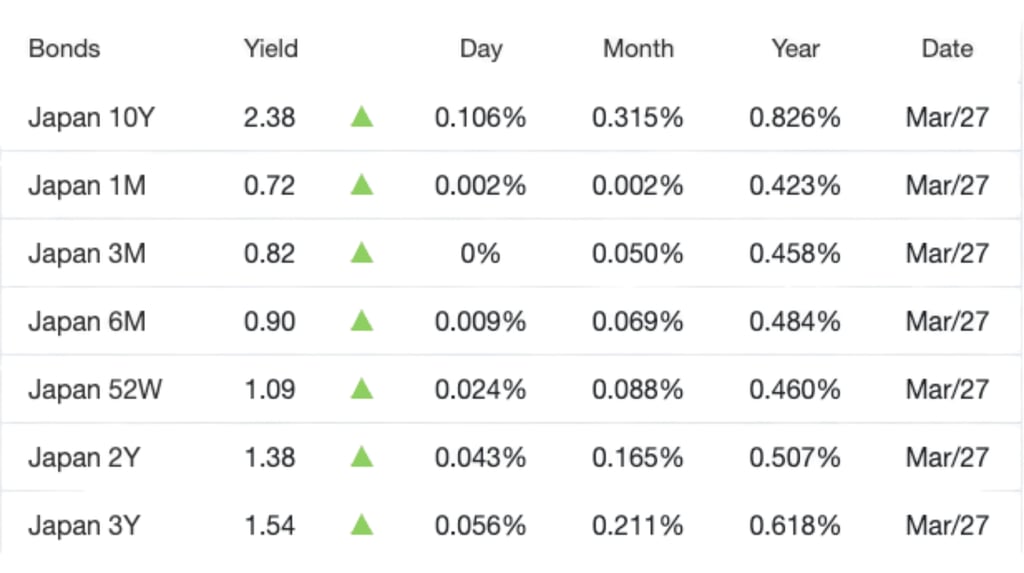
Yields on 10-year Japanese government bonds (JGBs) rose to 1.58% today – the highest level since 1999 – as investors anticipate the Bank of Japan (BOJ) will continue to tighten monetary policy.
3/27/20263 min read
Tighten monetary policy
Yields on 10-year Japanese government bonds have surged to their highest level since 1999, marking a historic shift for a nation long associated with ultra-low interest rates and aggressive monetary easing. This move signals that even the most accommodative major economies are beginning to experience structural changes in their interest rate environment.
The fact that it has surpassed levels not seen since 1999 shows that:
Loosen yield controls.
Inflation expectations are rising.
The shift away from extremely loose monetary policy.
This is a regime change, not just a short-term move. For global markets, its effects extend far beyond Japan—it impacts liquidity, capital flows, and risky assets worldwide. For decades, Japan maintained near-zero or even negative interest rates under its yield curve control (YCC) policy. Yields on 10-year Japanese government bonds (JGBs) were kept capped, keeping borrowing costs low and liquidity abundant.
Economic issues are in motion
The central bank has gradually scaled back its large-scale bond-buying program and has raised its policy interest rate from negative levels. Markets now expect at least one or two more rate hikes in 2026, with overnight rates potentially heading towards 0.5–0.75%.
Japan's core consumer price index (CPI) has remained above the Bank of Japan's (BOJ) 2% target for an extended period, driven by higher import costs (energy and food), wage growth, and a weakening yen. The 10-year break-even inflation rate has also risen, suggesting investors no longer expect deflation to return anytime soon.
The Japanese yen has depreciated significantly against the USD, making imports more expensive and contributing to import inflation. This has forced the BOJ to take more decisive action to curb inflation expectations.
Rising US Treasury yields and a stronger dollar have added upward pressure on Japanese government bond (JGB) yields, as foreign investors demand higher yields to offset currency risk.
Risk of economic crisis
Higher yields typically tighten financial conditions. As safe returns increase, investors can reduce the risk of investing in riskier assets.
For the cryptocurrency market, this could lead to increased volatility, potential short-term capital outflows, and a stronger correlation with macroeconomic factors. However, in the long term, macroeconomic changes could also generate new narratives—particularly around hedging against currency instability or currency transitions.
Domestically, higher yields could reshape Japan's financial landscape, increasing borrowing costs for the government and corporations, improving returns for savers and institutions, and putting pressure on Japan's large public debt structure. After decades of deflation, Japan may be entering a new economic phase shaped by inflation and normalization.
Our review
The rise in yields on 10-year Japanese government bonds to their highest level since 1999 is a clear sign that the era of ultra-loose monetary policy is coming to an end. For the first time in decades, investors in Japanese bonds are enjoying substantial yields, while borrowers and the government face higher financing costs. This shift has far-reaching implications:
This reduces global liquidity (less "free money" from Japan).
Supporting the yen (reducing depreciation pressure)
This adds further complexity to the global allocation of assets.
For the cryptocurrency market, the key question is how the reduction in yen-denominated interest rate arbitrage and tighter global financial conditions will impact risk appetite in the coming months. While not an immediate crisis, the normalization of the Japanese bond market is a structural change that investors should not ignore.
Disclaimer: The information presented in this article is the author's personal opinion in the field of cryptocurrency. This is not financial or investment advice. All investment decisions should be based on careful consideration of your personal portfolio and risk tolerance. The views expressed in this article do not represent the official position of the platform. We advise readers to conduct their own research and consult with experts before making any investment decisions.
Compiled and analyzed by HCC Venture
Follow HCCVenture here: https://link3.to/holdcoincventure
Explore HCCVenture group
HCCVENTURE QUANT JSCO
© 2026 HCCVENTURE. ALL COPYRIGHTS RESERVED.


Connect with us
Popular content
Contact to us
Address: 8th Floor, Bach Dang Complex Building, 50 Bach Dang Street, Hai Chau Ward, Da Nang City, Vietnam.
Phone: 1900 1509
Gmail : sp_contact@hccventure.com
Disclaimer: The information on this website is for informational purposes only and should not be considered investment advice. We are not responsible for any risks or losses arising from investment decisions based on the content here.
TERMS AND CONDITIONS • CUSTOMER PROTECTION POLICY
ANALYTICAL AND NEWS CONTENT IS COMPILED AND PROVIDED BY EXPERTS IN THE FIELD OF DIGITAL FINANCE AND BLOCKCHAIN BELONGING TO HCCVENTURE ORGANIZATION, INCLUDING OWNERSHIP OF THE CONTENT.
RESPONSIBLE FOR MANAGING ALL CONTENT AND ANALYSIS: HCCVENTURE FOUNDER - TRUONG MINH HUY
Read warnings about scams and phishing emails — REPORT A PROBLEM WITH OUR SITE.