
World Liberty Financial condemns the 'attack' on USD1
World Liberty Financial has publicly condemned what it describes as a “coordinated attack” on its flagship USD1 stablecoin, rejecting recent market volatility as a deliberate attempt to undermine confidence in the project.
2/24/20263 min read
Something happened to USD1
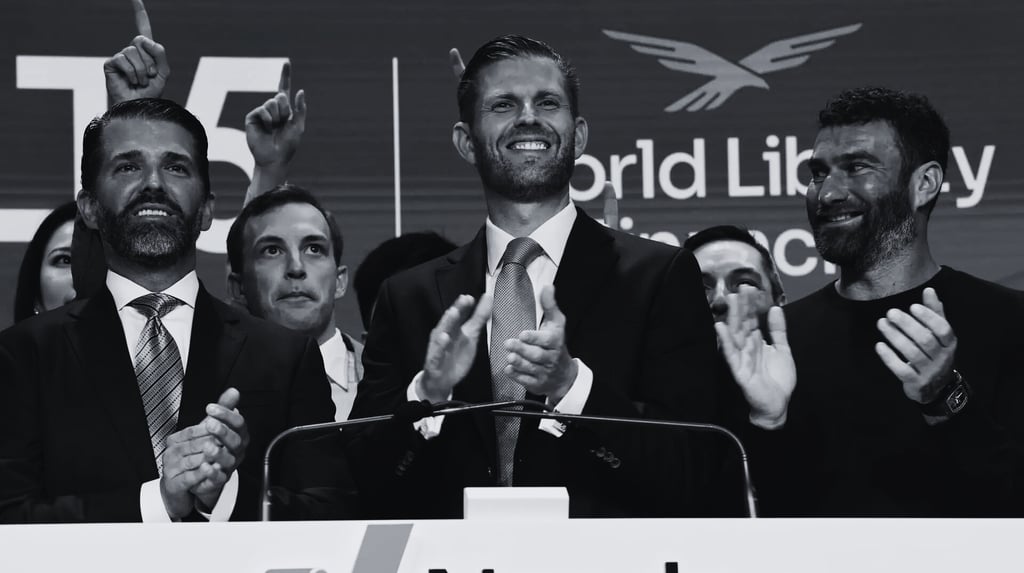
World Liberty Financial (WLFI), a cryptocurrency company closely associated with President Donald Trump and his family, publicly condemned what it described as a "coordinated attack" on the USD1 stablecoin pegged to the US dollar. The incident, which occurred early Monday morning, February 23rd, caused USD1 to temporarily lose its peg to the US dollar —dropping to lows of $0.9802–$0.994 on major exchanges like Binance and CoinGecko—before quickly recovering to parity.
Cause of the anchoring failure: Around 8:15 AM ET on February 23rd, USD1 fell below $1 amid strong selling pressure, coinciding with suspicious activity from compromised accounts of co-founder X posting misinformation.
Recovery: USD1 regained its price anchor within hours, stabilizing near the $1 mark. Trading volume for stablecoins surged, with USD1 recording a significant 24-hour increase along with other stablecoins such as PYUSD and USDC.
The broader context: This event follows the highly publicized WLFI cryptocurrency forum at Mar-a-Lago, attended by government officials, industry leaders, and former Binance CEO Changpeng Zhao (pardoned by Trump in 2025). The ongoing congressional investigation into WLFI's connections—including significant investments from entities linked to the UAE royal family and Binance's substantial role in holding the USD1 supply—adds to the sensitivity.
USD1 is among the top stablecoins by market capitalization ( approximately $4.7–$4.9 billion ), positioning WLFI as a significant player in the DeFi and stablecoin space despite its political affiliations.
Methods of Attacking Stablecoins
Stablecoins like USD1 are designed to stabilize price through adequate reserves and arbitrage incentives, but they remain vulnerable to confidence shocks—especially in politically motivated projects. This incident mirrors past instances of price anchor breaches where external pressure exploited low liquidity or market sentiment. Key elements of the attack believed to target WLFI include:
Social engineering: The hacked X accounts (names of co-founders not disclosed) allowed for the rapid spread of FUD, a low-cost attack method within the Twitter-driven cryptocurrency ecosystem.
Paid influence and short selling: Allegations of paid influencers and large short selling orders on $WLFI suggest a coordinated effort for profit, although no independent verification has emerged.
No on-chain breaches: Importantly, WLFI asserts that the core infrastructure—smart contracts and reserves—remains unaffected, which distinguishes this incident from hacks like Ronin or Wormhole.
Skeptics questioned whether the "coordinated attack" label mitigated natural market dynamics or internal issues, given WLFI's complex structure (e.g., highly concentrated USD1 supply on Binance, governance token sales to certified/foreign investors, and profit streams for holders). However, the rapid recovery reinforced the argument for WLFI's robust defenses.
The aftermath of the attack
This incident caused USD1 to temporarily lose the equivalent of $1, falling to around $0.994, but quickly recovered to its target level as traders leveraged the built-in exchange mechanism. The project emphasized that the underlying reserve asset remains secure and fully backed, and no smart contracts or core infrastructure were compromised. Numerous reports have reiterated this, with World Liberty asserting that the price volatility reflects external pressure and psychological manipulation rather than a fundamental flaw in the stablecoin's design.
From a broader perspective, this controversy has highlighted cryptocurrency projects linked to politics, particularly those that combine financial strategies with prominent public figures. USD1, issued by World Liberty Financial and backed by the Trump family's business interests, has grown into one of the largest stablecoins on the market, with billions of dollars in circulation. Its political ties have drawn attention and skepticism from observers concerned about conflicts of interest, regulatory scrutiny, and how such projects intersect with mainstream finance.
Disclaimer: The information presented in this article is the author's personal opinion in the field of cryptocurrency. This is not financial or investment advice. All investment decisions should be based on careful consideration of your personal portfolio and risk tolerance. The views expressed in this article do not represent the official stance of the platform. We recommend that readers conduct their own research and consult with experts before making any investment decisions.
Compiled and analyzed by HCCVenture
Follow HCCVenture here: https://link3.to/holdcoincventure
Explore HCCVenture group
HCCVENTURE QUANT JSCO
© 2026 HCCVENTURE. ALL COPYRIGHTS RESERVED.


Connect with us
Popular content
Contact to us
Address: 8th Floor, Bach Dang Complex Building, 50 Bach Dang Street, Hai Chau Ward, Da Nang City, Vietnam.
Phone: 1900 1509
Gmail : sp_contact@hccventure.com
Disclaimer: The information on this website is for informational purposes only and should not be considered investment advice. We are not responsible for any risks or losses arising from investment decisions based on the content here.
TERMS AND CONDITIONS • CUSTOMER PROTECTION POLICY
ANALYTICAL AND NEWS CONTENT IS COMPILED AND PROVIDED BY EXPERTS IN THE FIELD OF DIGITAL FINANCE AND BLOCKCHAIN BELONGING TO HCCVENTURE ORGANIZATION, INCLUDING OWNERSHIP OF THE CONTENT.
RESPONSIBLE FOR MANAGING ALL CONTENT AND ANALYSIS: HCCVENTURE FOUNDER - TRUONG MINH HUY
Read warnings about scams and phishing emails — REPORT A PROBLEM WITH OUR SITE.