

we flag Thailand has issued an arrest warrant for a Chinese businessman in connection with a crypto scam
The Thai Special Investigation Bureau has issued an arrest warrant for Chinese businessman Wang Yicheng, along with arrest warrants for three other Chinese citizens and four Myanmar citizens.
6/26/20264 min read
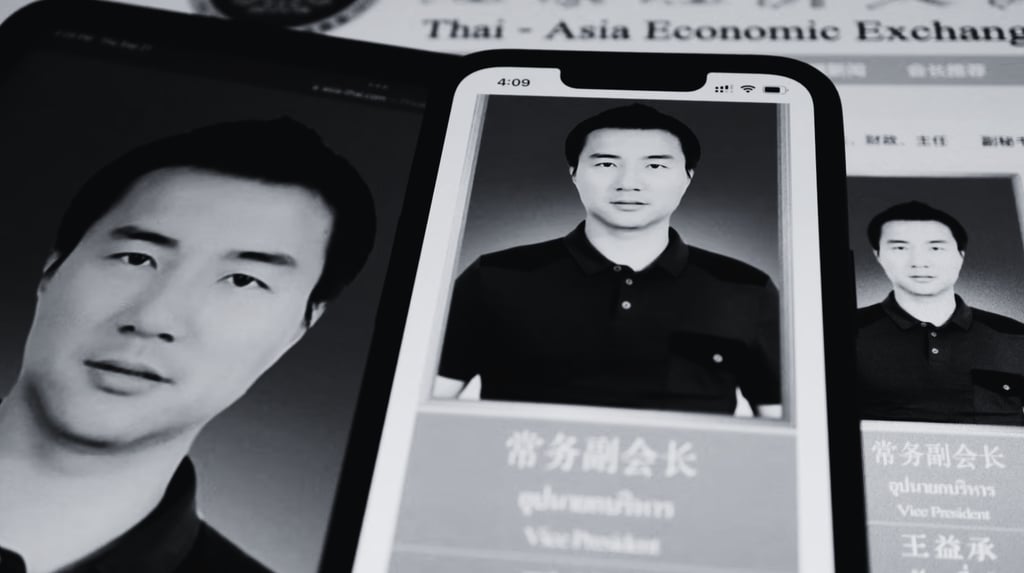

International criminal activities of Wang Yicheng
Wang Yicheng, a Chinese businessman based in Bangkok who formerly led a Thai-Chinese trade association, emerged as the prime target of an investigation spanning from mining operations in Southeast Asia to federal investigations into digital asset fraud in the United States. Thai authorities received intelligence from the U.S. Secret Service linking Wang to a large-scale digital asset fraud scheme, resulting in the seizure of over $17.8 million in cryptocurrency assets linked to his accounts, with total fraud losses estimated to exceed $61 million according to the U.S. investigation.
A 2023 Reuters investigation first publicly linked Wang to a fraudulent pig slaughtering infrastructure, revealing that a cryptocurrency wallet registered under his name received at least $9.1 million from accounts of blockchain analytics firms linked to the scams, and documenting Wang's systematic cultivation of relationships with influential figures in Thai politics and law enforcement. This relationship-building strategy represents a deliberate investment in operational security, allowing Wang's network to operate within Thai jurisdiction while remaining protected from domestic law enforcement actions through cultivated institutional connections.
According to Reuters, a cryptocurrency account under Wang's name is believed to have received more than $90 million in recent years, indicating a significant scale of cryptocurrency flow, suggesting a connection to the financial infrastructure of large-scale organized crime rather than opportunistic individual criminal activity.
Scale of the exploitation network and level of electricity theft
The DSI investigation documented three criminal networks dismantled that caused over 953 million baht (approximately US$29 million) in losses to the Electricity Authority of Thailand, with investigators seizing over 6,390 mining rigs at various locations, indicating significant investment in physical infrastructure. These networks systematically employed methods of tampering with electricity meters and illegally connecting to the power grid, allowing for continuous mining operations without paying corresponding electricity bills. The stolen electricity provided a significant cost advantage, enabling profitable mining despite the volatility of the cryptocurrency market.
The network structure established a hierarchical operational system, in which Chinese financiers provided capital and strategic direction, while Myanmar citizens acted as operators and cash transporters. Investigators found that the network used Myanmar citizens to withdraw between 30 million and 50 million baht (US$920,000 to US$1.5 million) in cash daily from Thai financial institutions, pushing the total annual outflow to over 10 billion baht (US$300 million). The daily cash withdrawals suggest that the mining operation primarily served as a mechanism to convert cryptocurrency into cash to profit illicitly from the scams, rather than a purely speculative investment in mining.
Money laundering structures and the flow of "grey capital"
The Department of Economic Crime Investigation (DSI) describes the criminal network as operating through "Chinese gray capital," a term referring to illicit funds transferred through seemingly legitimate commercial channels, with mining operations serving as a key money laundering mechanism, converting proceeds from fraud and gambling into cryptocurrency and then into Thai baht cash through withdrawals from financial institutions. This money laundering structure explains why electricity theft generates additional profits beyond cost reduction, as free electricity allows mining operations to generate cryptocurrency, representing a seemingly legitimate source of income that justifies subsequent conversion into cash.
Criminal groups have used illegal mining operations to generate revenue, launder money, and support broader technology-based criminal networks, as described by the DSI. The sophistication of this network's operations, which distinguishes it from simple electricity theft aimed at comprehensive money laundering infrastructure, reflects its connection to established transnational organized crime networks with significant resources and operational experience in managing complex multinational criminal enterprises.
The expansion of the investigation from the initial electricity theft to a comprehensive transnational money laundering network has revealed a pattern in which cryptocurrency crime investigations frequently uncover a larger scope of crime than what initial law enforcement actions suggested, as financial investigative techniques including blockchain analysis and traditional forensic accounting show interconnected criminal ecosystems, requiring a comprehensive investigation rather than just individual prosecutions.
Assessment and Conclusion
Thailand's robust law enforcement, including multinational arrest warrants, the transfer of corruption cases in the power sector, and the seizure of 6,390 offshore platforms, has established a comprehensive enforcement framework addressing illegal mining as a complex organized crime problem rather than a single regulatory violation. This holistic approach, targeting financial infrastructure, physical mining equipment, corrupt officials, and key operators simultaneously, reflects a sophisticated law enforcement strategy that recognizes that targeting a single network component allows for the restructuring of the criminal enterprise through alternative operating methods.
For cryptocurrency exchanges processing transactions from organized crime networks in Southeast Asia, the investigation reinforces compliance obligations to implement sophisticated transaction monitoring, identifying patterns consistent with money laundering through mining operations, including the sudden deposit of large amounts of cryptocurrency after the victim's payment deadline and rapid conversion to cash through withdrawals from multiple financial institutions.
The regional cooperation framework established between Thailand's Department of Special Investigation (DSI) and the U.S. Secret Service demonstrates the need to expand international law enforcement coordination targeting cryptocurrency-backed transnational crime, with intelligence sharing enabling enforcement actions that exceed the investigative resource capabilities of any single nation.
Disclaimer: The information presented in this article is the author's personal opinion in the field of cryptocurrencies. This is not financial or investment advice at all. Every investment decision should be based on careful consideration of your personal portfolio and risk tolerance. The opinion in the article does not represent the official position of the platform. We recommend that readers do their own research and consult experts before making any investment decisions.
Synthesized and analyzed by HCCVenture
Follow HCCVenture organization here: https://link3.to/holdcoincventure
Explore HCCVenture group
HCCVENTURE QUANT JSCO
© 2026 HCCVENTURE. ALL COPYRIGHTS RESERVED.


Connect with us
Popular content
Contact to us
Address: 8th Floor, Bach Dang Complex Building, 50 Bach Dang Street, Hai Chau Ward, Da Nang City, Vietnam.
Phone: 1900 1509
Gmail : sp_contact@hccventure.com
Disclaimer: The information on this website is for informational purposes only and should not be considered investment advice. We are not responsible for any risks or losses arising from investment decisions based on the content here.
TERMS AND CONDITIONS • CUSTOMER PROTECTION POLICY
ANALYTICAL AND NEWS CONTENT IS COMPILED AND PROVIDED BY EXPERTS IN THE FIELD OF DIGITAL FINANCE AND BLOCKCHAIN BELONGING TO HCCVENTURE ORGANIZATION, INCLUDING OWNERSHIP OF THE CONTENT.
RESPONSIBLE FOR MANAGING ALL CONTENT AND ANALYSIS: HCCVENTURE FOUNDER - TRUONG MINH HUY
Read warnings about scams and phishing emails — REPORT A PROBLEM WITH OUR SITE.