

Vitalik Buterin reconsiders Ethereum's rollup-focused roadmap
Vitalik Buterin reignited a core debate at Ethereum by questioning whether the network's rollup-focused roadmap would deliver the rapid—or reliable—decentralization originally envisioned.
2/5/20263 min read

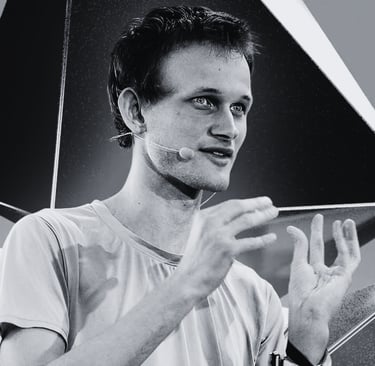
The shortcomings that Buterin raised.
Vitalik Buterin , co-founder of Ethereum, posted a detailed article on the rollup-centric roadmap on his personal blog and X account, acknowledging that Layer-2 scaling solutions are decentralizing “much slower” than initially anticipated — and warning that the current trajectory risks creating a few dominant, semi-centralized sequencers instead of a truly decentralized scaling ecosystem. The post — titled “ Rollups Are Decentralizing Much Slower Than Expected — We Need to Adjust Our Direction ” — marks one of Vitalik’s most candid assessments of Ethereum’s scaling path since the Merge (2022) and the widespread adoption of optimistic and zk-rollups.
Sequencer centralization remains a serious problem when:
Most large rollups (Arbitrum, Optimism, Base, zkSync Era, Starknet) still rely on a single active sequencer controlled by a group or organization. Decentralized sequencers have been deployed on test networks or with limited capacity on some chains but have yet to operate at significant scale on the mainnet.
The initial roadmap assumption was that decentralization of the process would be meaningful within 1-2 years of rollup maturity (2023-2025). However, current reality shows that most L2 servers are still 2-4 years away from implementing decentralized processes (sharing processes, separating proposers and builders, or economic decentralization mechanisms).
Without faster progress, Ethereum could end up with 3-5 dominant rollups, each controlled by a small entity or committee — essentially recreating centralized scaling under a decentralized brand.
Key suggestions from Buterin's community post:
Accelerate the creation of shared order sequences (e.g., Espresso, Astria, Radius, SUAVE) and offer stronger economic incentives to launch them sooner.
Lower the standards for what is considered “decentralized enough” in the short term (e.g., 10-20 independent proposers instead of over 100).
Apply stronger economic penalties for misconduct in the arrangement process (cuts, reputational damage, delays in economic viability).
Focus more on L1 enhancements (e.g., danksharding, blob scaling, Verkle trees) to reduce reliance on L2-centric sequencing in the short term.
Decentralization is lagging behind scale.
Buterin's criticism centers on the fact that many top rollups still rely on centralized arrangers, privileged operators, upgrade keys, or limited validator sets. While these designs were initially very pragmatic, their existence poses risks of transaction censorship, unilateral parameter changes, and opaque governance.
In short, users benefit from cheaper transactions—but often following trust models closer to centralized systems than the Ethereum platform layer . The gap between “ roadmap promises ” and “ production reality ” is what Buterin is highlighting.
Ethereum 's rollup vision prioritizes security legacy from L1, but sovereignty—who controls the scheduling, upgrades, and emergency actions—lags behind. Even with fraud proof or ZK proof, checkpoints remain crucial. If a small group can stop or reschedule transactions, decentralization is compromised regardless of cryptographic guarantees.
A perspective that emphasizes ecological thinking.
For rollup teams, the message is a call to action: mere scale is no longer enough. Investors and users can begin to value decentralization more clearly, rewarding projects that meet higher standards sooner. For organizations, clarity of control and governance is crucial; slower decentralization could delay wider adoption in regulated contexts.
This shift could reshape competition among L2s, favoring organizations that prioritize decentralization even at the cost of short-term efficiency.
Importantly, Buterin doesn't reject a rollup-centric approach. He acknowledges the mismatch in timing, given that scalability arrived faster than decentralization. The solution isn't a rollup, but a rebalancing—tightening requirements, establishing clearer standards, and ensuring Ethereum's ultimate goal remains consistent with its core values.
Assessment and Conclusion
Vitalik's candid admission that Layer-2 decentralization is progressing much slower than planned is both a wake-up call and a constructive one. It prevents complacency and refocuses the ecosystem on the original promise of scaling Ethereum without sacrificing decentralization.
The roadmap isn't broken — it's just taking longer than expected on one of the most important pillars. Sequence sharing, economic penalties for sequence misconduct, and continued Layer-1 improvement (danksharding, Verkle trees) are now the areas with the highest leverage for the 2026–2027 period.
Disclaimer: The information presented in this article is the author's personal opinion in the field of cryptocurrency. This is not financial or investment advice. All investment decisions should be based on careful consideration of your personal portfolio and risk tolerance. The views expressed in this article do not represent the official stance of the platform. We recommend that readers conduct their own research and consult with experts before making any investment decisions.
Compiled and analyzed by HCCVenture
Follow HCCVenture here: https://link3.to/holdcoincventure
Explore HCCVenture group
HCCVENTURE QUANT JSCO
© 2026 HCCVENTURE. ALL COPYRIGHTS RESERVED.


Connect with us
Popular content
Contact to us
Address: 8th Floor, Bach Dang Complex Building, 50 Bach Dang Street, Hai Chau Ward, Da Nang City, Vietnam.
Phone: 1900 1509
Gmail : sp_contact@hccventure.com
Disclaimer: The information on this website is for informational purposes only and should not be considered investment advice. We are not responsible for any risks or losses arising from investment decisions based on the content here.
TERMS AND CONDITIONS • CUSTOMER PROTECTION POLICY
ANALYTICAL AND NEWS CONTENT IS COMPILED AND PROVIDED BY EXPERTS IN THE FIELD OF DIGITAL FINANCE AND BLOCKCHAIN BELONGING TO HCCVENTURE ORGANIZATION, INCLUDING OWNERSHIP OF THE CONTENT.
RESPONSIBLE FOR MANAGING ALL CONTENT AND ANALYSIS: HCCVENTURE FOUNDER - TRUONG MINH HUY
Read warnings about scams and phishing emails — REPORT A PROBLEM WITH OUR SITE.