

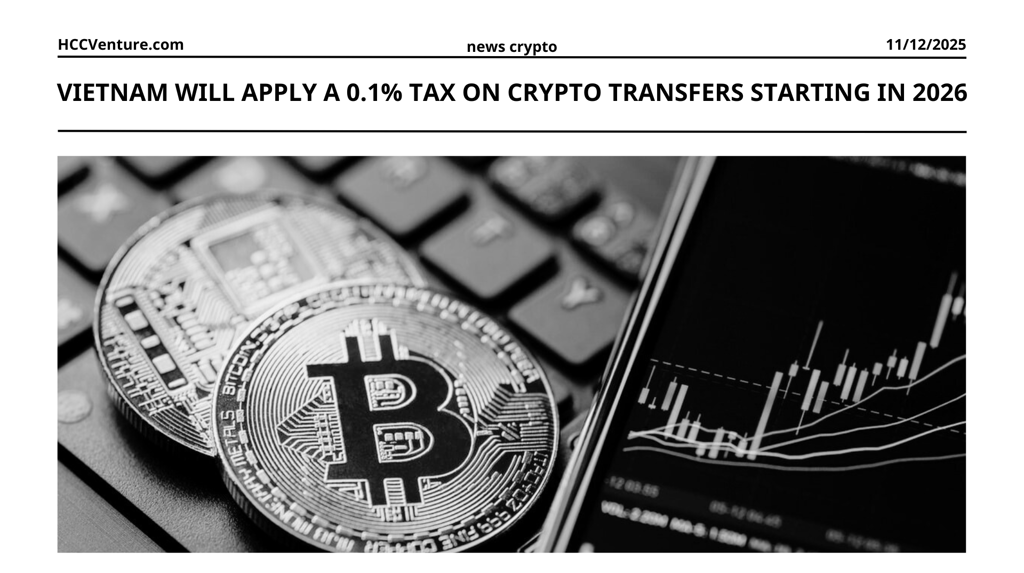
Vietnam will apply a 0.1% tax on crypto transfers starting in 2026
From July 1, 2026, income from the transfer of crypto assets will be taxed at 0.1% of the transaction value per transfer, similar to the current securities tax.
12/11/20253 min read
Regulating the digital asset economy
Vietnam will officially apply a 0.1% personal income tax on all digital asset transfers starting July 1, 2026, marking the nation's first comprehensive tax policy targeting cryptocurrencies and other tokenized assets. This represents a significant regulatory milestone as Vietnam transitions from a largely unregulated cryptocurrency market to a more structured and financially integrated digital economy.
The new tax applies to the total value of each transaction, not the net profit. This means individuals will have to pay 0.1% of the total transfer amount regardless of whether the transaction results in a profit or a loss — a model similar to the current tax applied to securities transactions in traditional financial markets.
The bill details
The draft revised Personal Income Tax Law, to be submitted to the Government in August 2025, adds "other income" including the transfer of crypto assets (such as Bitcoin, Ethereum, NFTs), in addition to the right to transfer ".vn" domain names, carbon credits, and auctioned vehicle license plates. Tax will apply when income from a single transfer exceeds VND 20 million.
Tax Rate : 0.1% on the transfer value of each transaction, applicable only on transparent exchanges (with publicly available prices and frequent transactions). If the purchase and related costs are identifiable, the tax = (Transfer Price - Purchase Price - Costs) x 20%. If the costs are not identifiable, the tax = Transfer Price x 2%.
Effective Date : From July 1, 2026, after the Digital Technology Law (passed in June 2025) recognizes cryptographic assets as civil property.
Reason : To expand the tax base in accordance with Resolution 07-NQ/TW of the Party and Resolution 23/2021/QH15 of the National Assembly , addressing the tax gap in the digital economy (Vietnam's crypto market is booming, ranking in the top 3 globally in 2022). The 0.1% rate is simple , easy to apply, and does not require complex valuation.
It is estimated that, with transactions totaling $120 billion in 2022, a 0.1% tax could generate over $100 million per year (according to the Vietnam Blockchain Association).
How the 0.1% tax is applied.
All transactions involving the transfer of digital assets — including cryptocurrencies, stablecoins, tokenized securities, NFTs, and other recognized digital assets — will be subject to a tax of 0.1% of the total transaction value.
Regardless of profit/loss – Taxes still have to be paid even if the investor incurs a loss on the transaction. For example:
Transfer value: $10,000
Profit or loss: irrelevant.
Tax payable: $10
Although official guidelines will be issued later, the government is expected to require exchanges operating in Vietnam to deduct taxes at the time of transaction, or self-declare taxes for transactions conducted on foreign platforms or self-managed wallets.
This could create an additional compliance burden for individual investors and traders using decentralized exchanges (DEXs) or cross-border applications.
Assessment perspective
Vietnam's decision to impose a 0.1% personal income tax on digital asset transfers marks a significant turning point for the country's rapidly developing cryptocurrency economy. By establishing a formal tax legal framework, the government demonstrates its readiness to integrate digital assets into the national financial infrastructure while addressing systemic risks.
However, market participants have raised several points for caution:
Fixed transaction taxes can reduce liquidity, especially in markets with high trading volumes.
Tracking transactions on DEXs and cross-chain transfers can be challenging, potentially creating loopholes in regulatory compliance.
Retail traders may face disproportionate burdens due to frequently making small trades.
Taxing based on total value rather than net profit could disadvantage consumers in highly volatile markets.
Industry groups are expected to lobby for clarification on the issue — particularly around staking, lending, NFTs, airdrops, and asset swaps that may not involve fiat currency conversion.
Disclaimer: The information presented in this article is the author's personal opinion on the cryptocurrency field. This is not financial or investment advice. All investment decisions should be based on careful consideration of your personal portfolio and risk tolerance. The views expressed in this article do not represent the official stance of the platform. We recommend that readers conduct their own research and consult with professionals before making any investment decisions.
Explore HCCVenture group
HCCVENTURE QUANT JSCO
© 2026 HCCVENTURE. ALL COPYRIGHTS RESERVED.


Connect with us
Popular content
Contact to us
Address: 8th Floor, Bach Dang Complex Building, 50 Bach Dang Street, Hai Chau Ward, Da Nang City, Vietnam.
Phone: 1900 1509
Gmail : sp_contact@hccventure.com
Disclaimer: The information on this website is for informational purposes only and should not be considered investment advice. We are not responsible for any risks or losses arising from investment decisions based on the content here.
TERMS AND CONDITIONS • CUSTOMER PROTECTION POLICY
ANALYTICAL AND NEWS CONTENT IS COMPILED AND PROVIDED BY EXPERTS IN THE FIELD OF DIGITAL FINANCE AND BLOCKCHAIN BELONGING TO HCCVENTURE ORGANIZATION, INCLUDING OWNERSHIP OF THE CONTENT.
RESPONSIBLE FOR MANAGING ALL CONTENT AND ANALYSIS: HCCVENTURE FOUNDER - TRUONG MINH HUY
Read warnings about scams and phishing emails — REPORT A PROBLEM WITH OUR SITE.