

Upexi reports a $179 million loss on shares as Solana's price plummets
Upexi, a publicly listed company often known for its role in the Solana (SOL) ecosystem, reported a massive $179 million loss as the price of SOL plummeted.
2/13/20262 min read
DATCO Crypto risks are looming.
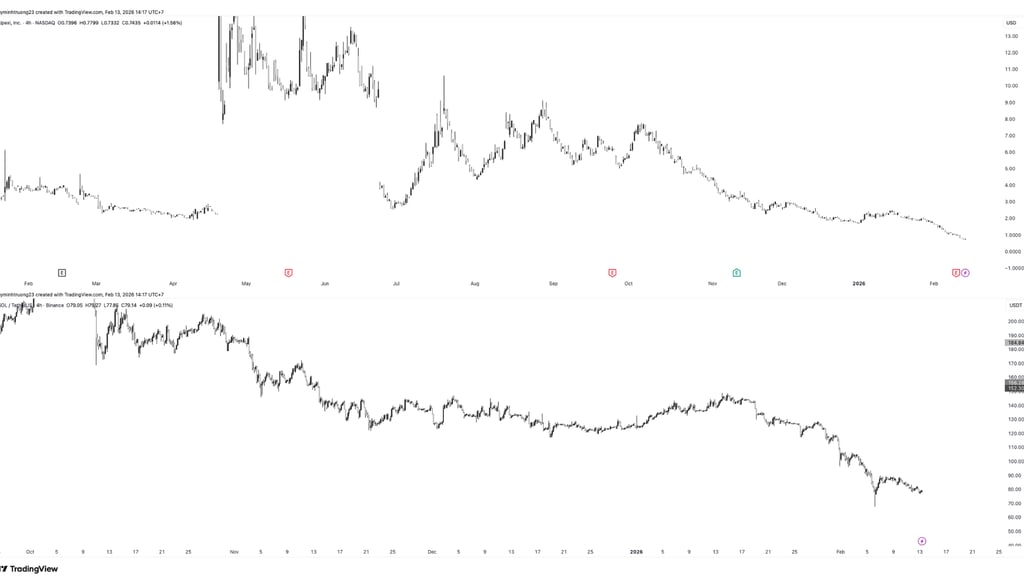
Upexi, Inc. (NASDAQ: UPXI) — a publicly listed company heavily focused on investing in the Solana ecosystem and DeFi infrastructure through its DAT (Digital Asset Treasury) division — reported a massive net loss of $179 million for the second quarter of fiscal year 2026 (ending December 31, 2025) in its 8-K filing and earnings announcement after the market closes on February 4, 2026.
This massive loss — which wiped out nearly three years of previous gains and sent UPXI shares plummeting from -42% to -48% in after-hours trading — was almost entirely due to unrealized and realized losses on Solana (SOL) and SOL-denominated assets held in DAT treasuries.
According to data collected for the Solana Treasury:
Solana fell from its cycle peak of nearly $240–260 (late 2025) to $140–150 during the January 2026 correction — a drop of approximately 40–45% that directly impacted the DAT portfolio.
Upexi revealed that approximately 350,000–400,000 SOL were liquidated in margin calls related to leveraged positions and to meet operating cash needs — resulting in significant actual losses.
According to US GAAP, digital assets are considered intangible assets with an unlimited useful life → recorded at their original cost minus impairment (repricing is not permitted). The sharp decline in SOL has resulted in huge non-cash impairment charges.
The DAT division used borrowed capital and derivatives to amplify the risks associated with SOL — a strategy that worked during the 2025 bull run but proved disastrous during the recession.
Deliberately high Beta strategy
Some companies deliberately adopt a cryptocurrency-heavy financial management strategy, positioning themselves as leverage representatives for specific digital assets. This model is similar to the approach taken by companies that accumulate Bitcoin or Ethereum as core reserves. The reasoning is simple: if the asset appreciates significantly, shareholder value can increase rapidly.
This case reinforces an important principle: holding cryptocurrency on a company's balance sheet alters its profit profile. While some companies view this as a long-term investment strategy, others may underestimate the accounting and market consequences of price cycles.
Our review
Upexi's $179 million loss in the second quarter was a staggering figure — but largely due to a market revaluation and tied to a sharp correction in SOL shares, rather than operational failure or insolvency. The company still holds approximately 980,000–1 million SOL shares (valued at around $142–145 million at current prices), generating revenue from traditional consumer products and maintaining sufficient cash reserves to avoid forced liquidation.
This isn't FTX or Celsius—it's a leveraged gamble that has suffered losses during a correction driven by macroeconomic factors. If SOL recovers to $180–200 or higher (as many analysts still predict for 2026–2027), much of the loss will be offset on paper. Otherwise, Upexi will face continued pressure on its balance sheet and the potential for share dilution due to the fundraising.
Disclaimer: The information presented in this article is the author's personal opinion in the field of cryptocurrency. This is not financial or investment advice. All investment decisions should be based on careful consideration of your personal portfolio and risk tolerance. The views expressed in this article do not represent the official stance of the platform. We recommend that readers conduct their own research and consult with experts before making any investment decisions.
Compiled and analyzed by HCCVenture
Follow HCCVenture here: https://link3.to/holdcoincventure
Explore HCCVenture group
HCCVENTURE QUANT JSCO
© 2026 HCCVENTURE. ALL COPYRIGHTS RESERVED.


Connect with us
Popular content
Contact to us
Address: 8th Floor, Bach Dang Complex Building, 50 Bach Dang Street, Hai Chau Ward, Da Nang City, Vietnam.
Phone: 1900 1509
Gmail : sp_contact@hccventure.com
Disclaimer: The information on this website is for informational purposes only and should not be considered investment advice. We are not responsible for any risks or losses arising from investment decisions based on the content here.
TERMS AND CONDITIONS • CUSTOMER PROTECTION POLICY
ANALYTICAL AND NEWS CONTENT IS COMPILED AND PROVIDED BY EXPERTS IN THE FIELD OF DIGITAL FINANCE AND BLOCKCHAIN BELONGING TO HCCVENTURE ORGANIZATION, INCLUDING OWNERSHIP OF THE CONTENT.
RESPONSIBLE FOR MANAGING ALL CONTENT AND ANALYSIS: HCCVENTURE FOUNDER - TRUONG MINH HUY
Read warnings about scams and phishing emails — REPORT A PROBLEM WITH OUR SITE.