

Upbit Suffers $37 Million Loss Due to Solana-Involved Security Breach
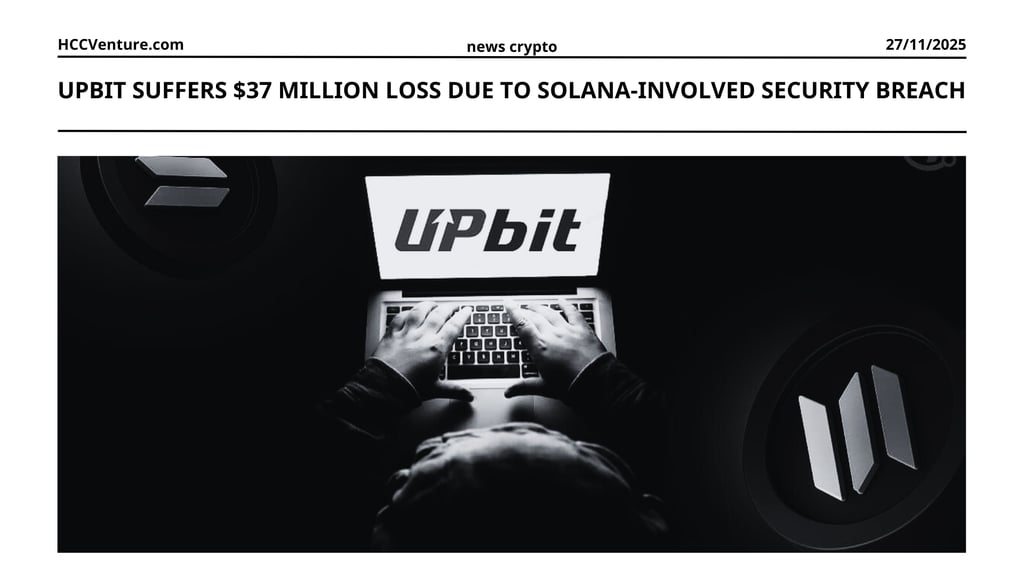
Upbit exchange has confirmed a major security vulnerability on its Solana hot wallet, resulting in the unauthorized transfer of approximately $37 million (54 billion KRW) in Solana ecosystem tokens to unknown addresses.
11/27/20252 min read
$37 million goes from Solana network hot wallet
A serious security incident on the Solana network has caused one of the most serious disruptions to a centralized exchange this year. Upbit, South Korea's largest cryptocurrency exchange by market share, has confirmed that it lost approximately $37 million after a malicious attacker exploited a vulnerability related to Solana-based assets.
In response, the exchange immediately halted all deposits and withdrawals across the entire platform, initiated a comprehensive legal investigation, and implemented unprecedented emergency controls. The event places new scrutiny on the security of the Layer 1 network, cross-chain asset custody and settlement infrastructure at a time when institutional participation in Solana is accelerating.
The course of the incident
Initial findings indicate that the attacker exploited a weakness in the deposit validation process for Solana native tokens, allowing fraudulent deposits to be credited as legitimate funds on Upbit’s system. Once these deposits were accepted, the attacker quickly dumped the credited assets before the exchange could detect the discrepancy.
This type of exploit doesn't rely on stealing private keys or draining user wallets; instead, it manipulates how exchanges interpret the state of a fast-moving network like Solana.
Solana’s high transaction throughput—while a competitive advantage—creates a particularly complex environment for centralized platforms, which must reconcile tens of thousands of on-chain orders per second. Any errors in the layer of interpretation between the chain and the exchange can lead to serious financial risks, and that appears to have been the case here.
Why Solan Architecture Matters
Solana's design is optimized for speed, parallel transaction execution, and latency-sensitive applications. However, these characteristics create many layers of complexity for centralized exchanges integrating Solana tokens, especially in areas such as:
Real-time confirmation tracking.
Align nonce and assume block finality.
Update token program status simultaneously.
Filter invalid or fake orders on-chain.
For exchanges, verifying Solana transactions is fundamentally different than validating assets on UTXO-based chains like Bitcoin or account-based chains like Ethereum. If internal systems do not fully capture Solana's unique exception or state transition behavior, an attacker can create transactions that appear valid at first glance but fail to validate further.
This incident highlights that the rush to list new assets and support high-throughput ecosystems must come with equally robust integration methods – something Upbit may now need to redesign from scratch.
Implications for the Solana Ecosystem
This attack does not appear to be a direct failure of the core Solana protocol, but rather a vulnerability at the integration level. However, the reputational impact is significant. As institutions increasingly experiment with Solana for high-frequency trading, stablecoin payments, and consumer-facing applications, the perception of secure exchange handling becomes essential to maintaining credibility.
Solana's recent rise—fueled by ecosystem growth, liquidity staking demand, and vibrant DeFi activity—has made it a prime target for attackers who exploit its complexity rather than its consensus model. This attack reinforces the need for more sophisticated trading engines, standardized validation libraries, and audited reference implementations of Solana's deposit processing logic.
Disclaimer: The information presented in this article is the author's personal opinion in the cryptocurrency field. It is not intended to be financial or investment advice. Any investment decision should be based on careful consideration of your personal portfolio and risk tolerance. The views expressed in this article do not represent the official position of the platform. We recommend that readers conduct their own research and consult with a professional before making any investment decisions.
Explore HCCVenture group
HCCVENTURE QUANT JSCO
© 2026 HCCVENTURE. ALL COPYRIGHTS RESERVED.


Connect with us
Popular content
Contact to us
Address: 8th Floor, Bach Dang Complex Building, 50 Bach Dang Street, Hai Chau Ward, Da Nang City, Vietnam.
Phone: 1900 1509
Gmail : sp_contact@hccventure.com
Disclaimer: The information on this website is for informational purposes only and should not be considered investment advice. We are not responsible for any risks or losses arising from investment decisions based on the content here.
TERMS AND CONDITIONS • CUSTOMER PROTECTION POLICY
ANALYTICAL AND NEWS CONTENT IS COMPILED AND PROVIDED BY EXPERTS IN THE FIELD OF DIGITAL FINANCE AND BLOCKCHAIN BELONGING TO HCCVENTURE ORGANIZATION, INCLUDING OWNERSHIP OF THE CONTENT.
RESPONSIBLE FOR MANAGING ALL CONTENT AND ANALYSIS: HCCVENTURE FOUNDER - TRUONG MINH HUY
Read warnings about scams and phishing emails — REPORT A PROBLEM WITH OUR SITE.