

Tron Blockchain is proactively addressing the threat from Quantum Computing.
Justin Sun has just announced that Tron is launching a post-quantum upgrade initiative, aiming to become the first major public blockchain to deploy NIST-compliant quantum-resistant signatures directly on its mainnet.
4/16/20263 min read
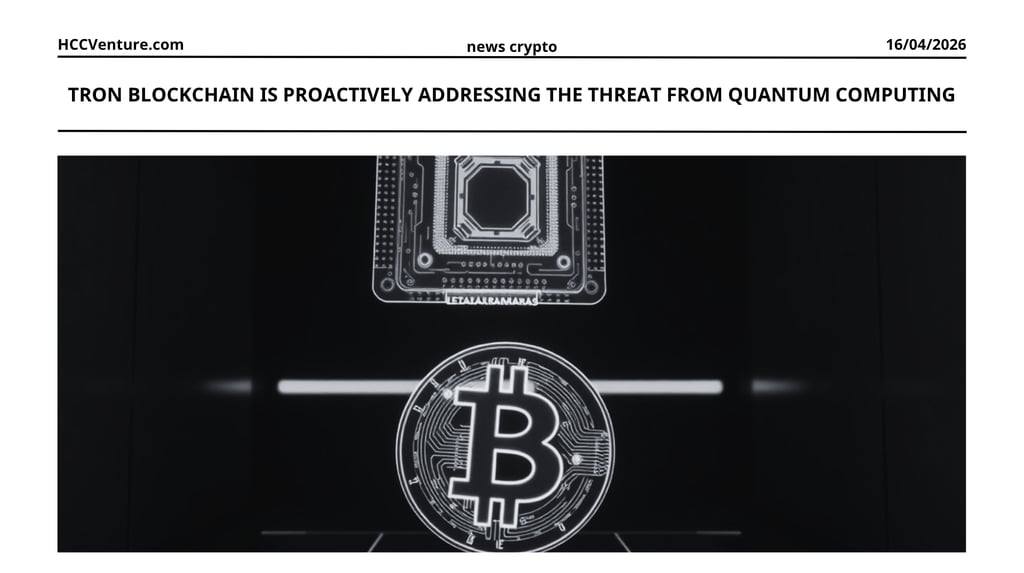
Proactively exploiting post-quantum cryptography on the mainnet.
Justin Sun has just announced the Tron Post-Quantum Upgrade Initiative, aiming for public blockchain success to be the first to develop NIST-standard digital signatures directly on the mainnet. The algorithms mentioned include ML-DSA, FN-DSA (Falcon), and other NIST standards approved in 2024.
Tron is committed to protecting all user assets from the risk of "harvest now, decrypt later" when quantum computers become powerful enough to store and decrypt data at a later time.
TRON is deploying quantum security upgrades, while Bitcoin developers are discussing access restrictions to legacy wallets, reflecting the growing awareness that advances in quantum computing could eventually challenge the cryptographic foundation of blockchain systems.
This shift is not driven by an immediate threat but by long-term risk management—a move from reactive security to predictive design.
Proposing “phased sunset” legacy signatures to protect the network.
Meanwhile, the Bitcoin community is discussing BIP-361 (“Post Quantum Migration and Legacy Signature Sunset”) – the most radical proposal to date. The main contents of BIP-361 (in stages):
Phase A (approximately 3 years after activation): Sending new BTC to legacy addresses is prohibited (especially those that have exposed their public keys).
Phase B (approximately 5 years): Completely disable legacy signatures (ECDSA and Schnorr) on the network.
Phase C : A later rescue mechanism using zero-knowledge proofs for those who miss the deadline.
The goal is to force users to move coins from legacy wallets (including a large portion of Satoshi's coins and old wallets) to quantum-resistant addresses, avoiding the risk of "harvest now, decrypt later." Currently, over 4 million BTC are held in legacy addresses vulnerable to attacks once quantum is strong enough (some estimates place the critical point around 2029). This proposal is highly controversial because it violates the "your keys, your coins" principle, even though it only applies to legacy outputs that have exposed the public key.
Tron moves toward protocol-level protection.
Tron's approach focuses on integrating quantum defense mechanisms directly into its network architecture. While details remain limited, the direction is clear: enhance cryptographic resilience before vulnerabilities emerge.
This reflects a broader strategy seen in newer or more agile networks, where upgrades can be implemented with fewer coordination challenges. By acting early, Tron is positioning itself as a network that prioritizes backward compatibility in its security design.
The situation with Bitcoin is more complicated.
Unlike newer chains, Bitcoin must maintain backward compatibility across a vast and decentralized ecosystem. Millions of addresses rely on existing cryptographic schemes, particularly older “legacy” wallets, which may be more vulnerable in a quantum scenario.
The proposal to restrict access to these wallets is not a technical limitation, but rather a risk mitigation strategy. It shows that, in extreme scenarios, a certain amount of funds can be isolated or protected to prevent exploitation.
Our review
These moves reinforce long-term confidence in blockchain infrastructure. For Tron, this is a positive signal for stablecoins (USDT on Tron) and DeFi on the network, as enhanced security will attract more institutional capital.
For Bitcoin, BIP-361 (though still controversial) shows the community's willingness to make short-term sacrifices to protect long-term core values. Overall, this is a positive step as major networks are preparing for "Q-Day" instead of waiting. Investors should consider transferring coins from old wallets (especially those previously used) to new addresses to minimize risk.
Disclaimer: The information presented in this article is the author's personal opinion in the field of cryptocurrency. This is not financial or investment advice. All investment decisions should be based on careful consideration of your personal portfolio and risk tolerance. The views expressed in this article do not represent the official stance of the platform. We recommend that readers conduct their own research and consult with experts before making any investment decisions.
Compiled and analyzed by HCCVenture
Follow HCCVenture here: https://link3.to/holdcoincventure
Explore HCCVenture group
HCCVENTURE QUANT JSCO
© 2026 HCCVENTURE. ALL COPYRIGHTS RESERVED.


Connect with us
Popular content
Contact to us
Address: 8th Floor, Bach Dang Complex Building, 50 Bach Dang Street, Hai Chau Ward, Da Nang City, Vietnam.
Phone: 1900 1509
Gmail : sp_contact@hccventure.com
Disclaimer: The information on this website is for informational purposes only and should not be considered investment advice. We are not responsible for any risks or losses arising from investment decisions based on the content here.
TERMS AND CONDITIONS • CUSTOMER PROTECTION POLICY
ANALYTICAL AND NEWS CONTENT IS COMPILED AND PROVIDED BY EXPERTS IN THE FIELD OF DIGITAL FINANCE AND BLOCKCHAIN BELONGING TO HCCVENTURE ORGANIZATION, INCLUDING OWNERSHIP OF THE CONTENT.
RESPONSIBLE FOR MANAGING ALL CONTENT AND ANALYSIS: HCCVENTURE FOUNDER - TRUONG MINH HUY
Read warnings about scams and phishing emails — REPORT A PROBLEM WITH OUR SITE.