

Today, the market capitalization of cryptocurrencies has decreased by $230 billion
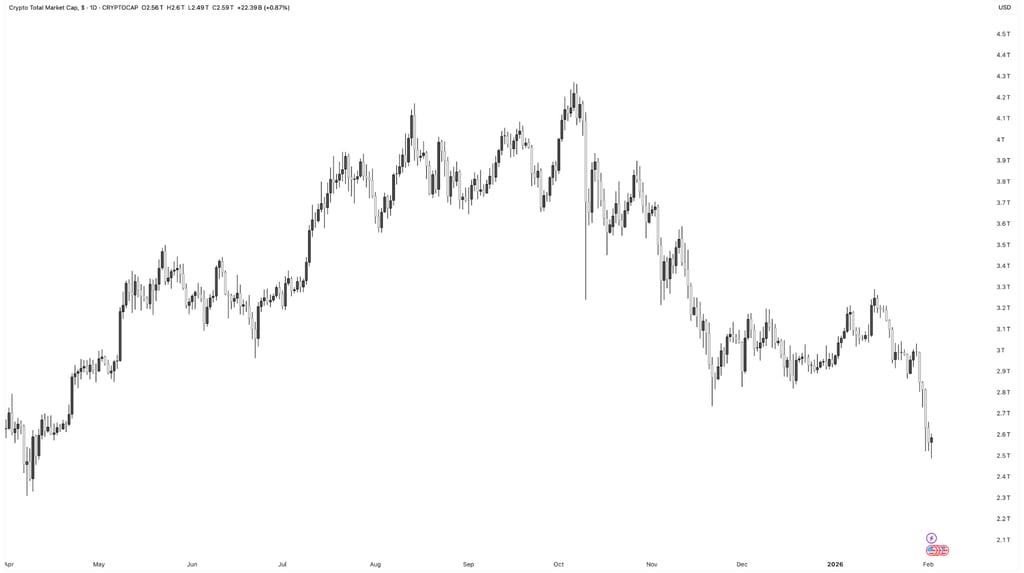
The global cryptocurrency market suffered a major shock, with approximately $230 billion wiped out from total market capitalization in a single trading session.
2/2/20262 min read
A sudden sell-off occurred.
The global cryptocurrency market capitalization has dropped by approximately $230-235 billion in the last 24 hours — one of the sharpest single-day drops in dollar terms since the May-June 2025 correction.
The total cryptocurrency market capitalization has decreased from approximately $3.45-$3.48 trillion to $3.21-$3.25 trillion , according to aggregated data from CoinGecko, CoinMarketCap, and DefiLlama as of February 2, 2026 (noon UTC).
The sell-off appears to have been driven by a combination of factors rather than a single catalyst. High leverage in the perpetual futures market, expectations of tightening global liquidity, and signals of reduced risk aversion from traditional markets combined to create a fragile setup. When key technical levels were broken, forced liquidations accelerated the decline, turning the orderly selling into a flood.
Leverage and liquidation are key.
A large portion of the $230 billion price drop reflects delevuring rather than fundamental revaluation. As prices fall, margin positions are automatically liquidated, pushing prices lower and triggering further liquidations in a self-reinforcing vicious cycle.
This move highlights a recurring structural problem: when leverage increases faster than the natural demand for spot trading, the market becomes mechanically unstable under pressure.
The losses were widespread, impacting large-cap assets, altcoins, DeFi tokens, and memecoins. Historically, segments with high beta coefficients tend to fall more sharply during these events, as liquidity evaporates first in areas where confidence is weakest.
Why is timing important?
This price drop is occurring at a sensitive macroeconomic time. Markets are reassessing interest rate trajectories, financial risks, and geopolitical instability. Cryptocurrencies, still considered risky assets by institutional allocators, remain vulnerable as global capital flows shift toward cash and short-term safe-haven assets.
Until macroeconomic conditions stabilize, cryptocurrency price surges may continue to face structural headwinds.
Large market capitalization losses in a single day often coincide with short-term capitulation, especially when due to forced liquidation rather than new information. Historically, such events can mark a local bottom—but only if selling pressure eases and leverage is meaningfully re-established.
Our review
A $230 billion drop in just one day is painful — but it's not the structural breaking point. Leverage was overused after the rapid price surge in January, macroeconomic data surprised the hawks, and risky assets (including cryptocurrencies) paid the price.
This is a typical delevering process—not a surrender. Long-term holders aren't selling off en masse, institutions continue to accumulate as prices fall, and the macroeconomic setup (high interest rates over a long period) is the primary driver, not any specific cryptocurrency failure. Markets rarely grow exponentially without a correction. This purging weeds out weak investors and sets the stage for the next sustained price surge—whenever the macroeconomic narrative changes.
Disclaimer: The information presented in this article is the author's personal opinion in the field of cryptocurrency. This is not financial or investment advice. All investment decisions should be based on careful consideration of your personal portfolio and risk tolerance. The views expressed in this article do not represent the official stance of the platform. We recommend that readers conduct their own research and consult with experts before making any investment decisions.
Compiled and analyzed by HCCVenture
Follow HCCVenture here: https://link3.to/holdcoincventure
Explore HCCVenture group
HCCVENTURE QUANT JSCO
© 2026 HCCVENTURE. ALL COPYRIGHTS RESERVED.


Connect with us
Popular content
Contact to us
Address: 8th Floor, Bach Dang Complex Building, 50 Bach Dang Street, Hai Chau Ward, Da Nang City, Vietnam.
Phone: 1900 1509
Gmail : sp_contact@hccventure.com
Disclaimer: The information on this website is for informational purposes only and should not be considered investment advice. We are not responsible for any risks or losses arising from investment decisions based on the content here.
TERMS AND CONDITIONS • CUSTOMER PROTECTION POLICY
ANALYTICAL AND NEWS CONTENT IS COMPILED AND PROVIDED BY EXPERTS IN THE FIELD OF DIGITAL FINANCE AND BLOCKCHAIN BELONGING TO HCCVENTURE ORGANIZATION, INCLUDING OWNERSHIP OF THE CONTENT.
RESPONSIBLE FOR MANAGING ALL CONTENT AND ANALYSIS: HCCVENTURE FOUNDER - TRUONG MINH HUY
Read warnings about scams and phishing emails — REPORT A PROBLEM WITH OUR SITE.