

The US Treasury Department confiscated 1 billion USD of Iranian cryptocurrency in "Operation Economic Fury"
The US Treasury Department announced that it had seized about a billion dollars of cryptocurrency assets linked to Iran through Operation Economic Wrath, a comprehensive financial pressure campaign.
6/2/20264 min read

Scope and Multifaceted Asset Targeting Strategy
The Economic Prosperity campaign was launched in March 2025 under the direction of the Trump administration as a comprehensive economic pressure campaign, beyond the seizure of cryptocurrencies to include the simultaneous disruption of Iran's traditional banking network, defense procurement system and underground financial infrastructure used to evade sanctions and illegal capital transfers.
This campaign represents a shift from traditional targeting sanctions that focus on individual entities to a systematic economic pressure method designed to weaken the overall ability of the Iranian government to access capital, conduct international trade, and maintain government operations regardless of which specific funding channel is used.
The cryptocurrency component of the Economic Rage Campaign became prominent as the Treasury Department realized that digital assets provide an alternative path to capital access, evading the sanctions of the traditional banking system, where Iranian entities accumulate cryptocurrencies allowing capital preservation, cross-border money transfers and the ability to convert into fiat money through decentralized exchanges and foreign brokers that lack frameworks. comply with strong sanctions.
The focus on cryptocurrencies reflects the recognition that modern economic pressure requires simultaneous settlement of multiple capital access mechanisms instead of relying solely on the controls of the traditional banking system that increasingly sophisticated competitors are avoiding through alternative financial infrastructure.
Freeze Tether and accelerate cryptocurrency confiscation
The freezing of Tether on the Tron blockchain on April 24, 2026 is the largest possible cryptocurrency seizure event that can be identified related to Iran during Operation Economic Fury, with stablecoin issuer Tether freezing the wallet by order of the Ministry of Finance, affecting 344 million USDT allocated on two Tron addresses, containing about 213 million USDT and 131 million USDT respectively.
The Tether freeze represents the collaboration between the stablecoin issuer and the Treasury Department, where the private financial infrastructure operator carries out government-directed asset forfeiting of designated wallet addresses through sanctions by the Office of Foreign Assets Control (OFAC) under the Ministry of Finance, based on the Chainalysis blockchain analysis firm identifying the asset holding addresses of sanctioned Iranian entities.
The Tether freezing mechanism shows the compliance of stablecoin issuers, allowing for the rapid immobilization of assets under government directives without the intermediary of the traditional financial system or court-ordered asset seizure procedures, with a private stablecoin infrastructure providing a frozen asset control mechanism equivalent to the government's direct wallet confiscation.
This precedent has established that stablecoin infrastructure operators will implement a government-required asset freeze on designated addresses regardless of the technical decentralized notions that cryptocurrency transactions remain out of government control, showing the fact that works where centralized stablecoin freezing mechanisms allow the government to effectively confiscate assets.
Economic impact on the activities of the Iranian Government
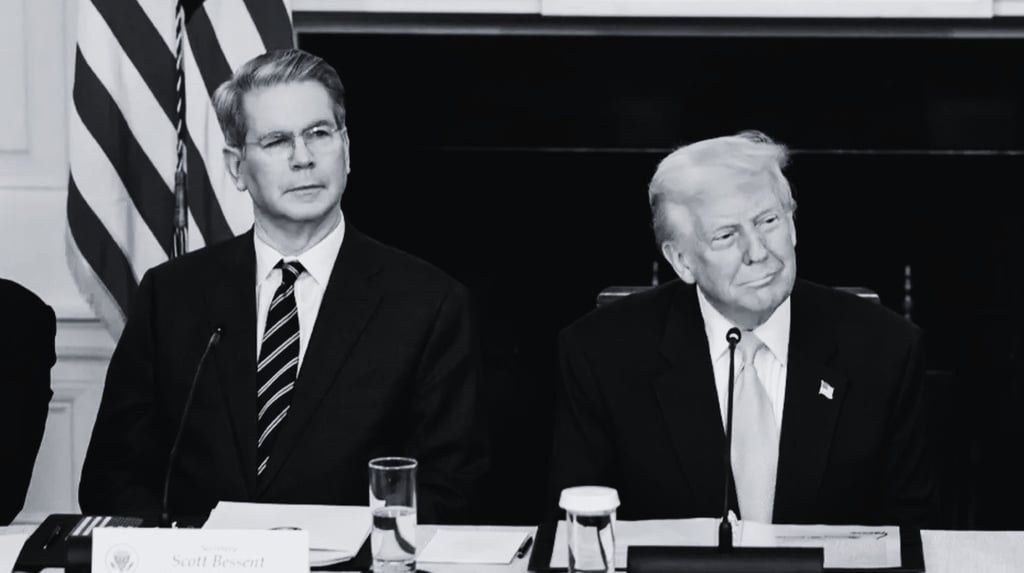
Finance Minister Bessent has linked the cryptocurrency seizure campaign to Iran's worsening economic recession, characterized by an annual inflation rate of over 200% and the inability to pay salaries to military personnel. He said that the disruption of capital access mechanisms through the seizure of cryptocurrencies has significantly contributed to the financial crisis of the Iranian government and the decline in the military's combat readiness.
The inflation rate far above the historical normal level shows that the decline in the Iranian government's revenue has exceeded its ability to manage the currency supply, making it impossible for the government to maintain monetary stability as sanctions increasingly limit access to capital and trade opportunities.
The shortage of salaries for military personnel shows that the Iranian government faces immediate operational challenges in maintaining the loyalty of its soldiers and the combat readiness of the force when paying wages becomes impossible in a high-inflationary environment, where the devaluation of the currency far exceeds the wage adjustment, creating a scenario where the military actually loses income regardless of the nominal wage adjustment does not maintain purchasing power.
The inability to pay salaries for military personnel is a destabilizing factor in the military command structure, where soldiers and subordinate officers face a minimum wage that may be vulnerable to desertion, reduced will to participate in activities or passive resistance that undermines operational efficiency.
Evaluation and conclusion
Iran's confiscation of cryptocurrencies shows that digital assets are increasingly becoming legitimate targets for sanctions, subject to government confiscation similar to traditional financial assets. This shows that cryptocurrencies no longer act as an effective sanctions avoidance mechanism as government agencies develop sufficient blockchain intelligence capabilities and maintain cooperation agreements with stablecoin infrastructure providers.
This challenges the argument that cryptocurrencies provide reliable alternative capital access for sanctioned subjects, instead showing that digital assets are facing an increasing risk of government surveillance and confiscation as sanction enforcement technology matures.
This campaign also illustrates the dependence on the technology platform, where cryptocurrency infrastructure developers have created foreclosure mechanisms that allow the government to freeze assets that, in theory, developers can resist through technical design options that prevent centralized wallet freezing.
The revelation that Tether and other stablecoin infrastructure providers have made government foreclosures shows that developers have deliberately chosen to maintain the possibility of freezing rather than pursuing an architecture that prevents involuntary asset confiscation, reflecting the assessment that the obligation to cooperate with the government has surpassed the myth of decentralization or commitments to protect users.
Disclaimer: The information presented in this article is the author's personal opinion in the field of cryptocurrencies. This is not financial or investment advice at all. Every investment decision should be based on careful consideration of your personal portfolio and risk tolerance. The opinion in the article does not represent the official position of the platform. We recommend that readers do their own research and consult experts before making any investment decisions.
Synthesized and analyzed by HCCVenture
Follow HCCVenture organization here: https://link3.to/holdcoincventure
Explore HCCVenture group
HCCVENTURE QUANT JSCO
© 2026 HCCVENTURE. ALL COPYRIGHTS RESERVED.


Connect with us
Popular content
Contact to us
Address: 8th Floor, Bach Dang Complex Building, 50 Bach Dang Street, Hai Chau Ward, Da Nang City, Vietnam.
Phone: 1900 1509
Gmail : sp_contact@hccventure.com
Disclaimer: The information on this website is for informational purposes only and should not be considered investment advice. We are not responsible for any risks or losses arising from investment decisions based on the content here.
TERMS AND CONDITIONS • CUSTOMER PROTECTION POLICY
ANALYTICAL AND NEWS CONTENT IS COMPILED AND PROVIDED BY EXPERTS IN THE FIELD OF DIGITAL FINANCE AND BLOCKCHAIN BELONGING TO HCCVENTURE ORGANIZATION, INCLUDING OWNERSHIP OF THE CONTENT.
RESPONSIBLE FOR MANAGING ALL CONTENT AND ANALYSIS: HCCVENTURE FOUNDER - TRUONG MINH HUY
Read warnings about scams and phishing emails — REPORT A PROBLEM WITH OUR SITE.