

The Swiss consumer confidence index remained stable in February
The Swiss consumer confidence index remained unchanged in February 2026, at -11 points — exactly the same as the adjusted figure for January and slightly higher than forecasts.
3/10/20263 min read
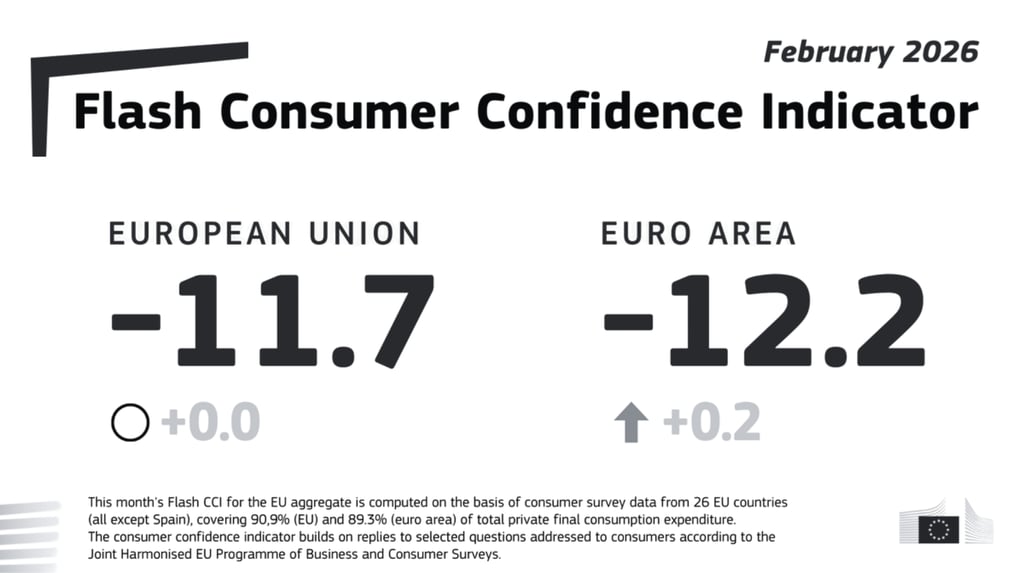
The Swiss consumer confidence index shows stability.
The Swiss consumer confidence index was virtually unchanged in February, suggesting that household sentiment in Switzerland remained stable despite widespread economic uncertainty across Europe . Consumer confidence indices measure how optimistic households are about their finances, employment prospects, and the economy in general.
The SECO index is based on a representative survey of approximately 1,200 households and includes four sub-indices (all seasonally adjusted):
Overall economic outlook (next 12 months): -12 (no change from January). Households remain skeptical about overall economic improvement but show no signs of further deterioration.
Personal financial situation (next 12 months) : +8 (up from +6 in January). This is the only sub-index in positive terms — Swiss consumers continue to feel relatively secure about their personal finances, supported by low unemployment ( ~2.3% ) and wage growth outpacing inflation.
Major purchasing power: -28 (slightly down from -26). Continued reluctance to make large purchases (cars, furniture, home repairs) amid high interest rates and rising living costs.
Unemployment forecast: -15 (improvement from -18). Perceptions of labor market stability have improved slightly.
The overall index is calculated as a weighted average of four components (with personal finances and unemployment expectations having higher weightings). Stability in consumer confidence generally signals that households are maintaining consistent spending expectations, which plays a crucial role in supporting economic growth.
Inflation and interest rates remain key factors.
Despite stable confidence, Swiss consumers continue to face economic pressures related to global inflation trends and higher interest rates. Although Switzerland has experienced lower inflation than many other European economies, households are still closely monitoring rising living costs and borrowing conditions. Monetary policy decisions by the Swiss National Bank remain a key factor influencing consumer sentiment.
The Swiss economy has shown resilience compared to many of its neighbors, supported by strong export sectors, a stable financial sector, and relatively low unemployment. These structural strengths have helped maintain consumer confidence even during periods of global economic uncertainty.
Broader economic and market context
Switzerland's CPI inflation fell to 0.7% year-on-year in February ( from 0.9% in January ), within the Swiss National Bank's (SNB) target range of 0-2% . Markets continue to forecast another 25 basis point interest rate cut by mid-2026 ( current policy rates are 0.75-1.00% ), supporting household purchasing power.
Switzerland's savings rate remains high ( ~15-16% of disposable income ), and its household debt-to-income ratio is among the lowest in Europe. This financial resilience is the foundation of confidence stability despite external shocks.
Conflicts in the Middle East, energy volatility in Europe, and US tariff uncertainties have created a cautious backdrop — however, Switzerland's safe-haven status, strong export sectors (pharmaceuticals, precision manufacturing), and limited direct reliance on energy have mitigated the impact.
The Swiss stock index ( SMI ) traded sideways or slightly higher after the data was released. The Swiss franc (CHF) continued to be favored against most G10 currencies, reflecting the ongoing safe-haven flows. Bond yields (10-year federal bonds) remained at around 0.35–0.40%.
Our review
The Swiss consumer confidence index remaining stable at -11 in February is a quiet but important sign of resilience. In a world grappling with geopolitical shocks and energy volatility, the Swiss household sector continues to act as a stabilizing force—supported by solid fundamentals, low unemployment, and a credible central bank. While not a signal of explosive growth, the absence of a slowdown is itself a positive sign in the current environment. For investors, this reinforces Switzerland's role as one of the few remaining "safe havens" in developed markets.
Disclaimer: The information presented in this article is the author's personal opinion in the field of cryptocurrency. This is not financial or investment advice. All investment decisions should be based on careful consideration of your personal portfolio and risk tolerance. The views expressed in this article do not represent the official stance of the platform. We recommend that readers conduct their own research and consult with experts before making any investment decisions.
Compiled and analyzed by HCCVenture
Follow HCCVenture here: https://link3.to/holdcoincventure
Explore HCCVenture group
HCCVENTURE QUANT JSCO
© 2026 HCCVENTURE. ALL COPYRIGHTS RESERVED.


Connect with us
Popular content
Contact to us
Address: 8th Floor, Bach Dang Complex Building, 50 Bach Dang Street, Hai Chau Ward, Da Nang City, Vietnam.
Phone: 1900 1509
Gmail : sp_contact@hccventure.com
Disclaimer: The information on this website is for informational purposes only and should not be considered investment advice. We are not responsible for any risks or losses arising from investment decisions based on the content here.
TERMS AND CONDITIONS • CUSTOMER PROTECTION POLICY
ANALYTICAL AND NEWS CONTENT IS COMPILED AND PROVIDED BY EXPERTS IN THE FIELD OF DIGITAL FINANCE AND BLOCKCHAIN BELONGING TO HCCVENTURE ORGANIZATION, INCLUDING OWNERSHIP OF THE CONTENT.
RESPONSIBLE FOR MANAGING ALL CONTENT AND ANALYSIS: HCCVENTURE FOUNDER - TRUONG MINH HUY
Read warnings about scams and phishing emails — REPORT A PROBLEM WITH OUR SITE.