

The Senate Banking Committee passed the Transparency Act with a rate of 15-9
The US Senate Banking Committee passed the Digital Asset Market Transparency Act with a 15-9 vote on Thursday, overcoming a significant obstacle after months of negotiations.
5/16/20264 min read
The vote divided the Democratic Party
Senator Ruben Gallego of Arizona and Angela Alsobrooks of Maryland disagreed with fellow Democrats to create an advantage to help pass the Transparency Act, although Ms. Alsobrooks made it clear that she would not support the bill on the Senate floor until outstanding issues, including ethical provisions and law enforcement concerns, were addressed. The split vote signals challenges ahead as the bill needs 60 votes to overcome the barrier on the Senate floor, which means that at least seven Democratic senators must join the Republican majority to pass.
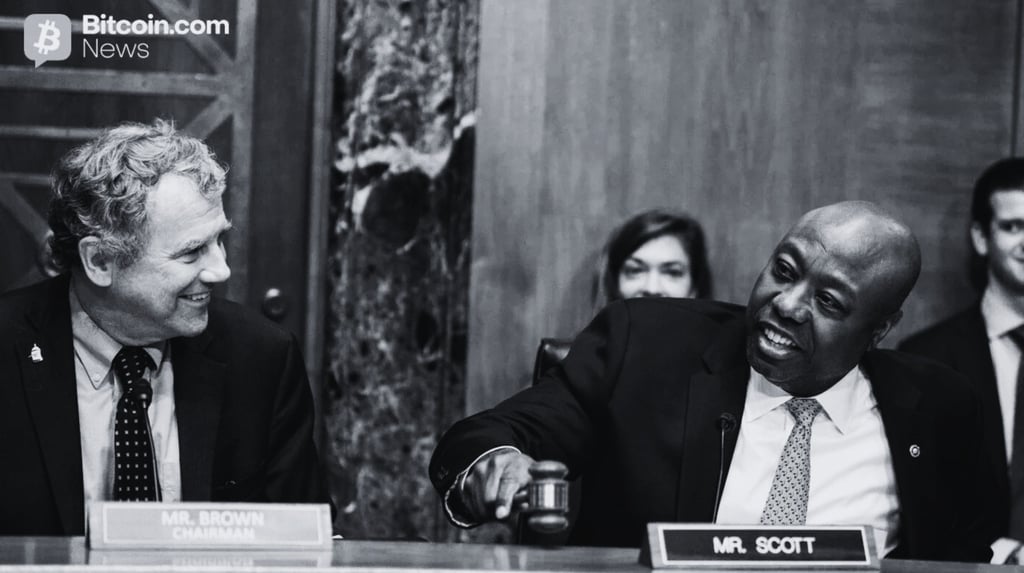
Chairman Tim Scott celebrated the bipartisan achievement after winning last-minute support from the Democratic Party through closed talks, allowing the addition of amendments related to investor protection and DeFi decentralization criteria. The move comes after a heated morning debate where Mrs. Warren and other Democratic senators accused Mr. Scott of violating procedural rules by declaring some of the proposed amendments invalid while later allowing Republicans' amendments that were initially not disclosed. Senator Mark Warner, a cryptocurrency-friendly Democratic senator who plays an important role in drafting compromise language, defended the process, saying it brought the bill closer to what he could support on the Senate floor.
The voting results clearly show the factions in the Democratic party. Mrs. Warren, along with Senators Raphael Warnock, Chris Van Hollen, Tina Smith and Jack Reed, have built a counter-position by considering Clarity as an industry-dominated framework, weakening investor protections and ignoring presidential conflicts of interest. Mr. Warner maintains a neutral stance, shaping important provisions while setting aside the final ruling for later legislative stages. Mr. Gallego and Mr. Alsobrooks provided decisive bipartisan votes, turning the possible outcome of 13-11 in a one-party favor to 15-9, showing the possibility of approval in parliament, although their conditional support still maintains pressure to require further amendments.
What does the Clarity Act really do?
This act creates a comprehensive framework, dividing the supervision of digital assets between the Securities and Exchange Commission (SEC) and the Commodity Futures Trading Commission (CFTC) based on the characteristics of the assets and how they are marketed. The SEC retains jurisdiction over digital assets sold as investments with the expectation of profits from regulatory efforts, while the CFTC oversees assets operating primarily as commodities or media of exchange. This split approach aims to address years of ambiguity of jurisdiction, when both agencies claim authority over different cryptocurrency activities without clear boundaries.
The bill establishes registration, publicity and compliance requirements for exchanges, brokers and guardians who handle digital assets, bringing cryptocurrency market intermediaries into a legal framework similar to traditional financial services. Platforms will need to separate customer assets, maintain capital reserves, implement cybersecurity protection measures and be subject to regular inspection. This framework aims to prevent the collapse of exchanges such as FTX, where customers' money is appropriated without adequate supervision or investor protection.
The stablecoin provisions are one of the most controversial elements of the bill after extensive negotiations between the banking industry and cryptocurrency companies. This legal framework generally prohibits paying interest or profit on payment stablecoins in order to prevent these instruments from directly competing with traditional bank deposits, although the last language includes exceptions and technical definitions that banking associations claim create loopholes that allow cryptocurrency companies to circumvent the law. The Bankers Association of the United States and the alliance of financial trading groups sent more than eight thousand letters to senators in the days leading up to the vote, demanding stricter restrictions on stablecoin profits.
DeFi protocols receive special treatment through security protection provisions, protecting truly decentralized systems from being classified as intermediaries requiring registration. The bill tries to distinguish between truly non-controlling distributed protocols and platforms that claim to be decentralized while maintaining centralized control. An amendment drafted by Senator Cynthia Lummis in consultation with Warner refined the criteria to determine when eligible protocols are decentralized, addressing concerns that too broad definitions can protect centralized platforms from proper oversight while too narrow definitions can hinder innovation.
Concerns of the banking industry about Stablecoin
While cryptocurrency companies celebrate the commission's vote as a confirmation of their participation in the regulatory regulation, traditional banking associations express conditional support, accompanied by concern that the bill does not adequately protect bank deposits from stablecoin competition. The joint statement from the Bankers Association of the United States, the Banking Policy Institute, the Consumer Banking Association, the Financial Services Forum, the Independent Community Banking Association of the United States and the National Banking Association praised the progress towards the legal framework for digital assets, and emphasized that stablecoin provisions should be "strengthened further by tightening the ban on interest-like rewards".
The banking industry's core concern is about stablecoin issuers seeking to pay profits to holders despite a nominal ban on interest payments. The current language prohibits the payment of explicit interest on payment stablecoins but still leaves open the possibility for reward structures, refund programs or other mechanisms to operate economically like interest rates without violating the technical ban. Banks argue that these loopholes will allow cryptocurrency companies to offer deposit-like products with competitive yields, withdraw capital from traditional banking systems and reduce capital for community lending.
Eight thousand letters sent to senators in the days before the vote represent a coordinated pressure campaign, emphasizing the importance of local banks, especially those that depend on deposit capital. Community banks and regional organizations are concerned that the large-scale shift of deposits to stablecoin products may force them to rely more on the wholesale capital raising market, increasing costs and reducing the ability to provide credit to small businesses and consumers. This concern not only stops at competitive disadvantage but also extends to systemic risk if stablecoins become the main means of cash management without full regulation of the banking industry.
Disclaimer: The information presented in this article is the author's personal opinion in the field of cryptocurrencies. This is not financial or investment advice at all. Every investment decision should be based on careful consideration of your personal portfolio and risk tolerance. The opinion in the article does not represent the official position of the platform. We recommend that readers do their own research and consult experts before making any investment decisions.
Synthesized and analyzed by HCCVenture
Follow HCCVenture organization here: https://link3.to/holdcoincventure
Explore HCCVenture group
HCCVENTURE QUANT JSCO
© 2026 HCCVENTURE. ALL COPYRIGHTS RESERVED.


Connect with us
Popular content
Contact to us
Address: 8th Floor, Bach Dang Complex Building, 50 Bach Dang Street, Hai Chau Ward, Da Nang City, Vietnam.
Phone: 1900 1509
Gmail : sp_contact@hccventure.com
Disclaimer: The information on this website is for informational purposes only and should not be considered investment advice. We are not responsible for any risks or losses arising from investment decisions based on the content here.
TERMS AND CONDITIONS • CUSTOMER PROTECTION POLICY
ANALYTICAL AND NEWS CONTENT IS COMPILED AND PROVIDED BY EXPERTS IN THE FIELD OF DIGITAL FINANCE AND BLOCKCHAIN BELONGING TO HCCVENTURE ORGANIZATION, INCLUDING OWNERSHIP OF THE CONTENT.
RESPONSIBLE FOR MANAGING ALL CONTENT AND ANALYSIS: HCCVENTURE FOUNDER - TRUONG MINH HUY
Read warnings about scams and phishing emails — REPORT A PROBLEM WITH OUR SITE.