

The Humanity Protocol suffered a catastrophic private key leak worth $32 million
Humanity Protocol revealed that a private key breach affected the wallets of its founding members, resulting in a loss of over $32 million across at least 17 victim wallets, and causing the price of the $H token to drop 90% in a few hours.
6/9/20264 min read
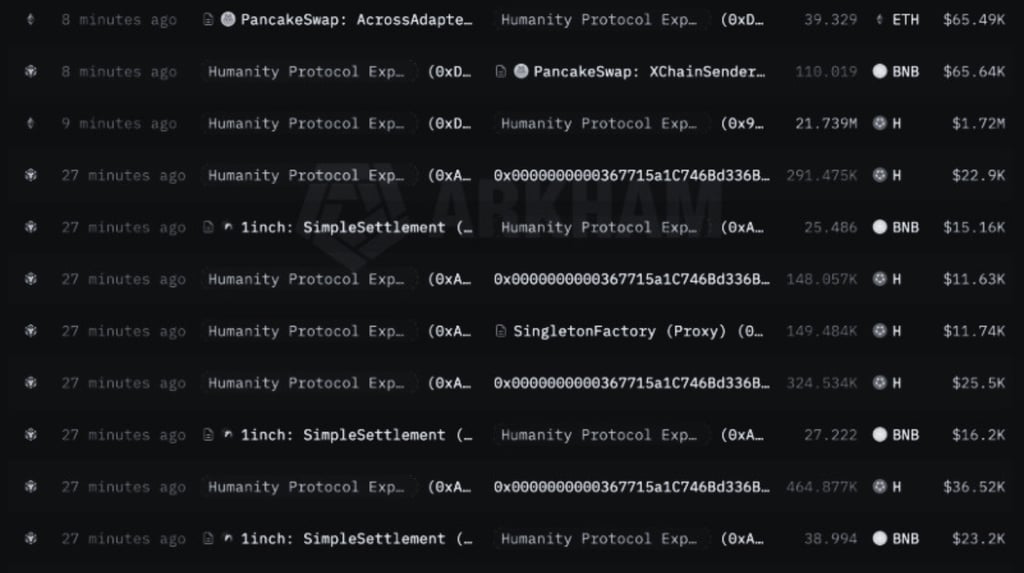
The intrusion mechanism and operation of the attacker.
The initial breach exposed private keys belonging to a member of the Humanitarian Organization, allowing the attacker to gain control of multiple connected wallets containing large amounts of H tokens and other digital assets. The multi-wallet breach pattern suggests either sophisticated social engineering targeting a single individual with access to multiple wallet storage mechanisms, or a shared key management infrastructure where a single breach spreads across multiple wallet locations.
On-chain analytics firm Arkham noted that the victim's wallets distributed the stolen funds across six addresses connected to the attacker, with the attacker's primary strategy focused on immediately converting liquidity to Ethereum rather than maintaining the H token position. This conversion to Ether reflects the attacker's rational assessment that the H token market liquidity was insufficient to convert the entire $32 million position without causing a price crash exceeding 89%, establishing a pattern where the attacker prioritized capital preservation through rapid ETH conversion over maximizing theoretical profits through selling H tokens.
The attacker also deployed a governance key breach on Binance Smart Chain, allowing the unauthorized creation of an additional 100 million H tokens to a new wallet address, establishing a secondary mining vector in addition to the initial withdrawal from the wallet. The ability to create tokens indicates the attacker gained access to contract governance functions or delegated governance control, allowing for arbitrary supply expansion, representing a higher level of authority violation than simply stealing wallet keys.
Reversing the growth trend from the beginning of the year.
The price curve of the H token prior to the attack established an outstanding performance in 2026, with the token surging approximately 875% from its annual low, reaching a record high in the week before the attack was announced. This extraordinary price surge since the beginning of the year has positioned H as one of the best-performing alternative cryptocurrency assets, generating significant investor confidence and community enthusiasm for the protocol's development roadmap.
The 88- to 89% drop in 24 hours caused by the attack completely reversed the year-to-date bullish curve, wiping out an accumulated 875% gain and setting a daily low of nearly 7.2 cents, representing the lowest token valuation since mid-December 2025. This magnitude of reversal created unprecedented value destruction in a single event, turning the H token from the best-performing asset to the worst-performing asset on the same trading day.
The extent of the price collapse suggests that market participants have come to understand that the private key breach is an existential threat to the protocol's viability rather than an easily remedied operational issue, with token holders systematically liquidating positions ahead of anticipated selling pressure from the attacker's ETH conversion mechanism and additional H token creation activities.
Community skepticism and accusations of staging.
Prominent on-chain analyst ZachXBT publicly questioned the official narrative of the Humanity Protocol hack shortly after the intrusion was announced, describing the event as "possibly staged" and suggesting possible collusion between the project team and market makers coordinating a withdrawal plan. ZachXBT's analysis pointed to a suspicious pattern in which the attacker maintained a concentrated supply of H tokens while simultaneously creating more tokens, possibly coordinated with market maker activities to maximize downward pressure.
ZachXBT also noted that three of the four Humanity Protocol project leaders have "dubious pasts" characterized by lawsuits, allegations of financial fraud, and ineffective organizational management, raising concerns about the team's credibility and competence. These questions about leadership credibility have fueled community skepticism about whether the breach was a genuine security flaw or a coordinated inside operation designed to facilitate the team's withdrawal of investor funds.
Allegations of a staged hack reflect a broader pattern within the cryptocurrency community, where sophisticated attacks targeting critical infrastructure are sometimes coordinated with insider involvement, particularly when organizational conflicts of interest may encourage collusion between the group and outside attackers. The skeptical pattern suggests that leaks of private keys affecting critical positions within a project would face increased scrutiny from the community regarding the potential for insider interference.
Worldcoin's competitive landscape
The positioning of Humanity Protocol as a direct alternative to Worldcoin allows for a comparative framework that highlights the differences in security outcomes, where Worldcoin has maintained continuous operation despite persistent criticism from regulators and community skepticism, while Humanity Protocol experienced a serious security breach shortly after its period of excellent performance in 2026.
The comparison results show that investors recognized both projects as competing alternatives, with Worldcoin's legal clarity and established operational history offering superior security guarantees compared to Humanity Protocol's younger infrastructure.
Assessment and Conclusion
The Humanity Protocol incident caused a significant setback in the perception of the feasibility of decentralized identity systems, as the leak of private keys undermined the fundamental security assumptions that enabled biometric-based identity verification infrastructure to function. The results showed that even sophisticated zero-knowledge proof infrastructure remains vulnerable to human-induced security errors at the operational level.
For investors in particular, this incident demonstrates that the superior performance trajectory of 2026 and record token value do not guarantee the security integrity of the underlying protocol, with just one leaked private key potentially destroying an investor's accumulated value in a single trading session. This model shows that assessing the maturity of a protocol should focus on operational security practices rather than solely on asset performance metrics.
Disclaimer: The information presented in this article is the author's personal opinion in the field of cryptocurrencies. This is not financial or investment advice at all. Every investment decision should be based on careful consideration of your personal portfolio and risk tolerance. The opinion in the article does not represent the official position of the platform. We recommend that readers do their own research and consult experts before making any investment decisions.
Synthesized and analyzed by HCCVenture
Follow HCCVenture organization here: https://link3.to/holdcoincventure
Explore HCCVenture group
HCCVENTURE QUANT JSCO
© 2026 HCCVENTURE. ALL COPYRIGHTS RESERVED.


Connect with us
Popular content
Contact to us
Address: 8th Floor, Bach Dang Complex Building, 50 Bach Dang Street, Hai Chau Ward, Da Nang City, Vietnam.
Phone: 1900 1509
Gmail : sp_contact@hccventure.com
Disclaimer: The information on this website is for informational purposes only and should not be considered investment advice. We are not responsible for any risks or losses arising from investment decisions based on the content here.
TERMS AND CONDITIONS • CUSTOMER PROTECTION POLICY
ANALYTICAL AND NEWS CONTENT IS COMPILED AND PROVIDED BY EXPERTS IN THE FIELD OF DIGITAL FINANCE AND BLOCKCHAIN BELONGING TO HCCVENTURE ORGANIZATION, INCLUDING OWNERSHIP OF THE CONTENT.
RESPONSIBLE FOR MANAGING ALL CONTENT AND ANALYSIS: HCCVENTURE FOUNDER - TRUONG MINH HUY
Read warnings about scams and phishing emails — REPORT A PROBLEM WITH OUR SITE.