


The CLARITY Act includes a Ethics Clause prohibiting federal officials from issuing digital assets
President Trump approved a provision that, for the first time in U.S. history, formally prohibits the President, Vice President, members of Congress, and senior federal officials from issuing or sponsoring digital assets.
7/24/20264 min read

What is Prohibited and What is Not.
The new provisions in the CLARITY Act of July 22 establish three specific requirements. First, it prohibits the President, Vice President, members of Congress, senior executive officials, their spouses, and their direct employees from issuing or sponsoring any "digital assets" during their term in office, specifically targeting memecoin and official-linked token issuances, with the Trump meme coin case being the most prominent example. Second, it prohibits crypto exchanges from listing any tokens issued or sponsored by federal officials. Third, it requires officials to place existing crypto assets in blind trusts or divest them within one year.
Most importantly, this provision doesn't do anything: it doesn't prohibit officials from profiting from pre-existing crypto assets. The approximately $1.4 billion in crypto-related income that Trump disclosed in his July 1st financial report—including around $580 million from World Liberty Financial, $635 million in memecoin royalties, and $197 million from the sale of shares in a stablecoin holding company—remains unaffected because this income comes from projects launched before the provision took effect.
The provision expires on January 20, 2029, the inauguration date of the next President — meaning that, if Trump is re-elected for a third term by any legal means, the provision will automatically expire and need to be reinstated, or if Trump leaves office on schedule, the provision will apply to his successor.
Trump Agrees to Terms After Last Week's Meeting
Senator Bernie Moreno (Republican, Ohio) confirmed to CNBC that Trump "signed off" on the ethics portion of the bill after a meeting with Republican senators at the White House on July 17. The White House said it agreed to the ethics provision after a meeting with White House crypto adviser Patrick Witt. This marks the first time a sitting U.S. president has accepted a legal provision restricting his personal crypto business rights, even though those businesses are generating billions of dollars in revenue.
However, Trump's acceptance of the provision doesn't solve the fundamental math problem facing the Senate. Republicans hold approximately 53 seats, and at least 60 votes are needed to overcome the risk of obstruction through a filibuster. That means at least seven votes from Democrats or independents are required. Alsobrooks and Gallego, the only two Democratic senators who voted in favor during the committee phase, immediately declared they could not support the current version.
Ballot Calculation and Remaining Bottlenecks
The group of seven Democratic senators who opened the bill and were crucial in securing the 60 votes sent a clear signal that the current version "is not satisfactory." The gap between the provision Trump approved and the provision this Democratic group is demanding has not narrowed in the July 22 text.
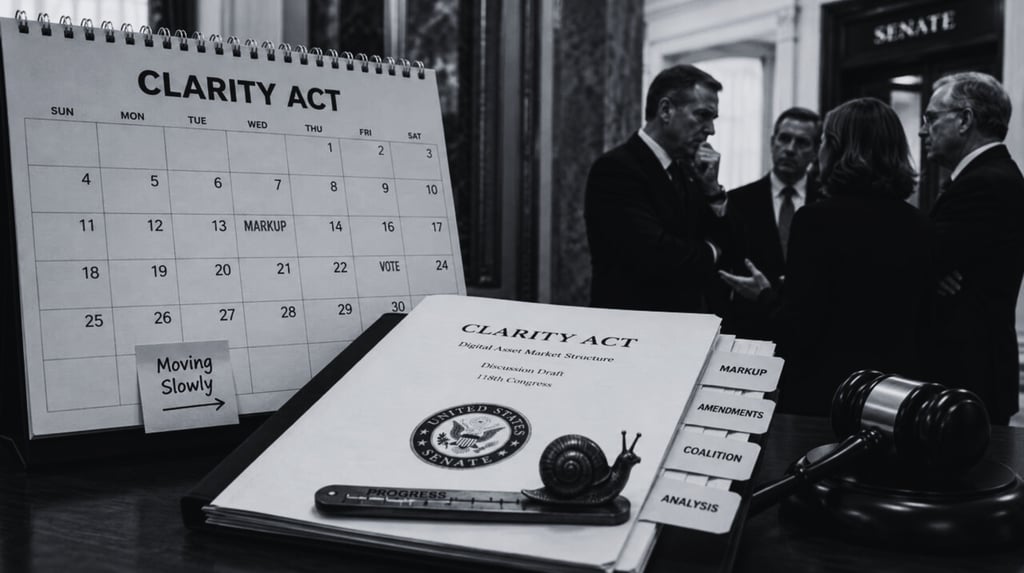
Gallego said he and a group of bipartisan senators are planning to propose their own ethical language, suggesting the negotiations are entering a phase of floor amendments where proposed amendments are made after the text is in place rather than before the closure vote. This could prolong the process, especially with the Senate scheduled to adjourn for the summer recess on August 7.
Besides the ethics clause, three other sticking points remain unresolved: the Senate Agriculture Committee's concerns about the CFTC's five-member composition, the DeFi developer protection clause (Section 604), and the stablecoin rewards issue, which the banking industry opposes.
Assessment and Conclusion
The inclusion of an ethics clause in the July 22 update, despite being rejected by Democrats, marks a real step forward from the previous week when no such clause existed in the text. Lummis said she wanted to reach an agreement with Democratic senators within a few days. Kalshi assessed the probability of a Senate vote before the August 7 summer recess as high, while the probability of it becoming law in 2026 remains at around 36-39% according to Kalshi and Polymarket.
The ethics provision, whatever form it ultimately takes, would be the first federal ethics provision in the U.S. specifically applied to crypto, setting a permanent legal precedent even if the provision expires in 2029, as future Congress could more effectively and broadly reinstate it as the political landscape changes. The central issue currently being debated is whether the enforcement infrastructure is truly deterrent or merely symbolic, and the answer to that question will determine whether the seven necessary Democratic senators will accept a compromise before the vote schedule is forced to move to 2027.
Disclaimer: The content in this article is for informational, research, data analysis, and reference purposes only regarding the cryptocurrency market. All opinions, assessments, forecasts, or opinions reflect the author's perspective at the time of publication and do not constitute investment advice, solicitations for buying or selling, trading recommendations, advertising, marketing, or promotion of any financial products, services, or cryptocurrencies. Mentions of projects, tokens, protocols, exchanges, wallets, or cryptocurrency service providers (CASPs) are for research, analysis, or informational purposes only and should not be construed as endorsements, recommendations, or guarantees in any way. HCCVenture does not broker, advertise, market, promote, or connect users in Vietnam with any cryptocurrency services from CASPs. HCCVenture does not accept asset custody, investment mandates, manage assets, or execute transactions on behalf of clients. All investment decisions are made entirely through the reader's own research (DYOR), evaluation, and responsibility; HCCVenture is not liable for any losses or damages arising from the use of or reliance on the information presented in this article.
Compiled and analyzed by HCCVenture
Join our information channels: https://link3.to/holdcoincventure
Explore HCCVenture group
HCCVENTURE QUANT JSCO
© 2026 HCCVENTURE. ALL COPYRIGHTS RESERVED.


Connect with us
Popular content
Contact to us
Address: 8th Floor, Bach Dang Complex Building, 50 Bach Dang Street, Hai Chau Ward, Da Nang City, Vietnam.
Phone: 1900 1509
Gmail : sp_contact@hccventure.com
Disclaimer: The information on this website is for informational purposes only and should not be considered investment advice. We are not responsible for any risks or losses arising from investment decisions based on the content here.
TERMS AND CONDITIONS • CUSTOMER PROTECTION POLICY
ANALYTICAL AND NEWS CONTENT IS COMPILED AND PROVIDED BY EXPERTS IN THE FIELD OF DIGITAL FINANCE AND BLOCKCHAIN BELONGING TO HCCVENTURE ORGANIZATION, INCLUDING OWNERSHIP OF THE CONTENT.
RESPONSIBLE FOR MANAGING ALL CONTENT AND ANALYSIS: HCCVENTURE FOUNDER - TRUONG MINH HUY
Read warnings about scams and phishing emails — REPORT A PROBLEM WITH OUR SITE.