

The Bank of Japan keeps interest rates unchanged
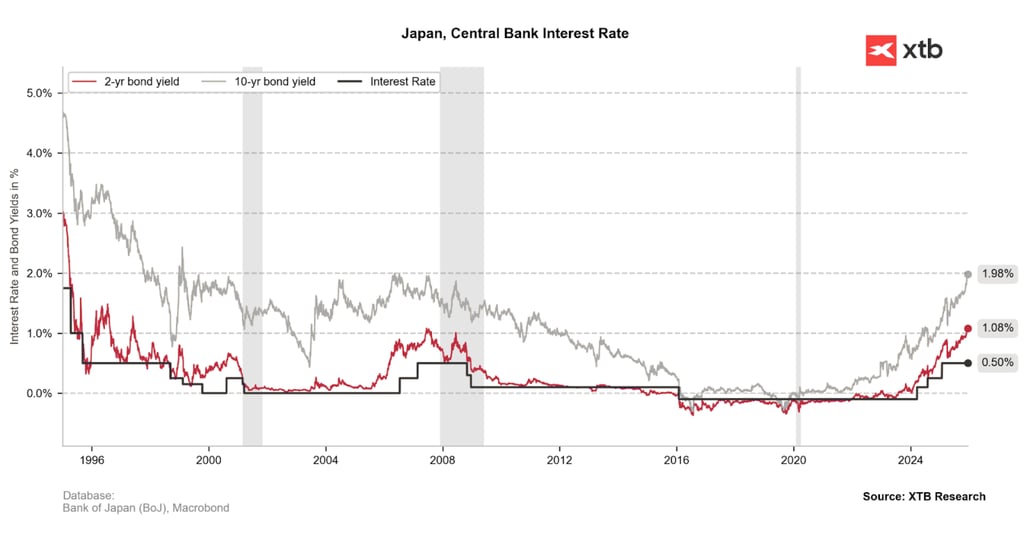
The Bank of Japan (BOJ) maintained its short-term policy interest rate at 0.25% at its January policy meeting on January 23-24, 2026, marking the third consecutive time it has kept interest rates unchanged since going negative.
1/26/20263 min read


Japan's interest rate decision
The Bank of Japan (BOJ) decided to keep its benchmark interest rate unchanged , as December inflation data showed signs of further cooling . This decision reinforces the central bank's cautious stance as it balances the need to normalize monetary policy with concerns about weak domestic demand and uneven wage growth.
Policy interest rate: Unchanged at 0.25% (short-term policy interest rate)
Yield curve control: The target yield for 10-year Japanese government bonds remains at approximately 0.75–1.0% (subject to adjustment).
Quantitative tightening: The rate of Japanese government bond issuance remains unchanged ( ~6 trillion yen/month ).
Inflation outlook: The core CPI forecast for fiscal year 2025 has been slightly revised downward to 1.9–2.1% (from 2.0–2.3%).
Growth forecast: Real GDP growth for fiscal year 2025 is projected to remain at 0.9–1.1%.
December inflation figures showed that price pressures had eased, particularly in the energy and imported goods sectors, factors that had previously driven overall inflation higher. This easing reduced the urgency of immediate policy tightening , allowing the Bank of Japan (BOJ) to observe whether core inflation can sustainably remain above its long-term target.
Why is this decision important?
The BOJ's decision reflects a delicate trade-off. On the one hand, years of extreme easing have distorted markets and weakened the yen . On the other hand, tightening policy too soon risks stifling an economic recovery that remains heavily reliant on loose fiscal conditions.
By keeping interest rates unchanged, the BOJ is signaling that it wants clearer evidence of sustainable inflation, driven by demand, particularly through sustained wage growth, before committing to further normalization.
Direct impact on the Yen
Keeping interest rates unchanged was largely anticipated by the market, limiting immediate volatility. However, this reinforces expectations that Japan will continue to differentiate itself from other major economies, where monetary policy remains tight.
This divergence continues to put pressure on the Japanese yen, as the yield differential favors foreign currencies. At the same time, policy stability reduces the risk of sudden market disruptions associated with unexpected changes in the Bank of Japan's (BOJ) guidance.
Japan and the Exception
Japan remains a global exception in monetary policy. While inflation in other countries has forced central banks to tighten policy aggressively, the challenge facing the Bank of Japan (BOJ) is fundamentally different – to emerge from decades of persistently low inflation without destabilizing growth.
The December inflation data reinforces the argument that Japan's inflation dynamics have a distinct structure, justifying a slower and more cautious approach.
Investors and policymakers will closely monitor upcoming wage negotiations, household spending data, and core inflation indicators. Any signs that price pressures are accelerating again, coupled with higher wages, could open the door to policy adjustments.
Assessment and Conclusion
The Bank of Japan's (BOJ) decision to keep interest rates unchanged despite falling inflation is a prime example of loose monetary policy – prioritizing achieving a sustainable 2% inflation rate rather than tightening policy too soon. With the consumer price index (CPI) falling and external risks increasing, the BOJ is signaling patience until 2026.
For risk assets – including Bitcoin, Ethereum, and other cryptocurrencies – this is more positive as a weaker yen, continued support for carry-trades, and global expectations of persistently low interest rates all benefit growth-sensitive assets and inflation-hedging assets.
Japan remains one of the most important potential buyers in the global cryptocurrency market. Any sustained weakening of the yen or further easing of policy by the BOJ could amplify capital inflows – especially if the proposed XRP tax cut (fixed tax rate of 20%) is approved in Q2 2026.
Disclaimer: The information presented in this article is the author's personal opinion in the field of cryptocurrency. This is not financial or investment advice. All investment decisions should be based on careful consideration of your personal portfolio and risk tolerance. The views expressed in this article do not represent the official stance of the platform. We recommend that readers conduct their own research and consult with experts before making any investment decisions.
Compiled and analyzed by HCCVenture
Follow HCCVenture here: https://link3.to/holdcoincventure
Explore HCCVenture group
HCCVENTURE QUANT JSCO
© 2026 HCCVENTURE. ALL COPYRIGHTS RESERVED.


Connect with us
Popular content
Contact to us
Address: 8th Floor, Bach Dang Complex Building, 50 Bach Dang Street, Hai Chau Ward, Da Nang City, Vietnam.
Phone: 1900 1509
Gmail : sp_contact@hccventure.com
Disclaimer: The information on this website is for informational purposes only and should not be considered investment advice. We are not responsible for any risks or losses arising from investment decisions based on the content here.
TERMS AND CONDITIONS • CUSTOMER PROTECTION POLICY
ANALYTICAL AND NEWS CONTENT IS COMPILED AND PROVIDED BY EXPERTS IN THE FIELD OF DIGITAL FINANCE AND BLOCKCHAIN BELONGING TO HCCVENTURE ORGANIZATION, INCLUDING OWNERSHIP OF THE CONTENT.
RESPONSIBLE FOR MANAGING ALL CONTENT AND ANALYSIS: HCCVENTURE FOUNDER - TRUONG MINH HUY
Read warnings about scams and phishing emails — REPORT A PROBLEM WITH OUR SITE.