


Swift enables blockchain-based shared ledger with 17 banks across six continents.
Swift announced that its blockchain-based shared ledger has reached initial operational readiness, with seventeen major commercial banks across six continents preparing to pilot cross-border transactions.
7/11/20264 min read
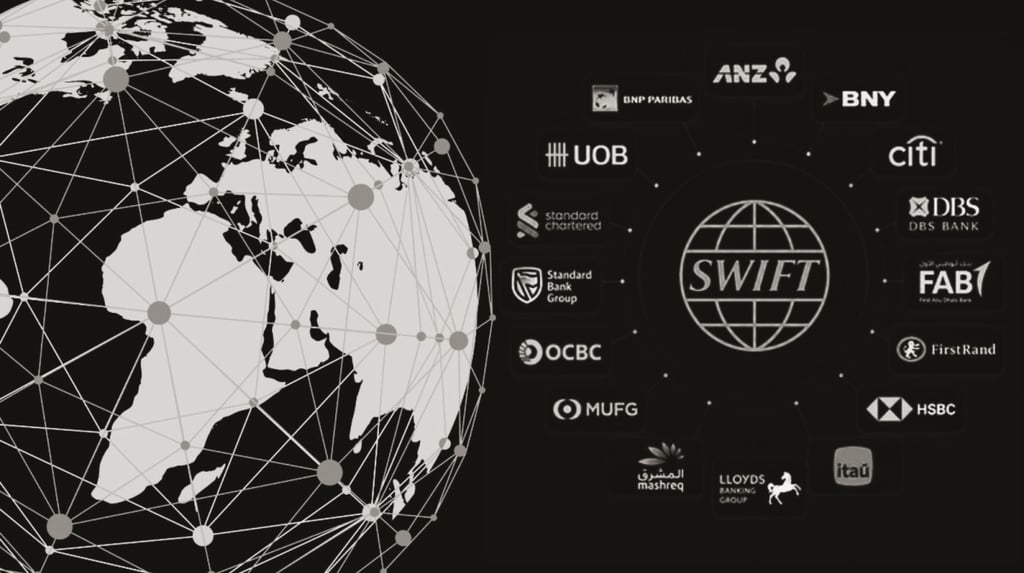
List of participating banks and scope across six continents.
The initial pilot group included the world's largest cross-border transaction banks, providing a geographic reach unmatched by any dedicated blockchain payments network of comparable scale: ANZ, BNP Paribas, BNY, Citi, DBS Bank, First Abu Dhabi Bank, FirstRand, HSBC, Itaú Unibanco, Lloyds Banking Group, Mashreq, MUFG Bank, OCBC, Standard Chartered, UBS, UOB, and Wells Fargo. This list encompasses North America, Europe, Asia, the Middle East, Africa, and Australia—reflecting the coordinated commitment of institutions across all major banking geographic regions, rather than a regional proof-of-concept with ambitions for future expansion.
Manish Kohli, Head of Global Payment Solutions at HSBC, described the practical value from a corporate client perspective: "We can improve liquidity efficiency, enhance cash flow visibility, and deliver a seamless 24/7 experience for businesses." He stressed that the integration with HSBC leverages the bank's existing internal encrypted deposit infrastructure deployed across multiple markets, transforming the Swift ledger into an interoperability layer connecting established bank-level capabilities instead of requiring participating organizations to develop entirely new encryption technology from scratch.
Melvyn Low of OCBC and So Lay Hua of UOB both highlighted the potential of real-time cross-time payments as a key trade driver for Asian financial institutions whose corporate clients frequently manage liquidity during business hours that overlap minimally with European and US payment hours.
The concept of living infrastructure
Swift's disclosure that the ledger moved from proof-of-concept to operational deployment in nine months carries significant implications for organizational reliability, demonstrating that coordinating technical standards, integrating compliance, and conducting operational testing across 17 major banks in six jurisdictions can be achieved in a much shorter development cycle than individual bank technology projects. This speed reflects both the maturity of Swift's existing technical and governance infrastructure—which provides a coordination framework that reduces the typical bilateral negotiation costs of multibank technology initiatives—and the genuinely high institutional urgency surrounding 24/7 payment capabilities as a commercial requirement from corporate clients.
The nine-month development timeline is particularly noteworthy because it encompasses the period when Swift announced the initiative in September 2025 with the participation of over 30 banks, indicating that the initial alliance of over 30 banks had already made full technical and governance adjustments to enable the transition from pilot announcement to live infrastructure within a financial year.
The difference between Managed Digital Currency and
Swift's clear positioning of tokenized deposits as a ledger payment instrument rather than a stablecoin or central bank digital currency reflects a deliberate product architecture choice, directly engaging in the competitive dynamics between bank-issued digital currencies and cryptocurrency-based alternatives. Tokenized deposits represent commercial bank money converted into a programmable digital form while remaining on the issuing bank's balance sheet, fully compliant with existing deposit insurance, prudent capital requirements, and banking regulations—qualities inherent in stablecoins issued by non-bank institutions, and which central bank digital currencies would require new central bank infrastructure to provide.
This difference is commercially significant because corporate finance departments, institutional asset managers, and regulated derivatives firms that maintain existing banking relationships face significantly lower compliance barriers when adopting tokenized deposits from their existing banking partners compared to integrating with stablecoin issuers outside the credit, compliance, and oversight framework of the banking system. Swift's ledger provides a connectivity layer that allows bank-issued tokenized deposits to achieve continuous 24/7 access and cross-border mobility that previously required stablecoin infrastructure or acceptance of correspondent bank time zone restrictions.
mBridge, Partior, and the race for 24/7 payment infrastructure.
Swift's encrypted deposit ledger enters a competitive landscape encompassing various alternative institutional blockchain payment initiatives at different stages of development and adoption. The mBridge project, a BIS-coordinated multi-CBDC platform currently under Chinese leadership and preparing for commercial deployment with a Hong Kong-based entity, targets cross-border payments between central bank digital currencies rather than commercial bank encrypted deposits. Partior, a network backed by JP Morgan, DBS, and Standard Chartered for wholesale bank payments, has achieved commercial operation across a smaller banking alliance than Swift's original group of 17 banks.
Swift's structural advantage over all alternatives is its network of 11,500 organizations already connected to its messaging infrastructure—a distributed base unmatched by any dedicated blockchain payment network—combined with the established trust, technical standards, and governance framework that Swift's member organizations have operated within for decades. Translating that structural advantage into blockchain-based payments requires demonstrating that encrypted deposit payments are operationally reliable, regulatoryly compliant, and commercially superior to existing alternatives throughout the actual transaction phase of the pilot project in 2026.
Our review
Swift's development roadmap clearly reflects the expectation that the ledger will create "a foundation for future innovation in areas such as programmable money and agency commerce," shaping the current encrypted money deposit pilot program as the infrastructure for applications not yet commercially deployed, rather than the end point of the blockchain integration initiative. Programmable money payment tools that execute automatically upon meeting defined conditions will enable use cases including supply chain milestone-triggered payments, regulatory-compliant automated payments, and self-executing financial contracts that current banking infrastructure requires manual confirmation to complete.
Agency commerce represents the most forward-looking element in Swift's direction, anticipating a future where AI agents operate automatically on behalf of businesses and financial institutions, executing transactions without human authorization for each individual payment – a capability that requires continuous payment infrastructure and programmable payment tools to operate at scale. The convergence of AI-powered commerce automation and 24/7 blockchain payment infrastructure positions Swift's ledger not merely as a weekend and overnight payment solution, but as the foundational infrastructure for the financial layer of the emerging automated commerce economy.
Disclaimer: The information presented in this article is the author's personal opinion in the field of cryptocurrencies. This is not financial or investment advice at all. Every investment decision should be based on careful consideration of your personal portfolio and risk tolerance. The opinion in the article does not represent the official position of the platform. We recommend that readers do their own research and consult experts before making any investment decisions.
Synthesized and analyzed by HCCVenture
Follow HCCVenture organization here: https://link3.to/holdcoincventure
Explore HCCVenture group
HCCVENTURE QUANT JSCO
© 2026 HCCVENTURE. ALL COPYRIGHTS RESERVED.


Connect with us
Popular content
Contact to us
Address: 8th Floor, Bach Dang Complex Building, 50 Bach Dang Street, Hai Chau Ward, Da Nang City, Vietnam.
Phone: 1900 1509
Gmail : sp_contact@hccventure.com
Disclaimer: The information on this website is for informational purposes only and should not be considered investment advice. We are not responsible for any risks or losses arising from investment decisions based on the content here.
TERMS AND CONDITIONS • CUSTOMER PROTECTION POLICY
ANALYTICAL AND NEWS CONTENT IS COMPILED AND PROVIDED BY EXPERTS IN THE FIELD OF DIGITAL FINANCE AND BLOCKCHAIN BELONGING TO HCCVENTURE ORGANIZATION, INCLUDING OWNERSHIP OF THE CONTENT.
RESPONSIBLE FOR MANAGING ALL CONTENT AND ANALYSIS: HCCVENTURE FOUNDER - TRUONG MINH HUY
Read warnings about scams and phishing emails — REPORT A PROBLEM WITH OUR SITE.