


Sui and Near Crypto vie for dominance in the high-speed blockchain market
Both Sui and NEAR Protocol achieve sub-one-second accuracy, extremely low transaction fees, and massive throughput—but they achieve similar performance through entirely different architectural philosophies.
3/16/20262 min read
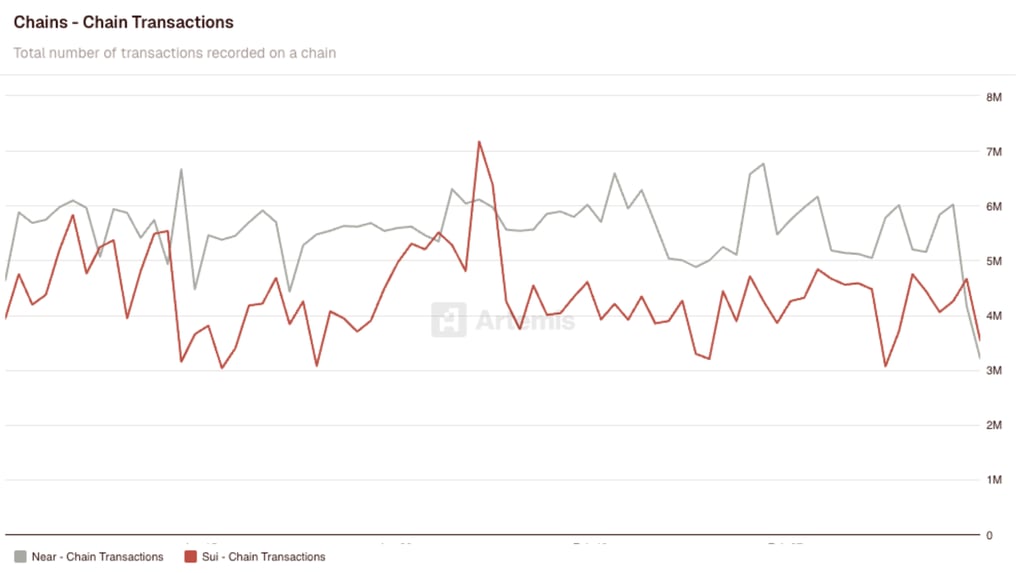
A new generation of high-performance blockchains.
The competition to build the fastest and most scalable blockchain infrastructure is intensifying, with Sui and Near Protocol emerging as two of the most technically ambitious networks in the field. Both projects aim to address one of the biggest limitations of early blockchains: scalability without sacrificing decentralization or security.
As decentralized finance, gaming, AI infrastructure, and real-world asset tokenization demand higher transaction throughput, next-generation blockchains are racing to provide faster speeds, lower latency, and a better development environment. In this competition, Sui and Near represent two very different architectural approaches to solving the same problem.
Object-oriented architecture and parallel execution capabilities of Sui
Sui was developed by Mysten Labs, a team of former engineers from the Meta Diem blockchain project. Its architecture is built on a unique object-oriented data model, allowing transactions to operate on independent objects rather than a shared global state.
This design allows for parallel transaction execution, meaning multiple transactions can be processed simultaneously instead of waiting in sequence. As a result, Sui can significantly reduce network latency and increase throughput.
Some of Sui's technical highlights include:
Parallel transaction processing
Low latency (usually under one second)
The Move programming language was originally designed for the Diem blockchain.
High throughput designed for consumer-scale applications.
This architecture makes Sui particularly attractive for high-frequency applications, such as games, trading platforms, and large-scale consumer Web3 applications.
Near's fragmentation method for scaling
The Near protocol takes a different path to scalability by using the Nightshade sharding system, which divides the blockchain into multiple shards that process transactions in parallel.
Instead of forcing each validator to handle every transaction, the network distributes the workload across fragments, allowing the system to scale as demand increases.
Key features of Near Architecture include:
Nightshade dynamic fragmentation
Complete the block quickly.
Developer-friendly environment with WebAssembly support.
Easy-to-read wallet address
Near's approach focuses heavily on developer usability and user experience, aiming to make building and adopting blockchain applications easier for the average user.
Network performance and design metrics
Both blockchains aim to support extremely high throughput, but they achieve this through fundamentally different technical strategies. Sui prioritizes parallelism at the transaction level, where multiple independent transactions can execute concurrently without competing for shared state resources.
Near focuses on horizontal scalability through sharding, meaning the network expands its processing capacity by adding shards as demand increases.
In fact, both systems are capable of processing thousands of transactions per second, although their actual performance depends heavily on the complexity of the application and the network's operation.
Our review
The competition between Sui and Near highlights the rapid evolution of blockchain architecture as developers strive to build networks capable of supporting global-scale applications. While both projects pursue high-speed performance, their engineering strategies—parallel execution versus fragmentation—represent two different visions of the future of blockchain scalability. As the demand for decentralized infrastructure continues to grow, the outcome of this technological race could shape the next generation of Web3 platforms.
Disclaimer: The information presented in this article is the author's personal opinion in the field of cryptocurrency. This is not financial or investment advice. All investment decisions should be based on careful consideration of your personal portfolio and risk tolerance. The views expressed in this article do not represent the official stance of the platform. We recommend that readers conduct their own research and consult with experts before making any investment decisions.
Compiled and analyzed by HCCVenture
Follow HCCVenture here: https://link3.to/holdcoincventure
Explore HCCVenture group
HCCVENTURE QUANT JSCO
© 2026 HCCVENTURE. ALL COPYRIGHTS RESERVED.


Connect with us
Popular content
Contact to us
Address: 8th Floor, Bach Dang Complex Building, 50 Bach Dang Street, Hai Chau Ward, Da Nang City, Vietnam.
Phone: 1900 1509
Gmail : sp_contact@hccventure.com
Disclaimer: The information on this website is for informational purposes only and should not be considered investment advice. We are not responsible for any risks or losses arising from investment decisions based on the content here.
TERMS AND CONDITIONS • CUSTOMER PROTECTION POLICY
ANALYTICAL AND NEWS CONTENT IS COMPILED AND PROVIDED BY EXPERTS IN THE FIELD OF DIGITAL FINANCE AND BLOCKCHAIN BELONGING TO HCCVENTURE ORGANIZATION, INCLUDING OWNERSHIP OF THE CONTENT.
RESPONSIBLE FOR MANAGING ALL CONTENT AND ANALYSIS: HCCVENTURE FOUNDER - TRUONG MINH HUY
Read warnings about scams and phishing emails — REPORT A PROBLEM WITH OUR SITE.