

Strategy's Bitcoin adoption index in the banking sector reached 32%
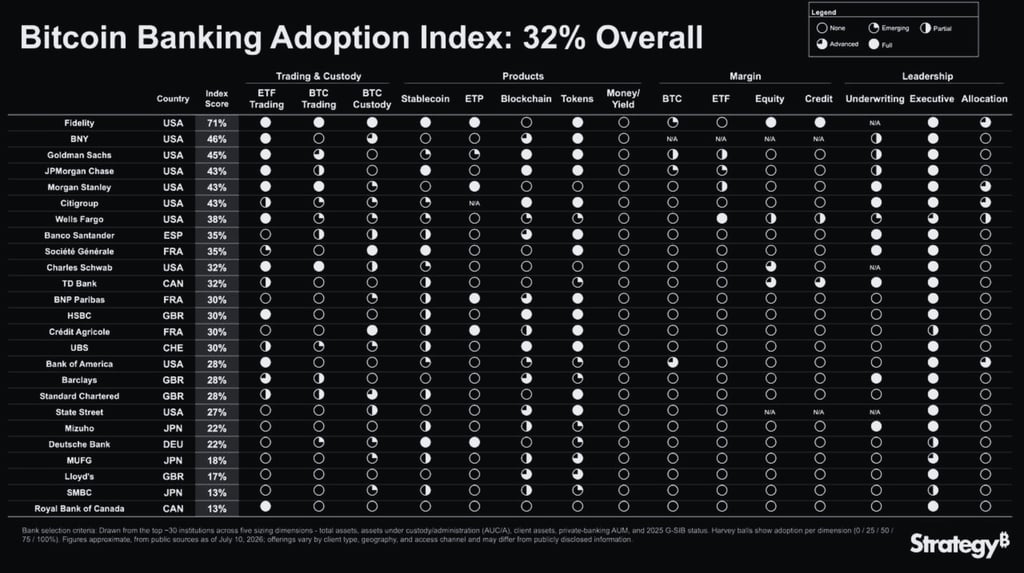
Phong Le, Chairman of Strategy Inc., announced the Bitcoin Banking Adoption Index, which scores each organization on a scale from 0 to 100% using the five-level Harvey Ball methodology.
7/16/20264 min read
Four aspects and the significance of each aspect.
This index assesses organizations based on four broad competency dimensions, each subdivided into specific product or service categories that are independently scored using the Harvey ball system, where a full circle represents full adoption, a three-quarter circle represents enhancement, a half circle represents partial adoption, an emerging circle represents initial engagement, and an empty circle represents no activity.
Trading and Custody encompass three categories: ETF Trading, which includes whether an institution facilitates client access to spot Bitcoin ETF products; BTC Trading, which includes the ability to directly trade spot Bitcoin and derivatives for clients; and BTC Custody, which includes whether the institution provides directly regulated Bitcoin custody services. These three categories represent the most fundamental layer of Bitcoin integration within the banking sector, and their scores correlate most directly with the regulatory environment in each institution's jurisdiction.
The product category comprises six subcategories: Stablecoin, reflecting whether an organization issues or actively integrates stablecoins into its customer offerings; ETP, referring to the development and distribution of exchange-traded products; Blockchain, encompassing whether the organization has deployed operational blockchain infrastructure for internal or customer purposes; Token, encompassing the tokenization of traditional assets; and Money/Yields, reflecting whether the organization offers cryptocurrency-linked yield products. The product category shows the greatest volatility in the index, with blockchain integration being relatively common while token and stablecoin capabilities remain limited for most organizations.
Margin lending comprises four categories: BTC Margin, ETF Margin, Equity Margin, and Credit, assessing whether institutions are expanding lending and financing based on Bitcoin, cryptocurrency ETF positions, cryptocurrency equities, and broader digital asset credit products. Margin lending represents an advanced stage of institutional integration, where banks take on balance sheet risk for digital collateral rather than simply facilitating customer access, and scores lower in this category compared to the trading and custody category.
American organizations dominate the top 5.
BNY's score of 46%, ranking second, reflects the bank's position as the primary custodian of USDC reserves and its newly expanded role as the first institution to offer USDC through the Digital Asset Guardianship platform, alongside the Dreyfus Stablecoin Reserve Fund and the ability to deposit crypto. The N/A entries in BNY's margin categories reflect the structural differences of this trust bank compared to commercial banks, which operate without the lending activities that create the margin product capability.
Goldman Sachs, with 45%, has built significant trading capabilities, including partial Bitcoin trading and advanced ETF trading, while its blockchain infrastructure is rated as advanced, reflecting the bank's Marquee platform, digital asset OTC trading division, and involvement in crypto pilot projects. JPMorgan Chase, with 43%, shows advanced blockchain platform and Kinexys capabilities, reflecting its Onyx history, along with partial Bitcoin trading, while its custodial score remains at partial rather than full despite its institutional trading activities. Morgan Stanley, with 43%, reflects active leadership engagement and a high capital allocation score, demonstrating CEO Ted Pick's embrace of digital assets, along with emerging positions in several product categories where the firm has announced intentions but has not yet fully deployed them.
The significance of the 32% figure as a baseline.
Le's interpretation of the 32% overall score as a starting point reflects the index's design as a time-tracking tool rather than a static snapshot. The organizations with the lowest current scores in the index represent the greatest potential for growth: if MUFG, SMBC, Royal Bank of Canada, and Lloyds move from their current 13- to 17% range to the 30- to 35% range already occupied by their peers, the index's overall score would increase significantly without any organization needing to reach the 70% range currently held by Fidelity.
The four categories with the most uniformly low scores in the index indicate where the next wave of Bitcoin adoption in the banking sector is most likely to occur. Token capability shows mostly incomplete or emerging scores in institutions that have announced tokenization strategies, suggesting deployment is lagging years behind the strategy announcement. Stablecoin scores are similar, showing only partial or no presence in most institutions, consistent with the view that integrating stablecoins at the institutional banking level requires regulatory frameworks such as the GENIUS Act to provide the legal clarity that compliance departments need before deployment. BTC margin and credit scores are among the lowest in the index, consistent with the credit risk associated with digital collateral, requiring guidance on regulated capital handling that banking regulators have only recently begun providing through guidance updates.
Assessment and Conclusion
Le's index is published by Strategy, a company that holds 847,363 Bitcoin and has built a capital market infrastructure specifically designed to promote Bitcoin adoption in institutions through equity and preferred stock products, giving institutional investors exposure to Bitcoin within a familiar financial framework. The publication of a comprehensive index on Bitcoin adoption in institutions serves a purpose directly aligned with Strategy's core commercial interests: demonstrating that the 32% global bank adoption recorded in this index represents an early-stage opportunity where the process from the current baseline to full integration creates sustainable Bitcoin demand within institutions. This index is also a genuine analytical contribution to understanding Bitcoin adoption in institutions and is part of the market development work for the ecosystem in which Strategy is a major participant.
Disclaimer: The information presented in this article is the author's personal opinion in the field of cryptocurrencies. This is not financial or investment advice at all. Every investment decision should be based on careful consideration of your personal portfolio and risk tolerance. The opinion in the article does not represent the official position of the platform. We recommend that readers do their own research and consult experts before making any investment decisions.
Synthesized and analyzed by HCCVenture
Follow HCCVenture organization here: https://link3.to/holdcoincventure
Explore HCCVenture group
HCCVENTURE QUANT JSCO
© 2026 HCCVENTURE. ALL COPYRIGHTS RESERVED.


Connect with us
Popular content
Contact to us
Address: 8th Floor, Bach Dang Complex Building, 50 Bach Dang Street, Hai Chau Ward, Da Nang City, Vietnam.
Phone: 1900 1509
Gmail : sp_contact@hccventure.com
Disclaimer: The information on this website is for informational purposes only and should not be considered investment advice. We are not responsible for any risks or losses arising from investment decisions based on the content here.
TERMS AND CONDITIONS • CUSTOMER PROTECTION POLICY
ANALYTICAL AND NEWS CONTENT IS COMPILED AND PROVIDED BY EXPERTS IN THE FIELD OF DIGITAL FINANCE AND BLOCKCHAIN BELONGING TO HCCVENTURE ORGANIZATION, INCLUDING OWNERSHIP OF THE CONTENT.
RESPONSIBLE FOR MANAGING ALL CONTENT AND ANALYSIS: HCCVENTURE FOUNDER - TRUONG MINH HUY
Read warnings about scams and phishing emails — REPORT A PROBLEM WITH OUR SITE.