

South Korea's Hangang Project integrates CBDC deposits into its ledger accounts
The Bank of Korea (BOK) has launched Phase 2 of its central bank digital currency initiative under Project Hangang, expanding from seven banks in Phase 1.
6/30/20263 min read

Hybrid architecture and a "harmonious" design philosophy.
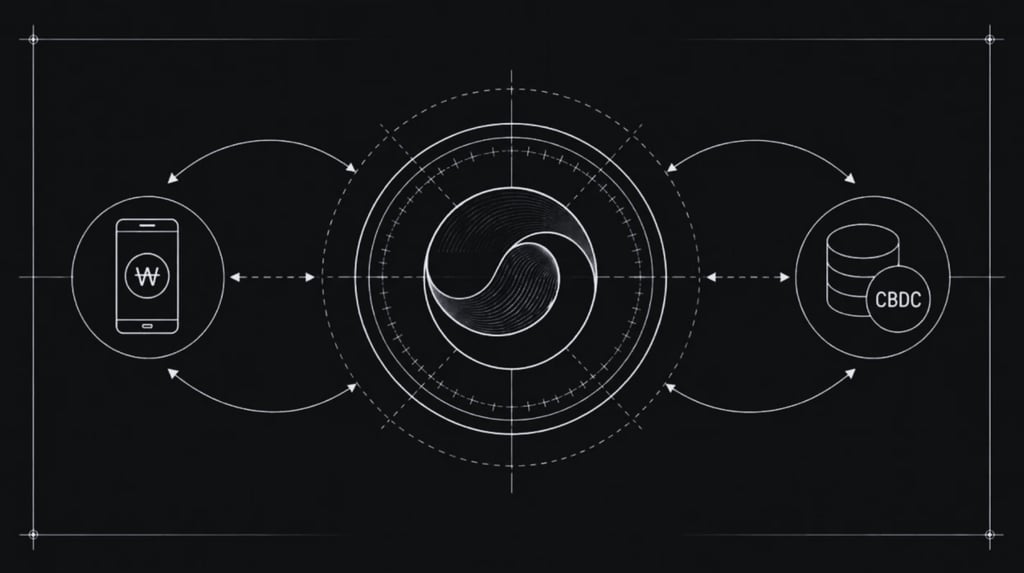
The Hangang project operates through a hybrid digital currency architecture, combining wholesale CBDCs issued to financial institutions as a payment layer with blockchain-based deposit tokens distributed directly to end users through participating commercial banks. Kim Dong-seop, head of the Digital Currency Planning Group at the Bank of Korea, describes this structure as "a compromise or compromise between CBDC and stablecoin," establishing a clear design philosophy that distinguishes South Korea's approach from direct retail CBDC models, where the central bank directly holds customer accounts.
This hybrid model offers significant impacts on financial stability by maintaining the role of commercial banks in customer relationship management, account management, and deposit taking, instead of allowing the central bank to directly compete with retail deposits. This architecture addresses the key systemic risk associated with retail CBDCs – the potential for customers to transfer deposits from commercial banks to central bank accounts during periods of financial stress, creating a massive bank run on an unprecedented scale and speed. By routing digital won through the issuance of commercial bank deposit tokens instead of a direct central bank wallet, the Hangang Project maintains the existing intermediary role of banks while adding blockchain-based programmability and payment capabilities to the established infrastructure.
Technical infrastructure
The most significant step in Phase 2 involves directly connecting the CBDC test network to the core account ledgers of participating commercial banks, enabling real-world transaction flows within existing banking infrastructure rather than parallel, independent systems. Participating organizations are building e-wallets, voucher distribution systems, and blockchain-based infrastructure that allows CBDC deposit tokens to seamlessly interact with existing customer account systems, compliance monitoring, and payment processes.
The integration with Naver Cloud, South Korea's leading domestic cloud infrastructure provider, reflects an emphasis on technological sovereignty and data security, ensuring that critical financial infrastructure remains under domestic legal control rather than relying on foreign cloud providers that may be subject to extraterritorial legal requirements. Prioritizing domestic cloud services aligns with South Korea's broader digital sovereignty goals and establishes clear chains of accountability within the Korean legal framework.
Participating banks bear the development costs themselves, while the Bank of Korea supports the core infrastructure and advisory services until October 2026, establishing a cost-sharing agreement that reflects the banks' genuine commercial interest in the digital currency infrastructure, rather than merely a regulatory compliance exercise. The bank-funded development model demonstrates that commercial institutions value CBDC deposit token infrastructure as a potentially valuable proprietary capability, justifying voluntary investment beyond minimum regulatory requirements.
Legal orientation
The Governor of the Bank of Korea, Shin Hyun-song, who takes office in April 2026, clearly prioritized the Hangang Project and CBDC development in his inaugural speech, notably omitting stablecoins despite the heated legislative debates surrounding South Korea's Digital Asset Fundamental Act. This omission of stablecoins demonstrates the Bank of Korea's preference for maintaining monetary policy control through tightly regulated, bank-issued deposit tokens, rather than allowing the issuance of private stablecoins that create parallel monetary systems outside of central bank oversight.
The Bank of Korea's clear stance that stablecoins pegged to the KRW should only be issued by licensed commercial banks has established a framework for direct competition, with the Hangang Project deposit token and privately issued Won stablecoin occupying disputed legal territory, awaiting resolution through the legislative process of the Digital Asset Fundamental Act. This legal dispute explains why the Act remains stalled despite advanced legislative developments — the fundamental disagreement between proponents of broader stablecoin issuance and the Bank of Korea's preference for bank-exclusive models remains unresolved.
Assessment and Conclusion
The expansion of South Korea's Hangang Project Phase 2 into its core banking system sets a significant benchmark for how advanced economies integrate CBDC infrastructure with existing commercial banking architecture without causing systemic disruption. The hybrid model of wholesale CBDC and commercial bank deposit tokens could have a major impact as other countries assess CBDC architecture, balancing innovation with financial stability considerations.
For private stablecoin issuers, South Korea's clear policy prioritizing the exclusive issuance of KRW stablecoins to banks creates a direct legal challenge, where privately issued stablecoins could be banned or severely restricted, favoring bank-issued deposit tokens operating under central bank supervision. This legal preference signals that South Korea's digital currency market structure will ultimately reflect government-directed financial innovation rather than allowing open competition between regulated monetary infrastructure and crypto-native monetary infrastructure.
Disclaimer: The information presented in this article is the author's personal opinion in the field of cryptocurrencies. This is not financial or investment advice at all. Every investment decision should be based on careful consideration of your personal portfolio and risk tolerance. The opinion in the article does not represent the official position of the platform. We recommend that readers do their own research and consult experts before making any investment decisions.
Synthesized and analyzed by HCCVenture
Follow HCCVenture organization here: https://link3.to/holdcoincventure
Explore HCCVenture group
HCCVENTURE QUANT JSCO
© 2026 HCCVENTURE. ALL COPYRIGHTS RESERVED.


Connect with us
Popular content
Contact to us
Address: 8th Floor, Bach Dang Complex Building, 50 Bach Dang Street, Hai Chau Ward, Da Nang City, Vietnam.
Phone: 1900 1509
Gmail : sp_contact@hccventure.com
Disclaimer: The information on this website is for informational purposes only and should not be considered investment advice. We are not responsible for any risks or losses arising from investment decisions based on the content here.
TERMS AND CONDITIONS • CUSTOMER PROTECTION POLICY
ANALYTICAL AND NEWS CONTENT IS COMPILED AND PROVIDED BY EXPERTS IN THE FIELD OF DIGITAL FINANCE AND BLOCKCHAIN BELONGING TO HCCVENTURE ORGANIZATION, INCLUDING OWNERSHIP OF THE CONTENT.
RESPONSIBLE FOR MANAGING ALL CONTENT AND ANALYSIS: HCCVENTURE FOUNDER - TRUONG MINH HUY
Read warnings about scams and phishing emails — REPORT A PROBLEM WITH OUR SITE.