

South Korea tightens cryptocurrency withdrawal restrictions following Bithumb's system failure
The South Korean Financial Services Commission (FSC) has imposed comprehensive new operating requirements on all domestic cryptocurrency exchanges following a serious internal control incident at Bithumb.
4/9/20262 min read
A wake-up call about systemic weaknesses
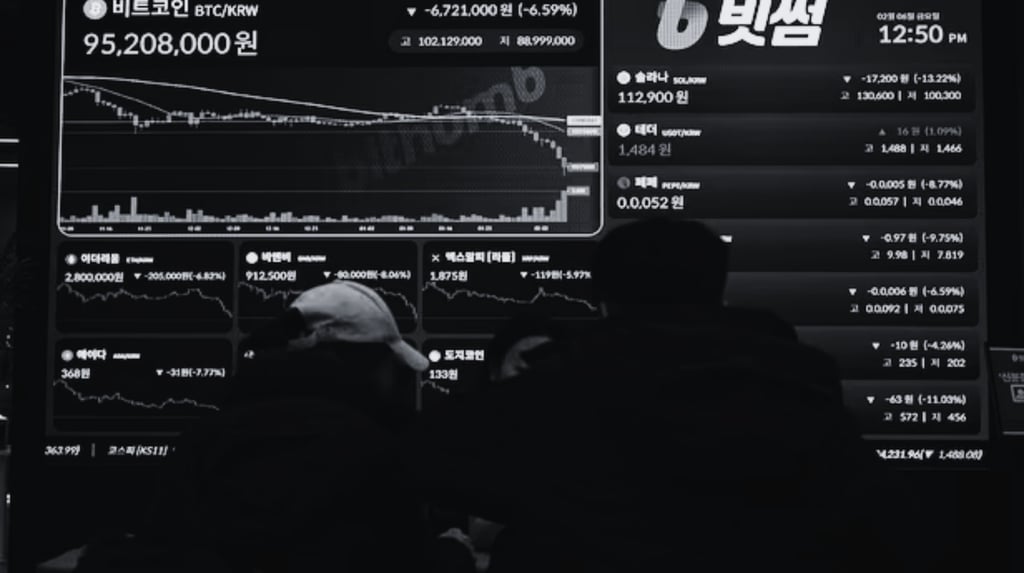
On February 6, 2026, during a regular promotional event, Bithumb staff mistakenly entered the reward unit as “ Bitcoin ” instead of South Korean won. This resulted in a massive virtual balance appearing in user accounts on the internal ledger.
Within minutes, some recipients attempted to sell or withdraw funds, causing a sharp drop in Bitcoin's price on the platform (Bitcoin fell to a low of around $55,000 on Bithumb ). Bithumb acted quickly: they restricted trading and withdrawals for affected accounts within 15-35 minutes, recovered 99.7% of the faulty BTC, and covered the remaining shortfall with company funds (including compensation for those who panic-sold).
No cyberattacks or security breaches occurred, but the event highlighted inadequate real-time monitoring and high-risk manual processes. Bithumb is now facing a six-month partial suspension of operations (March-September 2026) and a substantial fine for separate violations of anti-money laundering and customer verification.
The FSC's subsequent inspection of major exchanges (including its partnership with the DAXA Digital Asset Exchange Alliance) revealed that while all platforms generally held sufficient assets, reconciliation processes varied considerably and manual transaction safeguards were often inadequate.
The shift to continuous monitoring
The new regulations fundamentally change how exchanges operate. Instead of periodic checks, platforms must now implement a continuous reconciliation system, verifying customer balances against actual holdings in as little as five minutes.
This is not just a technical upgrade. It represents a shift in management philosophy from detecting problems after they occur to preventing them in real time. In fact, exchanges are being pushed toward standards closer to those of traditional financial institutions, where reconciliation and risk monitoring are ongoing processes rather than batch operations.
Withdrawal control as a risk mitigation tool.
Along with asset verification, authorities are also tightening withdrawal procedures. South Korea has mandated a 24- to 72-hour delay for cryptocurrency withdrawals after deposits to prevent fraud and facilitate quick withdrawals.
The new legal framework builds on that by ensuring that any withdrawal request is backed by a verified balance in near real-time. This helps mitigate risk:
Payment error
Internal system deviations
Exploiting accounting loopholes quickly
The focus is shifting from external threats, such as cyberattacks, to internal operational risks—a type of risk that the Bithumb incident has shown cannot be ignored.
Higher cost, higher trust
The immediate consequence could be higher operating costs for exchanges, as real-time monitoring systems require more advanced infrastructure and tighter internal controls.
But in return, confidence is boosted. For a market inherently affected by volatility and occasional operational failures, this move can improve investor confidence, attract institutional participation, and reduce the likelihood of serious missteps.
Our review
South Korea's response to the Bithumb incident exemplifies a proactive, technology-driven management philosophy: viewing operational errors as systemic risks and addressing vulnerabilities before they escalate. The 5-minute reconciliation rule, combined with stricter withdrawal safeguards, could serve as a model for other countries seeking to balance innovation and consumer protection.
Disclaimer: The information presented in this article is the author's personal opinion in the field of cryptocurrency. This is not financial or investment advice. All investment decisions should be based on careful consideration of your personal portfolio and risk tolerance. The views expressed in this article do not represent the official stance of the platform. We recommend that readers conduct their own research and consult with experts before making any investment decisions.
Compiled and analyzed by HCCVenture
Follow HCCVenture here: https://link3.to/holdcoincventure
Explore HCCVenture group
HCCVENTURE QUANT JSCO
© 2026 HCCVENTURE. ALL COPYRIGHTS RESERVED.


Connect with us
Popular content
Contact to us
Address: 8th Floor, Bach Dang Complex Building, 50 Bach Dang Street, Hai Chau Ward, Da Nang City, Vietnam.
Phone: 1900 1509
Gmail : sp_contact@hccventure.com
Disclaimer: The information on this website is for informational purposes only and should not be considered investment advice. We are not responsible for any risks or losses arising from investment decisions based on the content here.
TERMS AND CONDITIONS • CUSTOMER PROTECTION POLICY
ANALYTICAL AND NEWS CONTENT IS COMPILED AND PROVIDED BY EXPERTS IN THE FIELD OF DIGITAL FINANCE AND BLOCKCHAIN BELONGING TO HCCVENTURE ORGANIZATION, INCLUDING OWNERSHIP OF THE CONTENT.
RESPONSIBLE FOR MANAGING ALL CONTENT AND ANALYSIS: HCCVENTURE FOUNDER - TRUONG MINH HUY
Read warnings about scams and phishing emails — REPORT A PROBLEM WITH OUR SITE.