


Solana's Alpenglow upgrade achieves transaction completion times under 150 milliseconds.
Solana's Alpenglow consensus mechanism upgrade has progressed to the test cluster activation phase after receiving SIMD-0236 governance approval from 98.27% of validators.
7/6/20263 min read
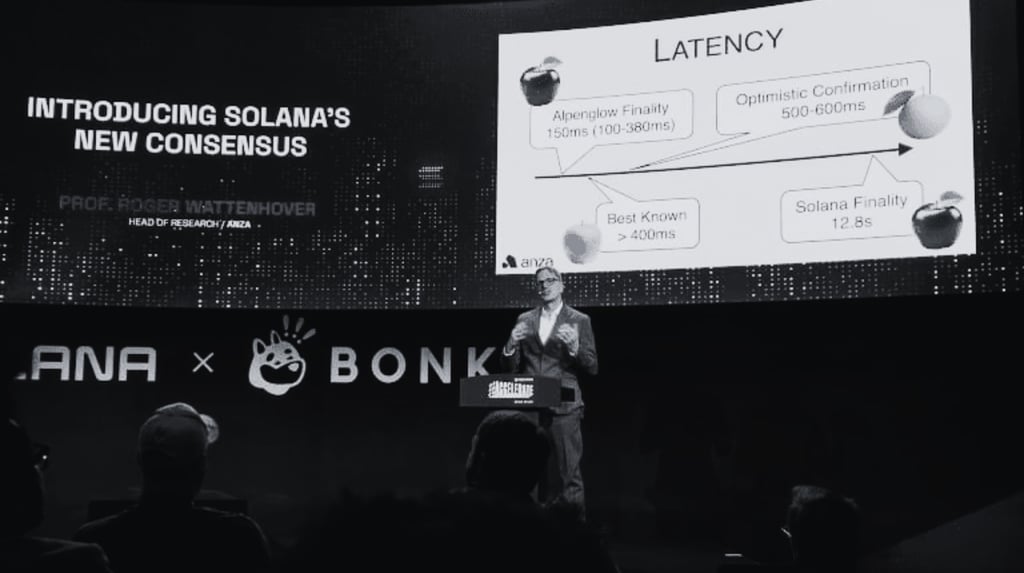
Eliminating the Proof of History mechanism after eight years.
Alpenglow replaces the two underlying systems Solana has used since its launch, Proof of History and Tower BFT, and shortens transaction completion times from approximately 12.8 seconds to around 100 to 150 milliseconds.
Proof of History, Solana's original 2017 innovation and the mechanism shaping the network's technical identity, provides verifiable timestamps that allow validators to agree on transaction order without real-time coordination by maintaining a continuous cryptographic hash chain that records elapsed computation time. Tower BFT, built on the PoH platform, provides a Byzantine fault-tolerant consensus mechanism by requiring validators to publish votes on-chain through 32 incremental voting rounds, each adding cumulative lock-up periods to the current base completion time of 12.8 seconds under normal conditions and longer under network overload.
Votor replaces Tower BFT. Instead of on-chain voting transactions occupying approximately 75% of block space, Votor moves all voting off-chain via lightweight UDP messages and BLS signature aggregation. Only a certificate of approximately 1,000 bytes is brought onto the chain. This freeing up of 75% of block space represents a structural capacity multiplier, allowing Solana to process a significantly higher number of user transactions per block by eliminating the validator self-reporting overhead, which previously occupied a large portion of available block space.
Rotor replaces Turbine. Instead of Turbine's multi-step tree structure, Rotor uses a single-step direct broadcast method, completed in approximately 18 milliseconds. The shift from multi-step transmission, where data propagates down a hierarchical validator tree requiring multiple sequential relay steps, to direct broadcast from leader to all, eliminates the cumulative latency from each intermediate step while reducing the likelihood of the network being affected by propagation errors introduced at any layer of the multi-step chain.
Free up 75% of the volume space.
The removal of validator voting transactions on the chain represents Alpenglow's most significant capability improvement, addressing a structural inefficiency where a large portion of Solana's total block space was consumed by validators publishing their own consensus participation records instead of processing user transactions.
Under the current architecture, each validator must submit voting transactions on the chain for each block, creating a constant transaction volume proportional to the number of validators rather than user demand. Alpenglow eliminates voting fees, which cost validators thousands of dollars annually, while freeing up 75% of the block capacity previously allocated for these costs to process actual user transactions, significantly increasing Solana's actual user-facing throughput without hardware upgrades or changes in transaction processing speed.
The freed-up capacity creates secondary network effects: higher available block space reduces competition for inclusion, thereby minimizing spikes in transaction fees during peak times, potentially reducing fee volatility that has hampered time-sensitive applications, including high-frequency trading and gaming. In Q1 2026, Solana's on-chain spot trading volume reached $1.6 trillion, second only to Binance, creating a liquidity platform for institutional participation.
The economics of the authenticator
The shift to off-chain voting eliminates the cost structure where validators previously paid ongoing on-chain transaction fees to participate in the consensus process, resulting in a significant reduction in operating costs for validator operators, who previously faced thousands of dollars in voting transaction fees annually, diminishing their staking profitability. Lower validator costs improve the economic efficiency of staking and attract more staking trustees.
The economic improvements for validators have implications for decentralization, where smaller validators operating with lower profit margins previously struggled to compete with staking operations of well-capitalized institutions, which viewed voting costs as negligible overhead. This reduction in fixed operating costs removes the economic barrier that disproportionately disadvantages smaller validators compared to larger operations with superior economies of scale, potentially expanding the active validator pool and improving the network's decentralization metrics along with performance enhancements.
Mainnet testing status and progress
The community validator testing phase began on May 11, 2026. Mainnet activation is now projected for late Q3 or early Q4 2026. The clearest indication of an imminent Mainnet launch is the official release of Agave 4.1, coupled with the successful activation of the test network.
The significance of this testing phase lies in confirming that performance in Alpenglow's controlled environment, as demonstrated by the Zurich-led node latency graph, is replicated across the entire global validator network with its diverse geographic distribution, hardware heterogeneity, and the changing network conditions characteristic of production operations. The dramatic increase in latency in the graph at the 95- to 100 percent stock coverage percentile reflects the real-world physical constraints that no protocol design can fully overcome for globally distributed validator networks, establishing the range of practical performance that the Mainnet deployment will exhibit rather than theoretical lab benchmarks.
Disclaimer: The information presented in this article is the author's personal opinion in the field of cryptocurrencies. This is not financial or investment advice at all. Every investment decision should be based on careful consideration of your personal portfolio and risk tolerance. The opinion in the article does not represent the official position of the platform. We recommend that readers do their own research and consult experts before making any investment decisions.
Synthesized and analyzed by HCCVenture
Follow HCCVenture organization here: https://link3.to/holdcoincventure
Explore HCCVenture group
HCCVENTURE QUANT JSCO
© 2026 HCCVENTURE. ALL COPYRIGHTS RESERVED.


Connect with us
Popular content
Contact to us
Address: 8th Floor, Bach Dang Complex Building, 50 Bach Dang Street, Hai Chau Ward, Da Nang City, Vietnam.
Phone: 1900 1509
Gmail : sp_contact@hccventure.com
Disclaimer: The information on this website is for informational purposes only and should not be considered investment advice. We are not responsible for any risks or losses arising from investment decisions based on the content here.
TERMS AND CONDITIONS • CUSTOMER PROTECTION POLICY
ANALYTICAL AND NEWS CONTENT IS COMPILED AND PROVIDED BY EXPERTS IN THE FIELD OF DIGITAL FINANCE AND BLOCKCHAIN BELONGING TO HCCVENTURE ORGANIZATION, INCLUDING OWNERSHIP OF THE CONTENT.
RESPONSIBLE FOR MANAGING ALL CONTENT AND ANALYSIS: HCCVENTURE FOUNDER - TRUONG MINH HUY
Read warnings about scams and phishing emails — REPORT A PROBLEM WITH OUR SITE.