

Solana DePIN's revenue increased to 2.8 million USD as data demand increased rapidly
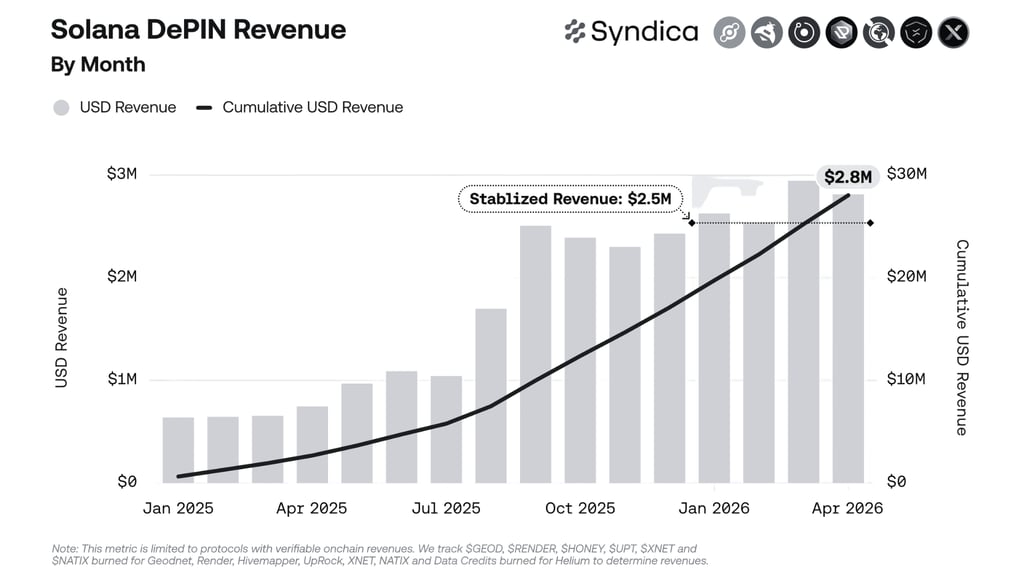
Revenue generated from decentralized physical infrastructure (DePIN) network projects is reported to have reached $2.8 million, while network data transmission activity has increased about 17 times in the past year.
5/23/20263 min read
DePIN is quietly becoming one of the practical fields
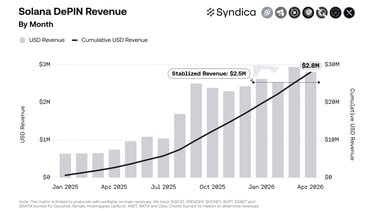
The total revenue generated by decentralized physical infrastructure (DePIN) networks built on Solana reached a monthly record high of $2.8 million by April 2026, according to on-chain analysis. At the same time, the volume of data downloaded and processed through Solana-based DePIN protocols has skyrocketed 17 times in the past 12 months, showing rapid practical application and utility growth in this field.
The 17-fold growth in processed data reflects extended use cases in decentralized wireless networks (DeWi), AI data processing, and IoT networks. Projects are succeeding in encouraging users and operators to contribute to practical physical infrastructure.
Monthly revenue increased to $2.8 million showing that many DePIN protocols have gone beyond pure token incentives to move towards sustainable, usage-based monetization models.
Solana's high throughput, low fees, and improved developer tools have made it an attractive foundation layer for hardware-heavy DePIN projects that require regular small transactions and data logs.
This strong growth highlights the emergence of Solana as one of the most powerful ecosystems for DePIN projects, which distribute physical resources such as wireless networks, data storage, computing power and sensor networks by using incentive mechanisms based on blockchain technology.
Solana's architecture is suitable for applications
The development of DePIN on Solana is not accidental. Infrastructure-based applications require low transaction costs, high throughput and fast payment speed.
These characteristics are very important when networks have to handle a large amount of interactions created by machines continuously and on a large scale. Solana's architecture makes it particularly attractive to systems that coordinate thousands or even millions of decentralized devices in real time.
As a result, this chain is increasingly positioning itself not only as a DeFi ecosystem, but also as an operating layer for machine-coordinated infrastructure economies.
The 17-fold increase in reported data transmission activity may be more important than the revenue figure itself. In the blockchain market, many indexes can be inflated by speculative trading or profit-mopping activities. This shows that DePIN is developing beyond test stories into systems that create measurable utility.
The story of AI and DePIN begins to intersect
The rise of AI is also increasing interest in decentralized infrastructure networks. As the demand for GPU computing, data bandwidth and distributed processing... continues to increase, DePIN systems provide an alternative model for centralized hyper-scale infrastructure controlled by a handful of tech giants.
This creates an increasing overlap between the demand for AI infrastructure and blockchain-based resource coordination systems, especially on chains optimized for high-throughput execution like Solana.
With a revenue of $2.8 million, DePIN's revenue is still relatively small compared to mature technology industries. However, the important thing is the development trajectory rather than the absolute number. Infrastructure businesses often scale up gradually before achieving the network effect that significantly accelerates adoption. The combination of increasing usage and revenue growth shows that DePIN may be entering the early stages of that transition.
Evaluation and conclusion
With exponential data processing and revenue reaching record highs, Solana's DePIN sector is showing clear signs of sustainable expansion. As more and more projects mature and integrate actual hardware with on-chain incentives, this sector is expected to become one of the most important growth engines for the entire blockchain industry in 2026 and the following years. The development of Solana's DePIN ecosystem highlights the broader transformation taking place in the blockchain market.
Cryptocurrencies are increasingly expanding beyond pure financial systems and aiming to coordinate real infrastructure and machine networks. And as computing systems, bandwidth, and decentralized data continue to expand, the long-term value of blockchain may depend not only on money transfers but also on the ability to coordinate the physical infrastructure that powers the digital economy itself.
Disclaimer: The information presented in this article is the author's personal opinion in the field of cryptocurrencies. This is not financial or investment advice at all. Every investment decision should be based on careful consideration of your personal portfolio and risk tolerance. The opinion in the article does not represent the official position of the platform. We recommend that readers do their own research and consult experts before making any investment decisions.
Synthesized and analyzed by HCCVenture
Follow HCCVenture organization here: https://link3.to/holdcoincventure
Explore HCCVenture group
HCCVENTURE QUANT JSCO
© 2026 HCCVENTURE. ALL COPYRIGHTS RESERVED.


Connect with us
Popular content
Contact to us
Address: 8th Floor, Bach Dang Complex Building, 50 Bach Dang Street, Hai Chau Ward, Da Nang City, Vietnam.
Phone: 1900 1509
Gmail : sp_contact@hccventure.com
Disclaimer: The information on this website is for informational purposes only and should not be considered investment advice. We are not responsible for any risks or losses arising from investment decisions based on the content here.
TERMS AND CONDITIONS • CUSTOMER PROTECTION POLICY
ANALYTICAL AND NEWS CONTENT IS COMPILED AND PROVIDED BY EXPERTS IN THE FIELD OF DIGITAL FINANCE AND BLOCKCHAIN BELONGING TO HCCVENTURE ORGANIZATION, INCLUDING OWNERSHIP OF THE CONTENT.
RESPONSIBLE FOR MANAGING ALL CONTENT AND ANALYSIS: HCCVENTURE FOUNDER - TRUONG MINH HUY
Read warnings about scams and phishing emails — REPORT A PROBLEM WITH OUR SITE.