

Sky Ecosystem invests $13.5 million in Osero to profit from the stablecoin
Osero has raised $13.5 million in a funding round led by Sky Ecosystem and co-led by Plasma to build infrastructure to channel profits from stablecoins from issuers like Circle and Tether to actual holders.
5/13/20264 min read
A $300 billion opportunity that nobody seized.
The stablecoin market has surpassed the $300 billion mark in total value, but the economy remains unbalanced in ways that even traditional financial industries would be ashamed of. Circle earns around 4-5% annually from Treasury bonds and cash backing USDC, generating approximately $3-4 billion in revenue each year that token holders never receive. Tether's economy is even more extreme, with the company generating billions of dollars in returns from reserve interest while USDT holders receive no yield whatsoever.
Osero founder Piotr Saczuk sees this as the core problem his company exists to solve. Platforms wanting to offer stablecoin savings products to users are currently facing a choice between self-managing complex treasury operations or accepting that their users earn nothing. The first option requires building asset management infrastructure, hiring credit analysts, and navigating regulatory frameworks that most fintech companies are reluctant to undertake. The second option means watching users migrate to yield-based platforms.
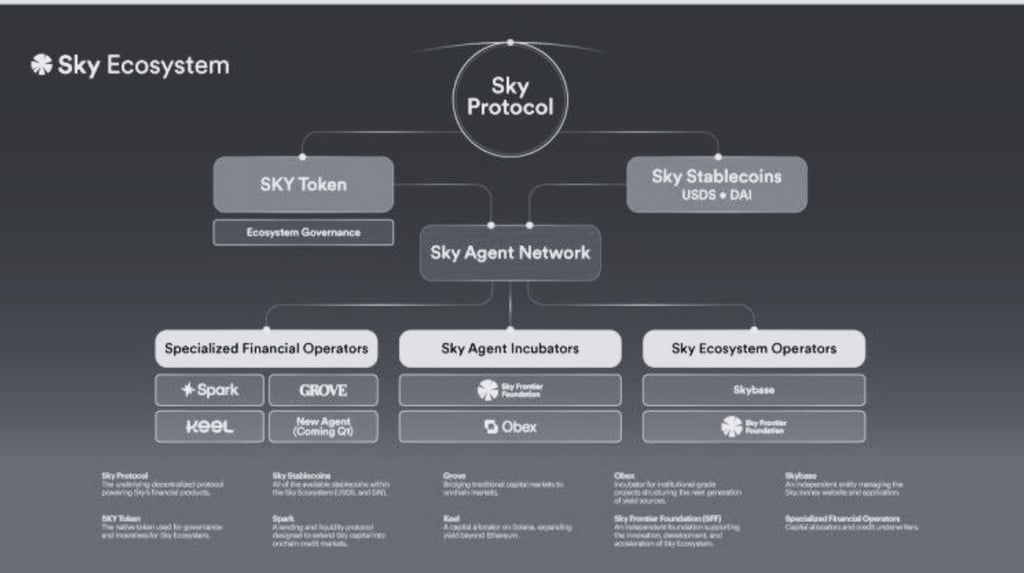
Sky Ecosystem's involvement as a principal investor is not charitable. The protocol, formerly known as MakerDAO, has been actively expanding its distribution of USDS and its yield-generating variant, sUSDS, since its rebranding. Last year, S&P gave Sky a B- credit rating, the first time a major authority has rated a DeFi protocol. Sky operates more like a central bank than a startup, with agents and subDAOs handling separate distribution segments. Osero is positioned as the consumer and fintech distribution layer, optimized to integrate Sky Savings Rate into applications where millions of users already hold the stablecoin.
Three products were developed for different distribution tiers.
Osero Earn targets e-wallets, digital banks, custodians, and exchanges that want to offer yields without becoming asset managers themselves. The integrated product, with only about ten lines of code, routes user deposits to Sky Savings Rate while Osero handles asset management, routing, and risk infrastructure. The platform never holds assets and never faces the regulatory complexities of managing other people's money. The complexity often encountered when launching a stablecoin savings product is streamlined in a single afternoon of engineering work.
The Osero app provides individual and institutional users with direct access to Sky Savings Rate across multiple chains without intermediaries. Users deposit stablecoins and earn yields, with Osero handling the cross-chain complexity and risk management behind the scenes. This simplicity is intentional. Most cryptocurrency users don't want to become professional DeFi users; they want something similar to a traditional savings account but that works with the stablecoins already in their wallets.
Osero Foundry represents an institutional strategy, providing asset managers and product issuers with the infrastructure to tokenize and deploy capital on the chain. The product comes with the ability to allocate up to $2.5 billion in anchor capital, swap liquidity, and lending liquidity. Each deployment undergoes a risk assessment framework inspired by Basel III banking regulations, the same standards Sky Protocol uses for its own capital allocation. Saczuk emphasizes that this isn't just empty cryptocurrency platitudes like "trust us," but rather an effort to bring institutional-level risk management discipline to the on-chain capital market.
$10 million is set aside as risk reserve capital.
The structure of the $13.5 million funding round shows how seriously Osero is considering partner risk. Ten million dollars of the total will be used as reserve capital to protect both users and Sky Protocol from potential losses. When Osero moves deposits into profitable strategies or lends USDS based on real assets through Foundry, that reserve capital will act as a buffer against initial losses, absorbing any defaults or security breaches of the protocol.
This is more important than ever given the current circumstances. April 2026 saw the highest number of DeFi security vulnerabilities in history, with North Korea-related activities accounting for 76% of total losses up to April, according to TRM Labs. Notorious hacks, including the $285 million loss from Drift Protocol and the $292 million loss from Kelp DAO, have made institutional investors more cautious about deploying profitable strategies without robust risk management.
Saczuk views reserve capital as a consensus of interests. Osero's business model generates revenue through two sources: earning a share on each USDS balance and sUSDS distributed through Earn integrations, and profiting from the spread between the yield generated from institutional investments and the Sky Base Rate paid on borrowed capital. If implementations fail, Osero will lose money before users or the Sky Protocol. These incentives encourage prudent, well-guaranteed strategies rather than seeking yields in risky protocols.
Assessment and Conclusion
Osero's fundraising comes at the intersection of several converging trends. The stablecoin legislation passed by Congress in 2025 with the GENIUS Act has provided a clearer legal framework for institutional investment in cryptocurrency infrastructure. Companies like Circle raising $222 million with a $3 billion valuation for the Arc blockchain and crypto money market funds demonstrate that the traditional financial industry is building parallel infrastructure for stablecoin and crypto asset markets.
Osero is betting that most stablecoin holders don't want to become sophisticated DeFi users, having to figure out protocols, gas fees, and smart contract risks on their own. They want savings account-like yields, integrated into the wallets and platforms they already use. Infrastructure that meets this need on a large scale becomes systemicly important regardless of which specific stablecoin dominates in the long term.
The competitive landscape includes established companies. Circle and PayPal have discussed yield-generating stablecoin variants. Coinbase offers yields through USDC staking rewards shared with users. Traditional banks will eventually join in with deposit-like stablecoin products. But none of these platforms have the combination that Osero offers: integrated infrastructure enabling branded platforms, direct access to the retail marketplace for users in need, and deployment capabilities for asset management organizations.
Disclaimer: The information presented in this article is the author's personal opinion in the field of cryptocurrencies. This is not financial or investment advice at all. Every investment decision should be based on careful consideration of your personal portfolio and risk tolerance. The opinion in the article does not represent the official position of the platform. We recommend that readers do their own research and consult experts before making any investment decisions.
Synthesized and analyzed by HCCVenture
Follow HCCVenture organization here: https://link3.to/holdcoincventure
Explore HCCVenture group
HCCVENTURE QUANT JSCO
© 2026 HCCVENTURE. ALL COPYRIGHTS RESERVED.


Connect with us
Popular content
Contact to us
Address: 8th Floor, Bach Dang Complex Building, 50 Bach Dang Street, Hai Chau Ward, Da Nang City, Vietnam.
Phone: 1900 1509
Gmail : sp_contact@hccventure.com
Disclaimer: The information on this website is for informational purposes only and should not be considered investment advice. We are not responsible for any risks or losses arising from investment decisions based on the content here.
TERMS AND CONDITIONS • CUSTOMER PROTECTION POLICY
ANALYTICAL AND NEWS CONTENT IS COMPILED AND PROVIDED BY EXPERTS IN THE FIELD OF DIGITAL FINANCE AND BLOCKCHAIN BELONGING TO HCCVENTURE ORGANIZATION, INCLUDING OWNERSHIP OF THE CONTENT.
RESPONSIBLE FOR MANAGING ALL CONTENT AND ANALYSIS: HCCVENTURE FOUNDER - TRUONG MINH HUY
Read warnings about scams and phishing emails — REPORT A PROBLEM WITH OUR SITE.