

S&P Global Downgrades USDT Stability Rating to “5"
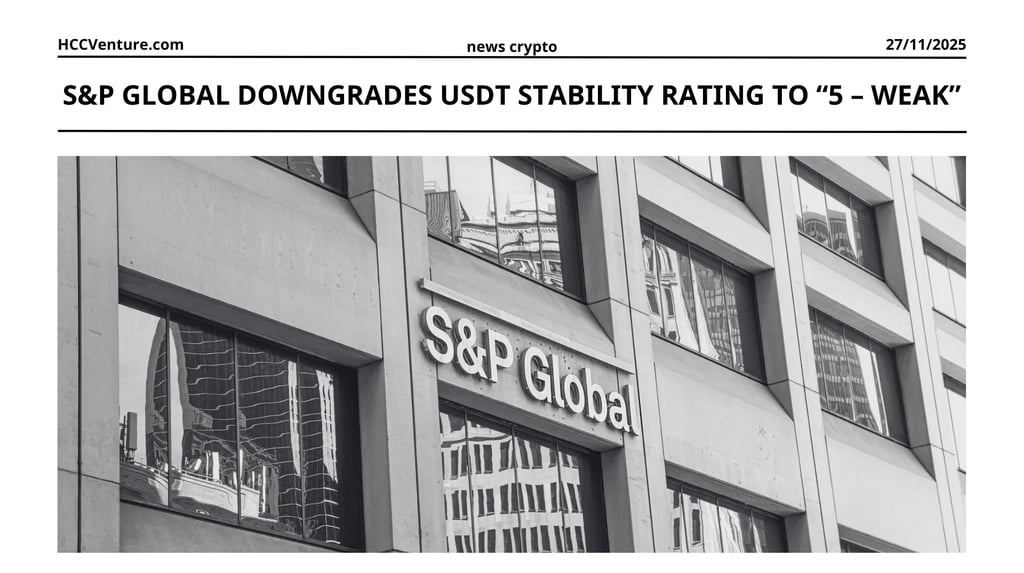
S&P Global Ratings has downgraded the stability rating of USDT—the world’s largest stablecoin with a market capitalization of $184 billion—to “5 (weak),” the lowest rating on its five-point scale.
11/27/20252 min read
Tether’s Dangerous Reserves
Bitcoin, gold, secured loans, corporate bonds, and opaque investment accounts—now account for 24% of reserves, supporting $174.4 billion in USDT in circulation, up from 17% a year ago.
Bitcoin uses just 5.6% of circulating USDT, surpassing the 3.9% threshold at 103.9%—leaving a small account if BTC falls 10-15%, as happened in October’s $20 billion liquidation. Transparency issues persist: S&P flags “limited insight” into custodians, partners, and asset product quality, with BDO’s quarterly attestation of Tether lacking the same detail as Circle’s USDC audits.
While USDT remains at $1 through shocks like Terra’s 2022 decline, S&P warns that “a significant decline” in BTC or borrowed accounts could cause the coin to lose value, similar to the $0.95 limit in 2022.
What do S&P ratings mean ?
The S&P Stablecoin Stability Score analyzes a token’s ability to maintain its peg under stress conditions — assessing its reserve composition, liquidity, counterparty risk, operational governance, and regulatory oversight.
A score of 5 indicates that S&P views USDT as structurally vulnerable, with poor resilience to market stress events, and insufficient safeguards to ensure parity with the US dollar over the long term.
This does not mean that USDT is on the verge of breaking its peg. Rather, it suggests that USDT is significantly riskier than other major stablecoins and does not meet the reliability standards expected of systemically important digital dollars.
The downgrade is consistent with concerns raised regularly by regulators, auditors and financial institutions over the years — but the formal announcement by the world's most influential credit rating agency elevates the issue from a debate to a recognized financial risk.
Regulatory Timing
S&P’s downgrade comes as global regulators are rapidly moving toward stablecoin-specific legislation:
US: GENIUS Act sets reserve and issuance standards
Europe: MiCA stablecoin mechanism officially goes live
Asia: Japan, Singapore, and Hong Kong are accelerating the development of a licensed stablecoin framework
Canada: Draft budget includes national stablecoin regulation
Latin America: Several governments are exploring the integration of CBDCs and oversight of private stablecoins
In this context, S&P’s rating is more than just an opinion — it could influence how policymakers view USDT’s risk profile, especially when deciding which stablecoins should be allowed to circulate in regulated financial markets.
Insight from HCCVenture
S&P Global’s decision to downgrade USDT to 5 – the weakest possible rating – is a watershed moment for the stablecoin industry, concerns that have long been discussed in the crypto community and opens the door for institutional capital to shift to more transparent and regulated alternatives.
USDT will remain dominant in the short term thanks to its strong network effects, global liquidity, and widespread adoption in emerging markets. However, this downgrade is a clear warning: in the next era of the digital dollar, legal legitimacy and transparency of reserves may become more valuable than market share.
Disclaimer: The information presented in this article is the author's personal opinion in the cryptocurrency field. It is not intended to be financial or investment advice. Any investment decision should be based on careful consideration of your personal portfolio and risk tolerance. The views expressed in this article do not represent the official position of the platform. We recommend that readers conduct their own research and consult with a professional before making any investment decisions.
Explore HCCVenture group
HCCVENTURE QUANT JSCO
© 2026 HCCVENTURE. ALL COPYRIGHTS RESERVED.


Connect with us
Popular content
Contact to us
Address: 8th Floor, Bach Dang Complex Building, 50 Bach Dang Street, Hai Chau Ward, Da Nang City, Vietnam.
Phone: 1900 1509
Gmail : sp_contact@hccventure.com
Disclaimer: The information on this website is for informational purposes only and should not be considered investment advice. We are not responsible for any risks or losses arising from investment decisions based on the content here.
TERMS AND CONDITIONS • CUSTOMER PROTECTION POLICY
ANALYTICAL AND NEWS CONTENT IS COMPILED AND PROVIDED BY EXPERTS IN THE FIELD OF DIGITAL FINANCE AND BLOCKCHAIN BELONGING TO HCCVENTURE ORGANIZATION, INCLUDING OWNERSHIP OF THE CONTENT.
RESPONSIBLE FOR MANAGING ALL CONTENT AND ANALYSIS: HCCVENTURE FOUNDER - TRUONG MINH HUY
Read warnings about scams and phishing emails — REPORT A PROBLEM WITH OUR SITE.