

RWA capitalization and trading volume on Ethereum L1 reached the highest level
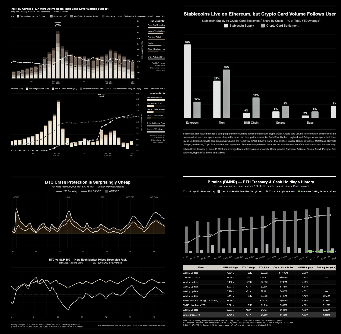
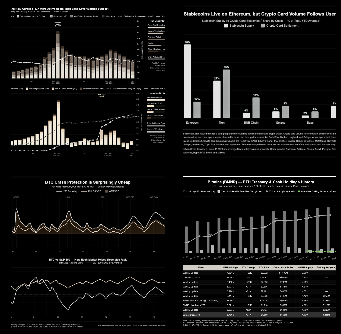
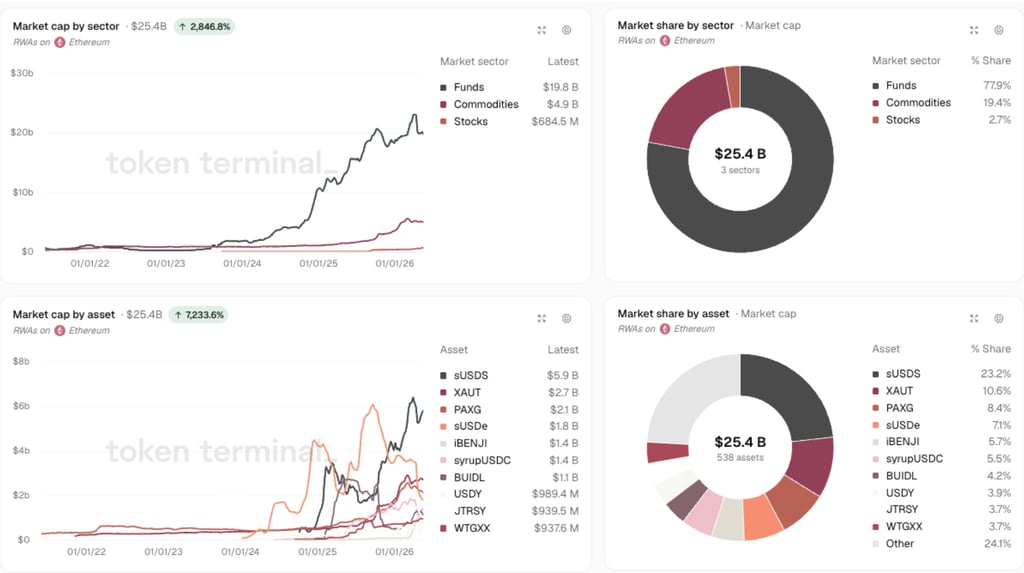
According to data from Token Terminal, Ethereum's first-layer network has reached an all-time high at the same time in terms of actual asset market capitalization and transaction number.
5/27/20265 min read
Token Terminal identifies and records data
Token Terminal highlighted record-breaking real asset indexes in the newsletter referring to what this analysis platform describes as "the silent winners of 2025", identifying issuers and protocols that have significantly expanded their mark on the chain without generating equal attention from the media compared to well-known decentralized financial protocols or first-layer competitors.
This approach acknowledges that the growth of real asset encryption takes place largely outside the main attention of the cryptocurrency community, with institutional investors and traditional financial companies building infrastructure and deploying capital without seeking the participation of cryptocurrency users or token speculation, factors that often drive story cycles in the digital asset market.
The simultaneous achievement of an all-time high on both market capitalization and trading volume is of special significance because this double record shows that the participation is expanding rather than merely the price increase of current holders, with the increased number of transactions demonstrating active issuance, acquisitions and transactions rather than a static accumulation of passive investors.
The increase in market capitalization without growth in trading volume may be merely an increase in asset price or due to a limited number of holders benefiting from valuation, while an increase in trading volume without expansion in market capitalization may indicate high-speed trading activity for low-value instruments. This makes the synchronization between the two aspects a stronger signal of the true maturity of the ecosystem and the expanding practical utility.
The dominance of encrypted treasury bonds
U.S. Treasury bonds represent the largest and fastest-growing segment in the cryptographic real asset portfolio, with Ethereum hosting more than $4.9 billion in cryptographic government debt instruments as traditional financial participants increasingly realize that blockchain-based payment systems are superiorly effective than older systems that require a multi-day payment cycle and broad engagement of intermediaries.
The crypto explosion of treasury bonds reflects a structural shift in which investors holding assets in US dollars prefer interest-rated government bonds over non-interest stablecoins when increased risk is minimal, creating a natural conversion path from first-generation cryptocurrencies replacing the US dollar to blockchain-based traditional financial instruments, providing liquidity equivalent to risk-adjusted returns. outstanding.
CoinShares' analysis noted that crypto real assets (excluding stablecoins) increased by 229% in 2025, expanding from $5.5 billion to $18.1 billion, with treasury bonds more than doubled from $3.91 billion to $8.68 billion and private credit nearly doubled from $9.85 billion to $18.58 billion.
The exponential growth trajectory shows that real-world asset encryption has moved from a concept-promponatory experimental stage to a sustainable adoption phase, in which traditional financial institutions see blockchain infrastructure as a viable alternative to conventional payment systems, rather than a speculative technology that needs a long evaluation period before deployment.
The sustainable network effect of Ethereum
Ethereum maintains a 55% market share in the field of real-to-beset crypto despite first-tier competitors such as Solana, BNB Chain and specialized platforms that provide superior transaction throughput and significantly lower fees, proving that the network effect from existing infrastructure, developer expertise, relationships with institutions and legal precedents create a significant barrier that protects dominance even when performance is art lags behind competitive alternatives.
This sustainability reflects a broader model, in which the pioneer advantage in the adoption of organizations is accumulated through dependence on the development path as auditors develop legal frameworks dedicated to Ethereum, lawyers draft references to the implementation of the main network and the guardians build integration that supports Ethereum standards, creating conversion costs that exceed the pure economic savings from switch to a cheaper enforcement environment.
About 17 billion USD of real assets were encrypted on Ethereum in early 2025 accounting for 34% of the total value of real assets on the chain across all blockchain networks, with the next growth maintaining or expanding that dominant market share as institutional issuers continue to choose Ethereum despite competing products from alternative platforms specially optimized for encrypted securities.
Market share stability shows that technical performance optimization has a lower priority than payment security, regulatory clarity and ecosystem maturity for institutional investors deploying actual financial instruments. Prutious risk management frameworks prioritize existing infrastructure over advanced technology when trust obligations and compliance requirements govern implementation decisions.
Growth in trading volume and behavior
Ethereum's record number of transactions on the first layer of real assets shows sustainable participation beyond the initial release events, with continuous secondary market trading, frequent acquisitions, and new releases continuously creating continuous on-chain activity instead of one-time deployment and then static holding.
The behavior model shows that encrypted instruments are gaining true market liquidity, where participants actively trade positions, rebalancing allocations and implementing price difference opportunities instead of considering blockchain implementation as merely an accounting convenience, maintaining passive investment through distributed ledgers instead of traditional custody agreements.
Chainalysis's research has recorded an explosive growth in the number of new Ethereum wallets receiving real asset tokens within the first six months of creating the wallet, with data showing stable performance from 2022 to the end of 2024 before a sharp acceleration in 2026, showing a market reversal, where real assets increasingly play the main reason why sophisticated organizations and users establish a presence on the blockchain, instead of just interface for advanced use cases applied after extensive participation in the cryptocurrency ecosystem.
This paradigm shift shows that traditional crypto assets provide a more attractive starting point for mainstream finance participants than native cryptocurrency applications, with organizations participating in specific blockchain to access encrypted private treasury, bonds or credit instead of adopting cryptocurrencies first and then exploring the actual asset encryption.
Evaluation and conclusion
The simultaneous achievement of a record high in real-market market capitalization and trading volume on the first layer of Ethereum attests the point that blockchain infrastructure brings real effective improvements to traditional financial market operations, beyond speculative cryptocurrency applications. Mainstrum financial institutions increasingly consider Ethereum as an important payment layer rather than a test technology that needs to be carefully evaluated. Confirmation from organizations creates a self-reinforcement cycle, in which regulatory clarity allows further deployment, creates an operational precedent that helps drive subsequent issuances, and the maturity of the ecosystem reduces friction in adoption for organizations looking for token crypto opportunities.
The continued preference for base-tier payments despite second-tier alternatives that provide outstanding economic efficiency suggests that security assurances and regulatory certainty are more important than cost optimization for organizational use cases involving customer assets and trust obligations. This shows Ethereum's position as a security-focused payment layer that aligns with traditional financial requirements even as consumer-oriented applications move to synthetic layers that optimize transaction throughput and user experience. The specialization, in which first-layer payment organizations while retail operations focus on the second-layer, creates a sustainable value proposition for the mainnet despite years of concern that the operational transition will undermine the economic efficiency of the base-layer.
Disclaimer: The information presented in this article is the author's personal opinion in the field of cryptocurrencies. This is not financial or investment advice at all. Every investment decision should be based on careful consideration of your personal portfolio and risk tolerance. The opinion in the article does not represent the official position of the platform. We recommend that readers do their own research and consult experts before making any investment decisions.
Synthesized and analyzed by HCCVenture
Follow HCCVenture organization here: https://link3.to/holdcoincventure
Explore HCCVenture group
HCCVENTURE QUANT JSCO
© 2026 HCCVENTURE. ALL COPYRIGHTS RESERVED.


Connect with us
Popular content
Contact to us
Address: 8th Floor, Bach Dang Complex Building, 50 Bach Dang Street, Hai Chau Ward, Da Nang City, Vietnam.
Phone: 1900 1509
Gmail : sp_contact@hccventure.com
Disclaimer: The information on this website is for informational purposes only and should not be considered investment advice. We are not responsible for any risks or losses arising from investment decisions based on the content here.
TERMS AND CONDITIONS • CUSTOMER PROTECTION POLICY
ANALYTICAL AND NEWS CONTENT IS COMPILED AND PROVIDED BY EXPERTS IN THE FIELD OF DIGITAL FINANCE AND BLOCKCHAIN BELONGING TO HCCVENTURE ORGANIZATION, INCLUDING OWNERSHIP OF THE CONTENT.
RESPONSIBLE FOR MANAGING ALL CONTENT AND ANALYSIS: HCCVENTURE FOUNDER - TRUONG MINH HUY
Read warnings about scams and phishing emails — REPORT A PROBLEM WITH OUR SITE.