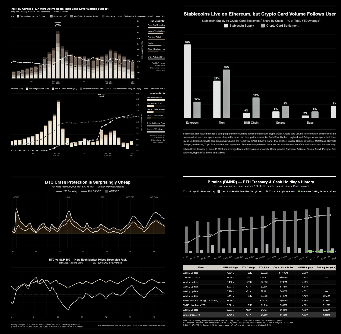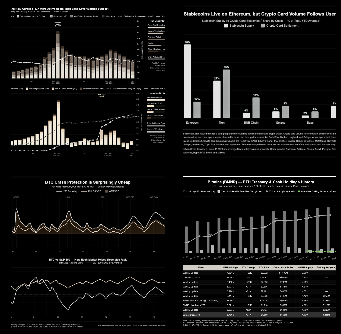


Robinhood Chain's transaction fees decreased by 97% while the number of transactions decreased by 32%
Across the Asia-Pacific region, September saw a flurry of regulations, deadlines, and tokenization releases, indicating the region's transition from a pilot phase to a regulatory framework.
9/21/20264 min read


Why are fees decreasing much faster than trading activity?
The mechanism lies in congestion pricing. Transaction fees on a blockchain are not fixed. When demand for block space exceeds supply, users bid against each other to be included in the block, and the price of a transaction spikes above the base level. When demand falls below supply, those auction fees disappear, and fees drop back to the floor.
This relationship is entirely non-linear. A network operating at its supply limit can see fees increase dramatically when demand rises slightly, and collapse rapidly when demand falls slightly. The cost per transaction on Robinhood Chain dropping from 64 cents to 2.6 cents, a reduction of approximately 25 times, when the number of transactions decreased by a third is a prime example.
The practical lesson is that revenue from fees measures the level of congestion on a chain, not its usage. A chain generating $8 million per day is not thirty times more useful than the same chain generating $230,000. It's simply overloaded.
That's crucial for understanding the previous headlines. On August 30th, apps running on the Robinhood Chain generated approximately $2.7 million in daily revenue, double that of Ethereum apps and second only to Solana. The rankings are built on single-day fee spikes reflecting periods of congestion, and these quickly reverse once the congestion subsides.
The volume of transactions since the launch of Memecoin has decreased.
The congestion stemmed from a specific source. Pons, the token launch platform, and GMGN, the Memecoin trading app, accounted for approximately $2 million of the app's total revenue of $2.7 million on August 30th, a day in which users launched 22,600 tokens within 24 hours.
Memecoin's launch activity was the kind of demand that created a surge in fees. Traders raced to buy the newly created tokens as soon as they were launched, and the order of participation determined who got in early, so participants were willing to pay any price to have their trades executed first.
That activity has slowed down. Pons recorded transaction volume of approximately $616 million from September 10 to 16, down 37% from the previous week, and its protocol revenue dropped from $10.7 million to $5.8 million. During the same period, Uniswap V3 on-chain transaction volume more than doubled.
The shift in composition explains the numbers. Regular trading on an automated market maker doesn't generate the same bidding priority as the Memecoin launch. This chain handles more traditional transactions and less of the initial transaction surge, and the fee structure changes accordingly.
It was not a migration to Solana.
One obvious explanation for the decrease in transaction fees is that high costs have driven memecoin traders back to Solana. However, the data does not support this.
deBridge processed approximately $8.2 million in transfers from Robinhood Chain to Solana between September 10th and 16th, with over $6 million moving in the opposite direction, totaling approximately $2 million inflows. The previous week was nearly perfectly balanced, with $13.4 million going out and $13.3 million coming in. In terms of transaction volume, the most recent week actually favored Robinhood Chain, with approximately 5,000 transactions from Solana compared to about 3,800 transactions in the opposite direction.
A net outflow of $2 million is negligible compared to a chain that processes approximately $1.5 billion worth of transactions daily and $12.8 billion in weekly decentralized exchange (DEX) trading volume. Furthermore, Solana's own DEX trading volume has decreased by 8% over the same period, which doesn't align with the hypothesis that traders are abandoning this exchange for another. The cooling down appears to be due to the overall market, not just one specific exchange.
Even traders themselves reject the cost explanation. Unipcs, the all-time leading profit earner on the FOMO trading platform that publicly tracks memecoin trading performance, told CoinDesk that the previously high gas fees didn't affect him or anyone he knew, adding that people don't care about fees as long as they can make money on the chain. Memecoin traders abandoned the launch frenzy because the opportunity had faded, not because of expensive transaction fees.
Significance for the Robin Hood Chain
The memecoin wave was never the official goal of Robinhood Chain. Robinhood built this network, launched on July 1st, as a payment infrastructure for tokenized stocks, and its development roadmap is focused on that business: 24/7 stock trading for international customers, with physical redemption and voting features announced on September 14th as upcoming additions.
For that use case, cheap block space is a requirement, not a problem. A tokenized stock product aimed at mainstream retail investors cannot function if a regular transaction has a network cost of 64 cents during periods of unrelated speculative activity on the same chain. Compared to the chain's actual strategic goal, the fee reduction to 2.6 cents per transaction is closer to the intended operational state than its peak in early September.
This drop in fees is negative for one particular argument: viewing Robinhood Chain's fee income as a meaningful revenue source in itself. The numbers from early September made the chain look like a significant revenue generator. That was the congestion caused by third-party memecoin issuing platforms, and it's over now.
The sustainability indicators look more stable. The number of transactions over the past seven days has decreased by about 6%, trading volume on the DEX has increased weekly, and the stablecoin supply of nearly $1 billion has increased significantly from around $640 million in mid-August. These suggest that a chain has retained users after a speculative surge, which is a more helpful signal about its prospects than fee lines at either extreme.
Disclaimer: The content in this article is for informational, research, data analysis, and reference purposes only regarding the cryptocurrency market. All opinions, assessments, forecasts, or opinions reflect the author's perspective at the time of publication and do not constitute investment advice, solicitations for buying or selling, trading recommendations, advertising, marketing, or promotion of any financial products, services, or cryptocurrencies. Mentions of projects, tokens, protocols, exchanges, wallets, or cryptocurrency service providers (CASPs) are for research, analysis, or informational purposes only and should not be construed as endorsements, recommendations, or guarantees in any way. HCCVenture does not broker, advertise, market, promote, or connect users in Vietnam with any cryptocurrency services from CASPs. HCCVenture does not accept asset custody, investment mandates, manage assets, or execute transactions on behalf of clients. All investment decisions are made entirely through the reader's own research (DYOR), evaluation, and responsibility; HCCVenture is not liable for any losses or damages arising from the use of or reliance on the information presented in this article.
Compiled and analyzed by HCCVenture
Join our information channels: https://link3.to/holdcoincventure
Explore HCCVenture group
HCCVENTURE QUANT JSCO
© 2026 HCCVENTURE. ALL COPYRIGHTS RESERVED.


Connect with us
Popular content
Contact to us
Address: 8th Floor, Bach Dang Complex Building, 50 Bach Dang Street, Hai Chau Ward, Da Nang City, Vietnam.
Phone: 1900 1509
Gmail : sp_contact@hccventure.com
Disclaimer: The information on this website is for informational purposes only and should not be considered investment advice. We are not responsible for any risks or losses arising from investment decisions based on the content here.
TERMS AND CONDITIONS • CUSTOMER PROTECTION POLICY
ANALYTICAL AND NEWS CONTENT IS COMPILED AND PROVIDED BY EXPERTS IN THE FIELD OF DIGITAL FINANCE AND BLOCKCHAIN BELONGING TO HCCVENTURE ORGANIZATION, INCLUDING OWNERSHIP OF THE CONTENT.
RESPONSIBLE FOR MANAGING ALL CONTENT AND ANALYSIS: HCCVENTURE FOUNDER - TRUONG MINH HUY
Read warnings about scams and phishing emails — REPORT A PROBLEM WITH OUR SITE.