

Real-World Assets exceeds 30 billion USD
The encryption of assets in the real world has quietly reached an important milestone, signaling a fundamental change in the way traditional financial instruments interact with blockchain technology.
5/12/20264 min read
The dominance of treasury bonds reflects the trend of seeking security
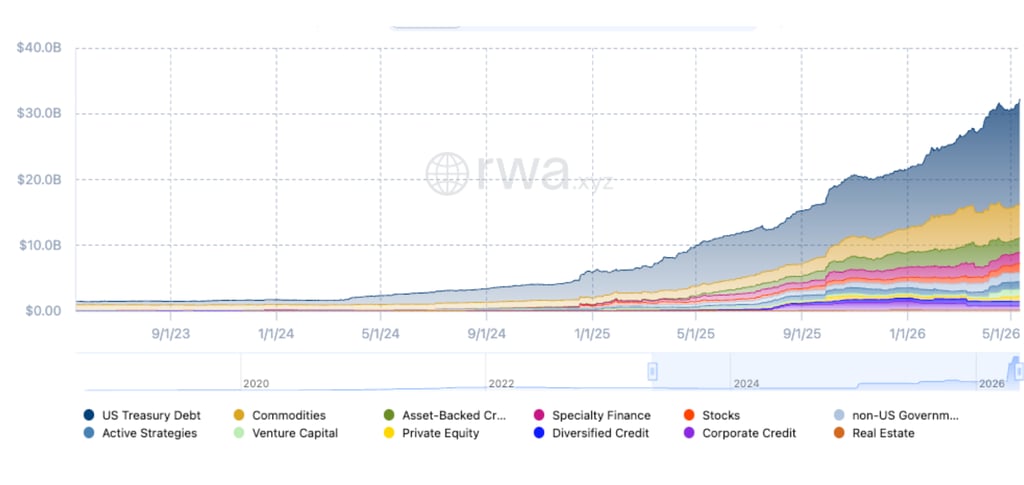
The component of the crypto-coded risk asset (RWA) market shows a fascinating story about the priorities of organizations. U.S. Treasury bonds, represented by the dark blue segment that dominates in market visualization images, account for about $15 billion in a total of nearly 50% of the entire cryptographic RWA ecosystem.
With the Federal Reserve maintaining interest rates in the range of 4-5% throughout 2024-2025, crypto-d treasury bond products have provided institutions with a way to earn significant returns while maintaining the security and liquidity advantages of blockchain payments. Platforms such as Ondo Finance, OpenEden and MatrixDock have taken advantage of this demand, creating encrypted treasury bond products that pay in real time and provide 24/7 access, a sharp contrast to traditional treasury bond markets that operate on a business day cycle.
Unlike many digital assets that are still in a legally unclear state, encrypted treasury bonds represent a relatively simple use case. The underlying asset is US government bond which is among the most tightly managed and transparent instruments in global finance. This has given institutional investors the peace of mind necessary to allocate significant capital.
DeFi protocols increasingly accept cryptographic treasury bonds as collateral, creating a bridge between traditional safe haven assets and decentralized finance. This development has unlocked new capital efficiency for organizations that want to participate in both markets simultaneously.
Beyond treasury bonds: A diversified picture
Despite the dominance of US treasury bonds, data shows that an ecosystem of crypto-asset assets is rapidly diversifying as Commodity represents the second largest category, with an estimated cryptographic value of $3-4 billion. This includes gold-secured tokens, crypto-a-coded oil futures contracts, and agricultural commodity derivatives. The ability to divide and trade goods 24/7 with instant payments has attracted the participation of both organizations and individual investors.
Private capital and credit segments have shown strong growth in recent quarters. Encrypted private credit includes corporate credit, asset-secured credit, and modern diversified credit strategies representing a total value of about 4-5 billion dollars. This development is very important: it shows that asset encryption is going beyond simple, highly liquid instruments, towards more complex, often illiquid assets.
Real estate encryption, although the absolute scale is smaller, has shown stable growth. Platforms that allow partial ownership of commercial assets and housing through encryption have helped previously inaccessible investments become more feasible for many investors.
Market dynamics and catalysts from organizations
The collapse of overspeculation in 2022 includes the failure of Terra/Luna, FTX and some major cryptocurrency lending companies, but further strengthens the argument for the use of risk asset tokenization (RWA). Investors and organizations look for blockchain use cases with tangible fundamental value and legal clarity.
Major financial institutions have shifted from skepticism about blockchain to active participation. BlackRock's digital liquidity fund for USD institutions (BUIDL), launched in 2024, has surpassed the $1 billion in assets and proved that the world's largest asset manager considers tokenization as a strategy rather than an experiment.
The prolonged high interest rate environment has made cash management and exposure to treasury bonds more attractive. Tokenized treasury bonds provide instant settlement and programming features have attracted significant capital flows from money market funds and corporate treasuries.
As DeFi protocols mature beyond speculatory token mining, the integration of real yields from treasury bonds, private credit and other RWAs has provided more sustainable economic models. Although the issuance of comprehensive regulations on cryptocurrencies is still in the process of completion, the way forward for tokenized RWA has become clearer. The SEC's approach to encrypted securities, although cautious, has provided enough guidance for large organizations to proceed.
Risks and Challenges ahead
Although some jurisdictions have given clear guidance, coordinating global regulations is still difficult. Cross-border token transfers face legal complexity, which can limit the ultimate scalability. Operational risks in managing cryptographic keys for institutional-level assets are still significant. Some of the famous depository failures in the cryptocurrency space in general have increased awareness of these risks. Although in theory, tokenization helps improve liquidity, many risky asset markets and the ability to quickly liquidate large positions have not been proven in stressful market conditions.
The programmable nature of tokenized assets creates code-based vulnerabilities. Although audit practices have improved, the risk of being exploited is still a concern for institutional investors. Many questions surrounding tokenized asset ownership, bankruptcy procedures and cross-border enforcement have not yet been verified in court. The first major legal challenges can significantly affect market confidence.
Evaluation and conclusion
Crossing the $30 billion threshold for tokenized RWA is not just a data milestone. It signals the beginning of a fundamental transformation in the way financial assets are expressed, transferred and managed. Unlike the speculative excesses that have characterized previous cryptocurrency cycles, the growth of crypto-risk assets is driven by real benefits in terms of efficiency, demand from institutions and legal maturity.
The dominance of the crypto of US treasury bonds, which accounts for nearly half of the market, shows that this is not a speculative bubble but a reasonable response to the advantages of blockchain payments over traditional instruments. As the market continues to diversify from treasury bonds to private credit, real estate, commodities and other assets, we are witnessing the early stages of what can become the standard infrastructure for the global capital market.
The question is no longer whether encryption will happen, but how quickly traditional financial institutions will adapt to a world where blockchain payment is the norm, not the exception. For investors, institutions and market observers, a 10-fold explosion in two-year growth shows that we are in the early stages of a much larger transformation - one that could reshape the global financial system worth more than $400 trillion in the next decade.
Disclaimer: The information presented in this article is the author's personal opinion in the field of cryptocurrencies. This is not financial or investment advice at all. Every investment decision should be based on careful consideration of your personal portfolio and risk tolerance. The opinion in the article does not represent the official position of the platform. We recommend that readers do their own research and consult experts before making any investment decisions.
Synthesized and analyzed by HCCVenture
Follow HCCVenture organization here: https://link3.to/holdcoincventure
Explore HCCVenture group
HCCVENTURE QUANT JSCO
© 2026 HCCVENTURE. ALL COPYRIGHTS RESERVED.


Connect with us
Popular content
Contact to us
Address: 8th Floor, Bach Dang Complex Building, 50 Bach Dang Street, Hai Chau Ward, Da Nang City, Vietnam.
Phone: 1900 1509
Gmail : sp_contact@hccventure.com
Disclaimer: The information on this website is for informational purposes only and should not be considered investment advice. We are not responsible for any risks or losses arising from investment decisions based on the content here.
TERMS AND CONDITIONS • CUSTOMER PROTECTION POLICY
ANALYTICAL AND NEWS CONTENT IS COMPILED AND PROVIDED BY EXPERTS IN THE FIELD OF DIGITAL FINANCE AND BLOCKCHAIN BELONGING TO HCCVENTURE ORGANIZATION, INCLUDING OWNERSHIP OF THE CONTENT.
RESPONSIBLE FOR MANAGING ALL CONTENT AND ANALYSIS: HCCVENTURE FOUNDER - TRUONG MINH HUY
Read warnings about scams and phishing emails — REPORT A PROBLEM WITH OUR SITE.