

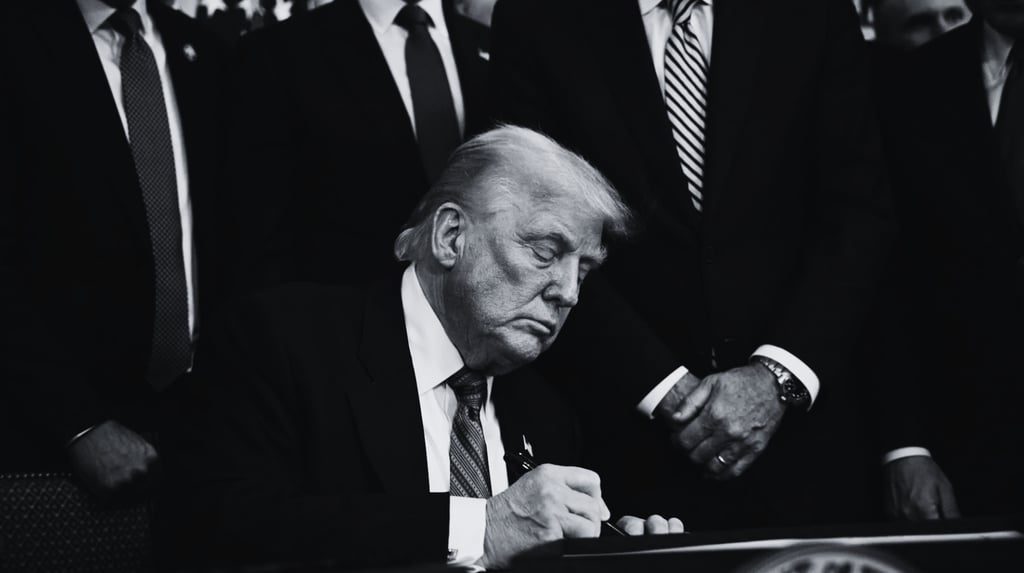
President Trump meets with senators to break the deadlock on the CLARITY Act
President Donald Trump met with a group of U.S. senators at the White House Thursday afternoon to try to resolve the ethics provision that has become a major obstacle preventing the Digital Asset Market Transparency Act from taking effect.
7/16/20264 min read
Why was this bill blocked at the 60-vote mark?
The CLARITY Act was passed by the Senate Banking Committee by a 15-9 vote, with bipartisan support, in May 2026, after Democratic Senators Ruben Gallego and Angela Alsobrooks, along with Republican Senators, brought the bill out of the committee. Both senators subsequently stated that their committee votes did not guarantee Senate support without an agreement on ethics and other changes. Because Republicans hold approximately 53 seats in the Senate, passing the bill before it is blocked requires at least seven votes from Democratic or independent Senators. With Gallego and Alsobrooks as the only confirmed supporters from the committee, the bill needs five more votes from Democratic Senators to reach the 60-vote threshold, and those votes are almost entirely dependent on how the ethics provision is resolved.
Democratic senators have called for a provision that would include the president, vice president, members of Congress, senior executive officials, and in some versions, their immediate family members, restricting their ability to hold personal business interests in the cryptocurrency sector while in office. Senator Kirsten Gillibrand of New York stated that she and other Democrats are pushing to make it illegal for the president to issue or finance any digital asset. Senator Chris Van Hollen proposed restrictions on officials and their families owning, promoting, or being affiliated with issuers or platforms of digital assets, along with disclosure requirements. An amendment that Van Hollen proposed during the committee's discussion to ban the president, vice president, and members of Congress from doing business with cryptocurrencies failed by an 11-13 vote, indicating that the current bill text lacks the ethical language that Democrats are seeking.
Trump's public disclosure of income from crypto.
Trump's annual financial disclosures, filed the same week the debate over the CLARITY Act intensified, showed he earned more than $1.4 billion from cryptocurrency in 2025, including $635 million in royalties from his cryptocurrency and approximately $515 million from the sale of World Liberty Financial tokens. This disclosure provided further justification for the central political argument of Democratic critics. Senator Chris Murphy stated at a July 14 press conference that "there is no reason to pass a new regulatory system for cryptocurrency if it does not stop Trump's corruption," directly linking the ethics provision to Trump's specific financial interests rather than considering it a principle of general conflict of interest.
Murphy, Van Hollen, and Jeff Merkley held a joint press conference calling for opposition to the CLARITY Act if it doesn't sever Trump's ties to cryptocurrency, while Gillibrand noted that Trump's biggest source of income in 2025 would come from the issuance of a cryptocurrency bearing his name. The political dynamics these revelations create explain why the ethics negotiations are "stalled," according to those informed of the talks, even as almost every other crucial provision of the bill has been resolved through months of Senate negotiations. The issue of restricting the sitting president's private business interests, at a time when public records show those interests generated more than $1 billion in just one year, is not a technical drafting issue that can be resolved through ordinary legislative compromise, but rather a political confrontation over whether the law truly restricts the official who should be most restricted from the Democratic perspective.
Four Other Unresolved Issues
The ethics clause is the most politically significant but not the only obstacle. Four separate lines of negotiation remain open as the August 7 deadline approaches, each needing to be fully addressed before a Senate vote can proceed with confidence in securing 60 votes.
Democratic members of the Senate Agriculture Committee have expressed concerns about the regulatory framework for commodities, including whether the Commodity Futures Trading Commission (CFTC) will function with its full five members, including the two currently vacant Democratic nominees. One cryptocurrency industry insider suggested that Democratic members of the Agriculture Committee might be satisfied if the bill guaranteed the CFTC would have five members, a concrete structural concession a majority could provide without compromising on substantive policy.
Law enforcement concerns about the decentralized finance developer protection provision, commonly known as Section 604 and formerly the DeFi section, reflect ongoing opposition from numerous law enforcement organizations and anti-trafficking groups, who argue that this developer protection provision could create loopholes in criminal investigation and prosecution. Senator Catherine Cortez Masto of Nevada led the Senate Agriculture Committee's negotiations on the DeFi section, and addressing her concerns was entirely separate from the broader ethics negotiations.
Assessment and Conclusion
Traders on the Kalshi exchange raised the probability of a Senate vote before the August recess to 79%, up from 68.8% a day before Thursday's meeting was confirmed, reflecting the market's assessment that Trump's direct involvement in the negotiations increases the likelihood of a breakthrough in the short term. Confidence in passage to law remains rather cautious, with the Kalshi market giving a 36% probability that the CLARITY Act will become law in 2026 and a 62% chance of being enacted before the end of 2027. Traders on the Polymarket exchange put the probability of signing into law in 2026 at around 39%, a significant drop from the 50-50 assessment Galaxy Research published earlier this month as time continues to tick away.
A final session after November is seen by some lawmakers as a contingency plan should the bill not pass before the August recess. That period also carries its own uncertainties: the midterm election results would reshape the Senate's dynamics, the unresolved CLARITY Act would become part of the midterm political landscape rather than a legislative achievement any party could claim to voters, and the packed schedule of the final term with other legislative priorities makes passage more difficult than the current pre-recess period. Summer Mersinger, CEO of the Blockchain Association, summed up the industry's view: "CLARITY is no longer a question of whether Congress passes it, but when." The question that Thursday's White House meeting will help answer is whether "when" means in the coming weeks or in 2027.
Disclaimer: The information presented in this article is the author's personal opinion in the field of cryptocurrencies. This is not financial or investment advice at all. Every investment decision should be based on careful consideration of your personal portfolio and risk tolerance. The opinion in the article does not represent the official position of the platform. We recommend that readers do their own research and consult experts before making any investment decisions.
Synthesized and analyzed by HCCVenture
Follow HCCVenture organization here: https://link3.to/holdcoincventure
Explore HCCVenture group
HCCVENTURE QUANT JSCO
© 2026 HCCVENTURE. ALL COPYRIGHTS RESERVED.


Connect with us
Popular content
Contact to us
Address: 8th Floor, Bach Dang Complex Building, 50 Bach Dang Street, Hai Chau Ward, Da Nang City, Vietnam.
Phone: 1900 1509
Gmail : sp_contact@hccventure.com
Disclaimer: The information on this website is for informational purposes only and should not be considered investment advice. We are not responsible for any risks or losses arising from investment decisions based on the content here.
TERMS AND CONDITIONS • CUSTOMER PROTECTION POLICY
ANALYTICAL AND NEWS CONTENT IS COMPILED AND PROVIDED BY EXPERTS IN THE FIELD OF DIGITAL FINANCE AND BLOCKCHAIN BELONGING TO HCCVENTURE ORGANIZATION, INCLUDING OWNERSHIP OF THE CONTENT.
RESPONSIBLE FOR MANAGING ALL CONTENT AND ANALYSIS: HCCVENTURE FOUNDER - TRUONG MINH HUY
Read warnings about scams and phishing emails — REPORT A PROBLEM WITH OUR SITE.