

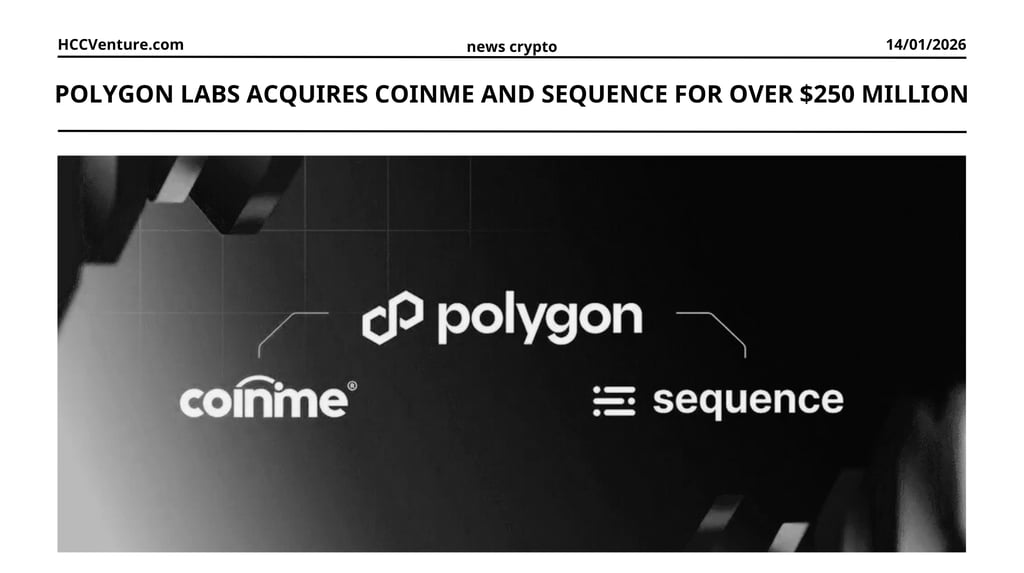
Polygon Labs acquires Coinme and Sequence for over $250 million
The total value of these transactions exceeds $250 million, making Polygon a fully regulated payment entity in the United States. These acquisitions provide immediate access to money transfer licenses in 48 states.
1/14/20262 min read
Latest announcement from Luxembourg
The approval, confirmed on January 13, 2026, allows Ripple to issue cryptocurrency, provide payment services, and operate as a fully regulated entity under the European Union's Cryptocurrency Directive (EMD2). Luxembourg is one of the most cryptocurrency and fintech-friendly jurisdictions in the EU, serving as a strategic gateway for cross-European operations. This license allows Ripple to:
Ripple USD (RLUSD) stablecoin will be launched directly on the European market (awaiting any further announcements).
Providing gateways for converting fiat currency to cryptocurrency and payment processing services.
Providing cross-border money transfer transactions managed by RippleNet and On-Demand Liquidity (ODL).
Serving banks, payment service providers (PSPs), and fintech companies under full EU licensing authority.
Ripple's Luxembourg subsidiary, Ripple Luxembourg S.à rl, will serve as the central hub for its European operations, allowing the company to expand its services across the EEA (European Economic Area) without requiring separate licenses in each member state.
In accordance with the European legal framework
Europe is emerging as one of the most structured and predictable regions for cryptocurrency regulation. The MiCA Act creates clear rules for stablecoins, custody services, and service providers—prioritizing companies that proactively seek licensing.
Readiness for MiCA (Miscode Asset Market Regulation) — Ripple has been actively preparing for MiCA compliance since 2024.
The launch of the stablecoin — Ripple USD (RLUSD) — has received initial approval in New York (via a NYDFS trust license) and is now being prepared for deployment in Europe.
Collaborative impetus — Recent integrations with major European banks and PSPs have fueled demand for regulated ODL corridors.
Ripple's EMI approval demonstrates alignment with this direction. Instead of waiting for enforcement pressure, the company is integrating itself into the legal system, reducing uncertainty for its business and institutional partners.
Our perspective
The Luxembourg EMI license is a crucial step in Ripple's years-long effort to become a fully regulated global payment service provider. By integrating RippleNet/ODL with a regulated fiat currency system, issuing stablecoins, and operating across the EEA, Ripple is building a strong bridge between traditional finance and blockchain payments in Europe.
This approval—combined with the momentum of RLUSD and the clarity of MiCA—positions Ripple favorably in the rapidly evolving European payments landscape. As organizations increasingly seek faster, cheaper, and more transparent cross-border solutions, Ripple's managed infrastructure could capture significant market share by 2026 and beyond.
Watch out for upcoming RLUSD launches in Europe, new banking partnerships, and ODL volume growth in the region — these will be key indicators of how effectively Ripple is leveraging this regulatory milestone.
Disclaimer: The information presented in this article is the author's personal opinion in the field of cryptocurrency. This is not financial or investment advice. All investment decisions should be based on careful consideration of your personal portfolio and risk tolerance. The views expressed in this article do not represent the official stance of the platform. We recommend that readers conduct their own research and consult with experts before making any investment decisions.
Compiled and analyzed by HCCVenture
Follow HCCVenture here: https://link3.to/holdcoincventure
Explore HCCVenture group
HCCVENTURE QUANT JSCO
© 2026 HCCVENTURE. ALL COPYRIGHTS RESERVED.


Connect with us
Popular content
Contact to us
Address: 8th Floor, Bach Dang Complex Building, 50 Bach Dang Street, Hai Chau Ward, Da Nang City, Vietnam.
Phone: 1900 1509
Gmail : sp_contact@hccventure.com
Disclaimer: The information on this website is for informational purposes only and should not be considered investment advice. We are not responsible for any risks or losses arising from investment decisions based on the content here.
TERMS AND CONDITIONS • CUSTOMER PROTECTION POLICY
ANALYTICAL AND NEWS CONTENT IS COMPILED AND PROVIDED BY EXPERTS IN THE FIELD OF DIGITAL FINANCE AND BLOCKCHAIN BELONGING TO HCCVENTURE ORGANIZATION, INCLUDING OWNERSHIP OF THE CONTENT.
RESPONSIBLE FOR MANAGING ALL CONTENT AND ANALYSIS: HCCVENTURE FOUNDER - TRUONG MINH HUY
Read warnings about scams and phishing emails — REPORT A PROBLEM WITH OUR SITE.