

Polish president rejects MiCA bill - legal tensions
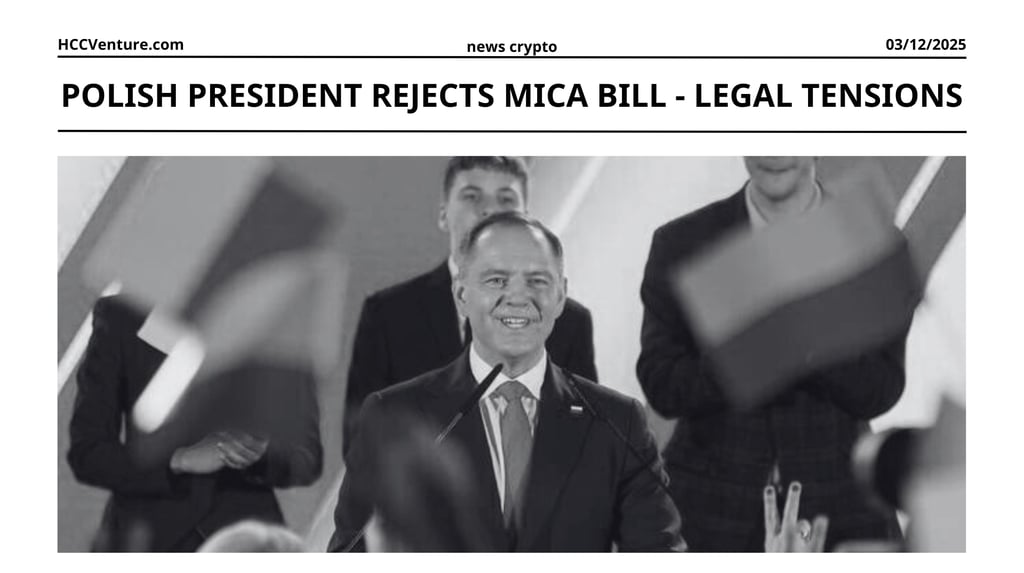
Polish President Karol Nawrocki has vetoed the Markets in Cryptoassets Act—a comprehensive bill designed to transform the European Union’s Markets in Cryptoassets (MiCA) regulation.
12/3/20252 min read
Decision from Poland
Europe’s landmark crypto framework — the Markets in Crypto Assets (MiCA) regulation — has hit an unexpected political snag after the Polish president vetoed the national compliance bill needed to implement MiCA domestically.
The veto creates a temporary regulatory vacuum in one of Eastern Europe's largest economies and causes uncertainty just months before the EU expects MiCA's rules on stablecoins, exchanges and service providers to be fully implemented across the bloc.
While MiCA is EU law, each member state must pass unified national legislation to establish licensing processes, enforcement powers, tax regimes, and supervisory coordination. Poland’s rejection marks the first major national-level opposition to the implementation process — and raises questions about political motivations, industry impact, and the timetable for regulatory harmonization across the continent.
Reasons for the President's Veto of the Bill
While the official reason given revolved around “legal inadequacies and insufficient consumer protection”, analysts noted that the veto was rooted more deeply in Poland's internal political tensions.
Key factors that may influence this decision include:
(1) Political Power Dispute
The Polish government currently faces a competitive political landscape, with the president and parliament frequently at odds over economic and technological policy. The MiCA veto gives the president leverage over parliamentary agendas and delays policies seen as beneficial to rival political factions.
(2) Concerns about Burden on Local Businesses
Critics within the government say the bill could impose high compliance costs on domestic exchanges, fintechs and payments companies – potentially consolidating the market in favor of larger EU companies and pushing innovation outside Poland.
(3) Report on Sovereignty Regulation
Some policymakers have expressed frustration with what they see as excessive EU oversight, particularly in financial services. The veto allows the president to position himself as a guardian of national autonomy in a highly technical and little-known policy area.
Stress Test for MiCA
The promise of MiCA is regulatory harmonization across the 27 EU member states. However, Poland’s veto exposes a structural risk:
EU law may mandate standards, but national governments still have to work together to enforce them.
Other countries with political divisions or concerns about losing competitiveness in the fintech sector could follow Poland's example, creating a patchwork rather than unified regulatory environment.
Furthermore, Poland's delay in compliance complicates EU-wide enforcement of:
Regulations on stablecoin reserves (June 2024–2025 period).
CASP licensing (implementation 2025).
Coordinate cross-border surveillance.
The case could force Brussels to consider stronger central supervisory mechanisms or intervention powers for ESMA and EBA in future amendments to MiCA.
Disclaimer: The information presented in this article is the author's personal opinion in the cryptocurrency field. It is not intended to be financial or investment advice. Any investment decision should be based on careful consideration of your personal portfolio and risk tolerance. The views expressed in this article do not represent the official position of the platform. We recommend that readers conduct their own research and consult with a professional before making any investment decisions.
Explore HCCVenture group
HCCVENTURE QUANT JSCO
© 2026 HCCVENTURE. ALL COPYRIGHTS RESERVED.


Connect with us
Popular content
Contact to us
Address: 8th Floor, Bach Dang Complex Building, 50 Bach Dang Street, Hai Chau Ward, Da Nang City, Vietnam.
Phone: 1900 1509
Gmail : sp_contact@hccventure.com
Disclaimer: The information on this website is for informational purposes only and should not be considered investment advice. We are not responsible for any risks or losses arising from investment decisions based on the content here.
TERMS AND CONDITIONS • CUSTOMER PROTECTION POLICY
ANALYTICAL AND NEWS CONTENT IS COMPILED AND PROVIDED BY EXPERTS IN THE FIELD OF DIGITAL FINANCE AND BLOCKCHAIN BELONGING TO HCCVENTURE ORGANIZATION, INCLUDING OWNERSHIP OF THE CONTENT.
RESPONSIBLE FOR MANAGING ALL CONTENT AND ANALYSIS: HCCVENTURE FOUNDER - TRUONG MINH HUY
Read warnings about scams and phishing emails — REPORT A PROBLEM WITH OUR SITE.