


Pineapple Financial is transferring $100 billion in mortgages to the Injective
Pineapple Financial Inc. has launched an ambitious blockchain-based mortgage crypto platform, Injective, with over $100 billion in mortgages transferred to the Injective network.
12/13/20252 min read
Real asset enforcement
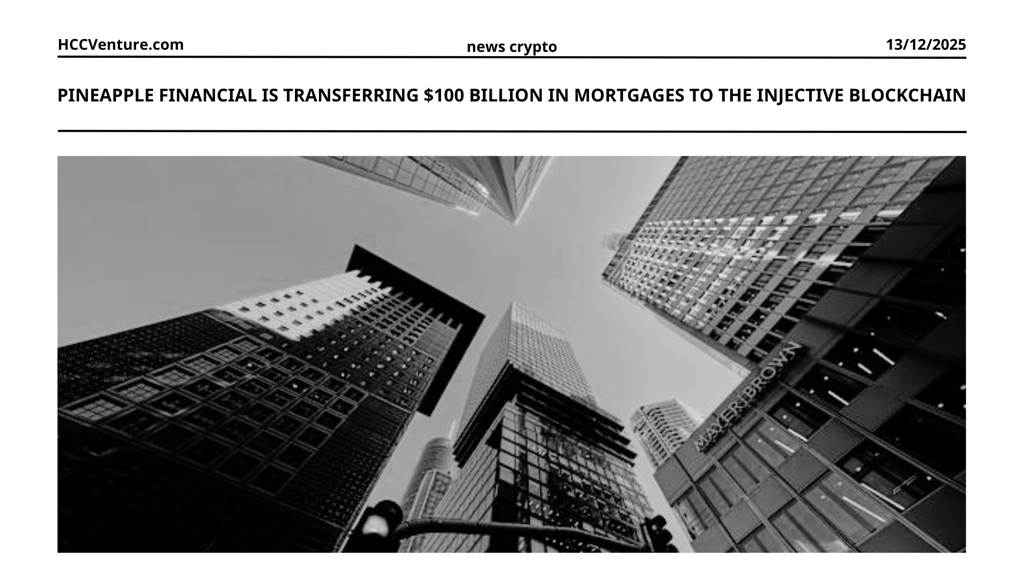
Pineapple Financial has announced plans to convert 29,000 mortgages with a total notional value of approximately $100 billion to the Injective blockchain, marking one of the largest real asset tokenization (RWA) initiatives ever announced. This move signals a decisive step toward integrating traditional mortgage finance with blockchain-based infrastructure and positions Injective as a strong contender for on-chain capital market adoption for institutions.
As cryptography moves from the experimental to the implementation phase, Pineapple's decision underscores how blockchain platforms are increasingly seen not just as speculative tools, but as core financial infrastructure capable of handling complex, tightly regulated assets at scale.
Why is the mortgage market shifting to blockchain?
The mortgage market is one of the most expensive segments to operate in traditional finance. It relies on distributed databases, slow payment cycles, manual reconciliation, and costly intermediaries.
By moving mortgage records and related processes onto the blockchain, Pineapple aims to achieve:
Real-time data integrity for loan records and service updates.
Enhancing transparency for auditors, regulators, and investors.
Automate cash flow, including payments, deposits, and service logic.
Reduce operating costs by decreasing reliance on intermediaries.
In essence, blockchain becomes a formal record-keeping system rather than a parallel experiment. Pineapple Financial's initiative reflects a broader industry awareness that blockchain technology can significantly improve these inefficiencies.
Injective was selected as the payment class.
Injective is increasingly establishing itself as an institutional-grade blockchain optimized for financial applications, especially those requiring high throughput, low latency, and deterministic execution.
Injective's architecture supports custom financial logic through smart contracts designed for capital markets, enabling programmable payments, compliance checks, and reporting.
Furthermore, its performance characteristics allow for real-time updates and scalable transaction processing, which is crucial when managing tens of thousands of active collateral positions.
Injective's increasing focus on RWA infrastructure—including integration with traditional financial systems—aligns with Pineapple's need for a blockchain that can coexist with existing legal and regulatory frameworks.
Risk factors
Compliance with regulations remains paramount. Collateral is tightly controlled, and blockchain information must conform to legal ownership, data privacy laws, and jurisdictional requirements.
Operationally, integrating traditional mortgage systems with blockchain infrastructure is complex and requires seamless implementation to avoid service disruptions.
There is also a reputational risk: any technical issue could slow down the adoption process across the industry.
Disclaimer: The information presented in this article is the author's personal opinion in the field of cryptocurrency. This is not financial or investment advice. All investment decisions should be based on careful consideration of your personal portfolio and risk tolerance. The views expressed in this article do not represent the official stance of the platform. We recommend that readers conduct their own research and consult with experts before making any investment decisions.
Compiled and analyzed by HCCVenture
Follow HCCVenture here: https://link3.to/holdcoincventure
Explore HCCVenture group
HCCVENTURE QUANT JSCO
© 2026 HCCVENTURE. ALL COPYRIGHTS RESERVED.


Connect with us
Popular content
Contact to us
Address: 8th Floor, Bach Dang Complex Building, 50 Bach Dang Street, Hai Chau Ward, Da Nang City, Vietnam.
Phone: 1900 1509
Gmail : sp_contact@hccventure.com
Disclaimer: The information on this website is for informational purposes only and should not be considered investment advice. We are not responsible for any risks or losses arising from investment decisions based on the content here.
TERMS AND CONDITIONS • CUSTOMER PROTECTION POLICY
ANALYTICAL AND NEWS CONTENT IS COMPILED AND PROVIDED BY EXPERTS IN THE FIELD OF DIGITAL FINANCE AND BLOCKCHAIN BELONGING TO HCCVENTURE ORGANIZATION, INCLUDING OWNERSHIP OF THE CONTENT.
RESPONSIBLE FOR MANAGING ALL CONTENT AND ANALYSIS: HCCVENTURE FOUNDER - TRUONG MINH HUY
Read warnings about scams and phishing emails — REPORT A PROBLEM WITH OUR SITE.