

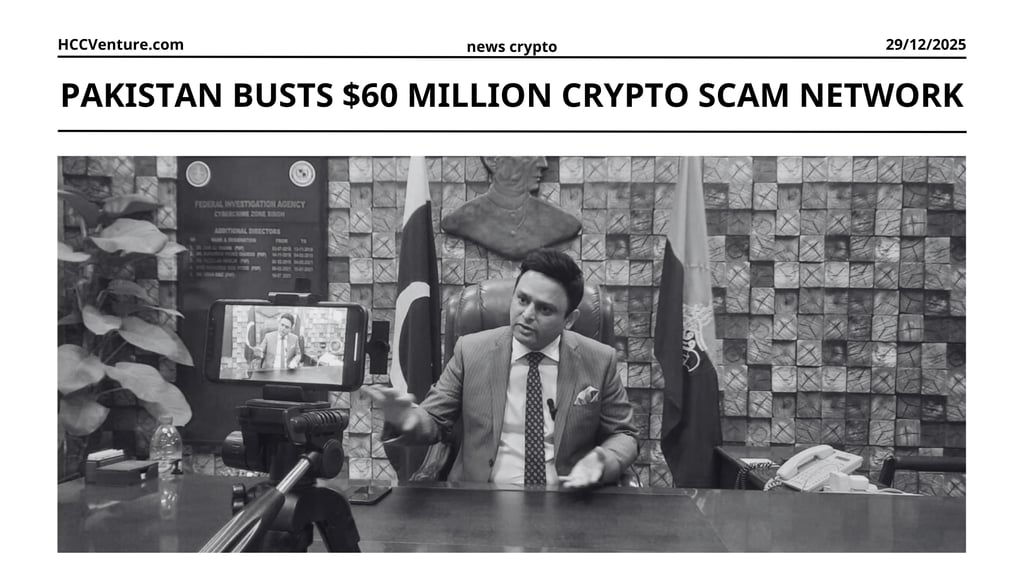
Pakistan dismantles cryptocurrency scam network worth $60 million
Pakistani authorities have dismantled a sophisticated international cyber fraud network, allegedly defrauding victims of approximately $60 million through fake cryptocurrency and forex investment platforms.
12/29/20252 min read
Fraud analysis
According to investigators, this scam was carried out as a multi-tiered, closely coordinated fraud scheme targeting both domestic and international victims. The network is believed to have used a combination of fake investment platforms, social media advertising, and impersonation tactics to lure users with promises of high, guaranteed returns related to cryptocurrency trading and mining.
The funds obtained from victims were quickly converted into cryptocurrency, distributed across multiple wallets, and transferred through exchanges and peer-to-peer channels to conceal their origin. This structure allowed the group to operate on a large scale while minimizing the likelihood of detection—at least initially.
Authorities describe the operation as highly organized, involving multiple parties handling recruitment, collection of funds, money laundering, and technical infrastructure.
Tracing the source of the money
Although the fraudsters attempted to conceal their activities, law enforcement leveraged a combination of blockchain transaction analysis, financial intelligence from banks and payment service providers, seized digital devices and records, and collaboration with international partners.
The transparency of blockchain ultimately worked against the criminals. After the wallet clusters were identified and linked to real identities, investigators were able to map the transaction flow and uncover the full scale of the operation.
This case illustrates how cryptocurrencies are impersonable, not anonymous, and how large-scale fraud leaves a lasting trail on the blockchain.
Strong law enforcement
The $60 million seizure sends a strong signal that Pakistani authorities no longer view cryptocurrency scams as low-priority cybercrimes. Instead, digital asset fraud is increasingly seen as a systemic financial crime requiring dedicated resources and technical expertise.
This incident could spur calls for clearer cryptocurrency regulations, closer oversight of exchanges and deposit gateways, enhanced anti-money laundering (AML) enforcement, and public education campaigns about cryptocurrency-related fraud.
For legitimate cryptocurrency businesses, stronger enforcement could ultimately improve trust — but only if accompanied by legal clarity.
Assessment and Conclusion
The crackdown on a $60 million cryptocurrency fraud ring in Pakistan is not just a single victory for law enforcement—it's a clear signal that the country is making decisive strides from ambiguous legal status to structured oversight. While the arrests target the bad guys, the parallel progress toward PVARA adoption and global exchange integration reveals a broader vision: transforming one of the world's most dynamic retail cryptocurrency markets into a law-abiding and innovation-friendly jurisdiction.
As the market cleanup process in Pakistan continues and businesses are licensed to participate, the contrast between regulated opportunities and unregulated risks has rarely been more pronounced.
Disclaimer: The information presented in this article is the author's personal opinion in the field of cryptocurrency. This is not financial or investment advice. All investment decisions should be based on careful consideration of your personal portfolio and risk tolerance. The views expressed in this article do not represent the official stance of the platform. We recommend that readers conduct their own research and consult with experts before making any investment decisions.
Compiled and analyzed by HCCVenture
Follow HCCVenture here: https://link3.to/holdcoincventure
Explore HCCVenture group
HCCVENTURE QUANT JSCO
© 2026 HCCVENTURE. ALL COPYRIGHTS RESERVED.


Connect with us
Popular content
Contact to us
Address: 8th Floor, Bach Dang Complex Building, 50 Bach Dang Street, Hai Chau Ward, Da Nang City, Vietnam.
Phone: 1900 1509
Gmail : sp_contact@hccventure.com
Disclaimer: The information on this website is for informational purposes only and should not be considered investment advice. We are not responsible for any risks or losses arising from investment decisions based on the content here.
TERMS AND CONDITIONS • CUSTOMER PROTECTION POLICY
ANALYTICAL AND NEWS CONTENT IS COMPILED AND PROVIDED BY EXPERTS IN THE FIELD OF DIGITAL FINANCE AND BLOCKCHAIN BELONGING TO HCCVENTURE ORGANIZATION, INCLUDING OWNERSHIP OF THE CONTENT.
RESPONSIBLE FOR MANAGING ALL CONTENT AND ANALYSIS: HCCVENTURE FOUNDER - TRUONG MINH HUY
Read warnings about scams and phishing emails — REPORT A PROBLEM WITH OUR SITE.