

On-chain analysis week 48/2025: Bittensor and the first Halving
Bittensor is entering a period of strong transformation as the network rapidly expands in scale, on-chain activity grows steadily, and stake allocation becomes increasingly efficient across key subnets.
11/30/202512 min read
Bittensor Summary
Bittensor is a decentralized AI network: computers ( nodes ) in the network learn machines and contribute “intelligence” to the system, then get rewarded with TAO . The current reward mechanism ( block reward ) is about 1 TAO per block ( at least before the halving ), equivalent to b being released every day.
The first TAO halving is expected to occur around December 10–13, 2025 (multiple sources estimate). When the halving occurs, daily issuance will decrease from ~7,200 TAO to ~ 3,600 TAO — a 50% reduction . Bittensor's halving is different from many other blockchains in that it is not based on a fixed block-count but on the total amount of TAO issued ( when it reaches ~10.5 million TAO ).
Staking data on the Alpha subnet shows strong growth, going from around 100,000 TAO to over 1.9 million TAO in just 8 months, reflecting the long-term confidence of validators and subnet owners in Alpha 's central role . This staking flow also supports a significant reduction in the amount of TAO in free circulation, contributing to the formation of a scarce supply structure before the halving .
The stake in the Root subnet has been adjusted down from 6.1 million to around 5.7 million TAO , indicating an internal reallocation to more specialized subnets. However, the Root stake level remains high, exceeding 5.5 million TAO , confirming the fundamental stability of the Bittensor network and showing no signs of abandonment.
Regarding extrinsics, the number of successful transactions increased sharply over time and reached more than 1 million extrinsics/week , while the number of failed transactions decreased significantly compared to the beginning of the year. The success rate increased from 30% to more than 80% , proving that the network processing performance has been significantly upgraded and Bittensor has the capacity to handle increasingly large workloads.
Analyzing on-chain metrics
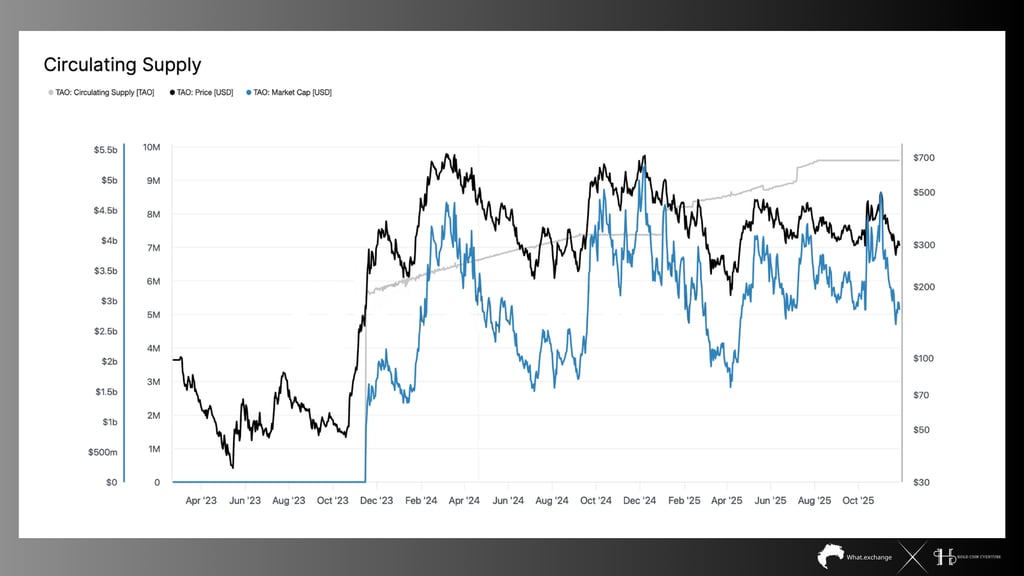
The maximum supply of TAO tokens is 21 million tokens , which is similar to the total supply of Bitcoin. As of late November 2025 — early December 2025, the circulating supply is recorded at around 10.39–10.40 million TAO — which is ~49.5% of the total supply.
The issuance system currently generates around 7,200 TAO per day (1 TAO per block ~12 seconds).
The first halving event is coming when the issued supply exceeds 10.5 million TAO , expected around mid-December 2025 (common sources say 10–13 Dec 2025, or 11–13 Dec 2025). After the halving, the issuance will be halved: from 7,200 TAO/day to 3,600 TAO/day .
Typically, before a halving, supply is released continuously. At one point, around mid-2025, only about 8.8 million TAO were released (~42% of total supply). Thus, from mid-2025 to late 2025, the network released an additional ~1.5–1.6 million TAO — reflecting a steady release of about 7,200 TAO per day.
Pre-Halving tokenomics structure is always sustainable regardless of price fluctuations:
Each block (~12 seconds) creates 1 TAO, which is about 7,200 TAO/day .
When the total issuance reaches 10.5 million TAO , the system will automatically reduce the block reward from 1 TAO → 0.5 TAO (ie the issuance will decrease by 50%).
After the halving, the estimated daily issuance is only 3,600 TAO .
This structure is similar to how Bitcoin operates its halving — that is, switching the network to a “ gradual deflationary ” mode to counteract token inflation, increasing scarcity over time. For TAO, because the maximum supply is predetermined and the halving is supply-based, tokenomics becomes predictable and transparent .
A key point of TAO is its high staking/relock ratio , meaning that the majority of circulating tokens are not in liquid form, but are staked/delegated/locked to support the network. Analysis from mid-2025 indicates that ~72% of the circulating supply is staked, which reduces the amount of freely tradable tokens — thus increasing the actual scarcity of tokens on the market.
When the halving occurs, the amount of new tokens released into the market is reduced by half. With high stakes, this event can lead to a reduction in selling pressure – free float becomes even more limited — which can create upward pressure on prices if demand for holding or participating in staking/validation/subnet remains stable or increases.
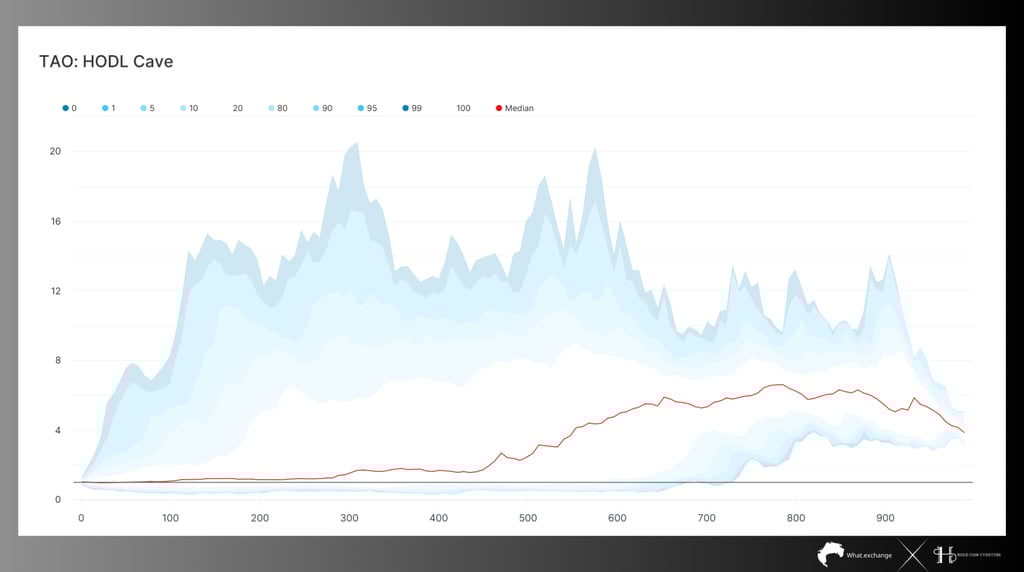
The HODL Cave Index measures the distribution of TAO holding times across percentiles (0 → 100) , helping to assess the behavioral structure of all holders in the network. This index is systematic because it reflects the stability of the supply, the reliability of the holder base, and the trend of TAO allocation before major changes in the network , including the upcoming halving event.
Early stage (0–250): HODL distribution zone expands rapidly, many long-term holders are formed. Median low oscillation ~1–1.5.
Middle Phase (250–650): The upper percentiles (80–100) peak, with the HODL zone extending above 20 time units , indicating a long and stable accumulation phase. Median increases to ~3–4.
Late Phase (650–950): HODL structure narrows but remains stable. Median peaks at ~5.2 before correcting slightly to ~4.0.
Median HODL increased sharply over time from ~1 to ~5.2 , equivalent to an increase of more than 400% , indicating that the network's Holder base is becoming more long-term, the amount of TAO moving in the short term has decreased significantly, and the sustainability of trust is increasing with the mainstream investment trend in the long term.
The steady increase in the median shows that the endogenous confidence of network participants is sustainable, consistent with the trend of expanding the subnet, increasing stakes in Alpha and preparing for the halving.
The 80–100 percentile zone expanded from ~12 to over 20 time units , establishing the highest peak of the entire cycle. The amount of old TAO coins barely moved. This period recorded the strongest accumulation rate in Bittensor network history. This period coincided with the subnet explosion , attracting large stakes.
After the large peak, the percentile bands gradually shrink. Part of the supply is reallocated to run subnets or staked in better yielding positions (e.g. Alpha subnet). Holders do not exit, but only transfer internally within the system . Median is still 3–5 times higher than the entire first phase.
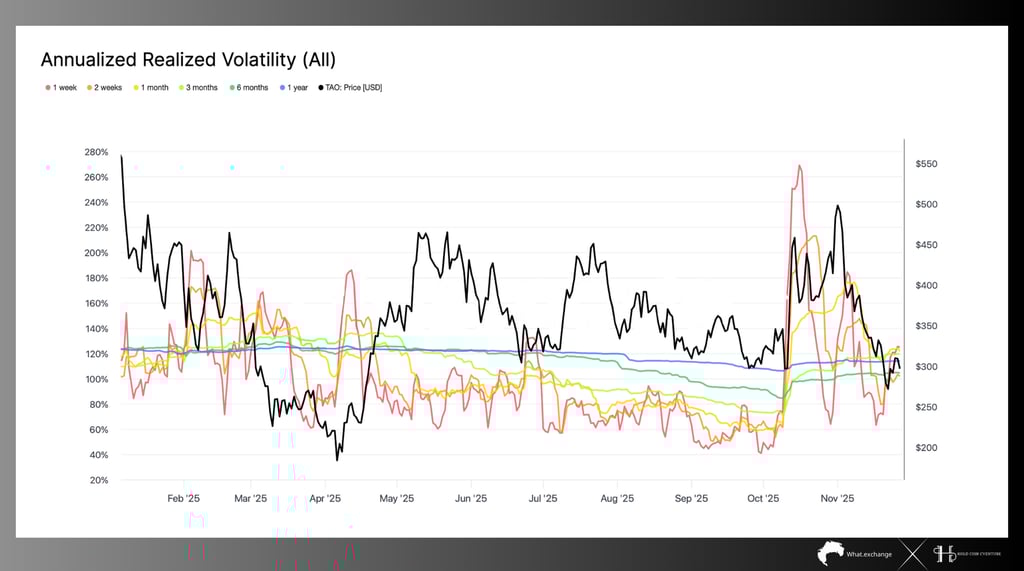
TAO's realized volatility data over the past 12 months shows a trend of relative stabilization of long-term volatility horizons, while short-term volatility contracted sharply towards the end of 2025.
TAO is moving into a “matured volatility regime”, in line with the context of deflation (halving) and high staking ratio is reducing liquidity supply, thereby strengthening the quantitative foundation for a medium-long term bullish trend.
1W ARV is sometimes higher than 260% ,
1M ARV ranges from 130–150% ,
3M ARV about 120–140% .
Actual volatility is very high, market liquidity is still thin, Free-float is low (staking has been high since the beginning of the year) . Capital flows into and out of TAO are mainly cyclical and react strongly to price. Most of the initial supply has been staked, so liquidity is not abundant, which can cause strong price changes.
Volatility is decreasing gradually but not completely. At this point, TAO price went from ~$350 → ~$250 then bounced back to ~$400 , creating a large amplitude oscillation level but not creating a volatility spike like the beginning of the year.
Increasing circulating supply as the halving progresses (approaching 10.5M). Gradual market maturity (more liquidity, more active subnets). Market structure enters “ semi-stabilization regime ”. TAO is entering a medium/long-term volatility stabilization phase , despite short-term price fluctuations.
The system is absorbing volatility with its low supply and low free float, causing prices to fall without disrupting the long-term volatility structure. In other words, prices are volatile but the market is no longer “ panic-stricken ” like it was at the beginning of the year — a sign of a mature market. Halving will increase long-term price stability, without increasing risk, and create conditions for prices to react upward in a narrowing volatility environment.
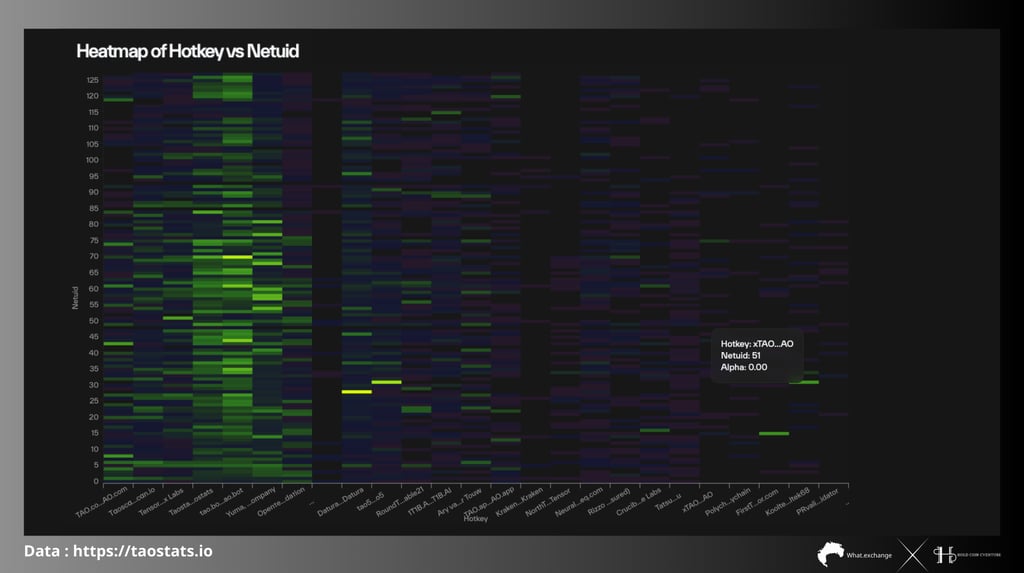
Bittensor’s Hotkey–Netuid Heatmap shows a functionally centralized distribution of network activity, reflecting a mature subnet structure, deep stabilization, and consistent with TAO’s supply deflationary context. The system is operating under a clear subnet accountability structure, thereby strengthening the network’s performance and sustainability ahead of the halving.
Bittensor is different from conventional blockchains because it is not simply a ledger, it measures the machine learning performance of nodes by subnet (called Netuid), and reflects the contribution (alpha/value) of each hotkey.
The Hotkey vs Netuid heatmap has a dense distribution in the low region, the distribution is not uniform where the alpha is relatively deviating from Netuid. The Netuids that contribute a lot are located far away from the concentrated area of alpha. On the other hand, many other netuids have almost no significant alpha, indicating zero or almost negligible contribution.
The rise of “mission-specific” subnets, representing practical AI functions:
Subnet inference, embedding, language modeling,
Compute-intensive subnets.
This is a hallmark of “ functional subnet consolidation ” – the structure that mature decentralized AI networks should strive for: A few highly efficient subnets will generate the majority of real value, while less efficient subnets are naturally weeded out.
Halving will reduce issuance from 7,200 TAO/day to 3,600 TAO/day , which is a ~50% reduction in inflation . In this context, two factors need to be evaluated in relation:
High alpha subnets are maintaining stability. TAO’s network structure does not depend on “token farming”, but on the real capacity of the subnet, helping TAO maintain stability even if the reward is reduced by 50% after the halving.
Hotkey behavior is consistent with natural selection. Competition will be even fiercer when the halving occurs, but the network has shown stability in the pre-halving period.
The convergence of high-quality subnets shows that the network is operating efficiently, stably, and shows no signs of decay before the halving. The halving will increase the scarcity of TAO, coupled with stable staking demand from strong subnets, creating a sustainable bullish environment. The heatmap has proven that TAO is no longer a testnet network – it has reached system stability, a prerequisite for the asset to enter a new bull cycle after the halving.
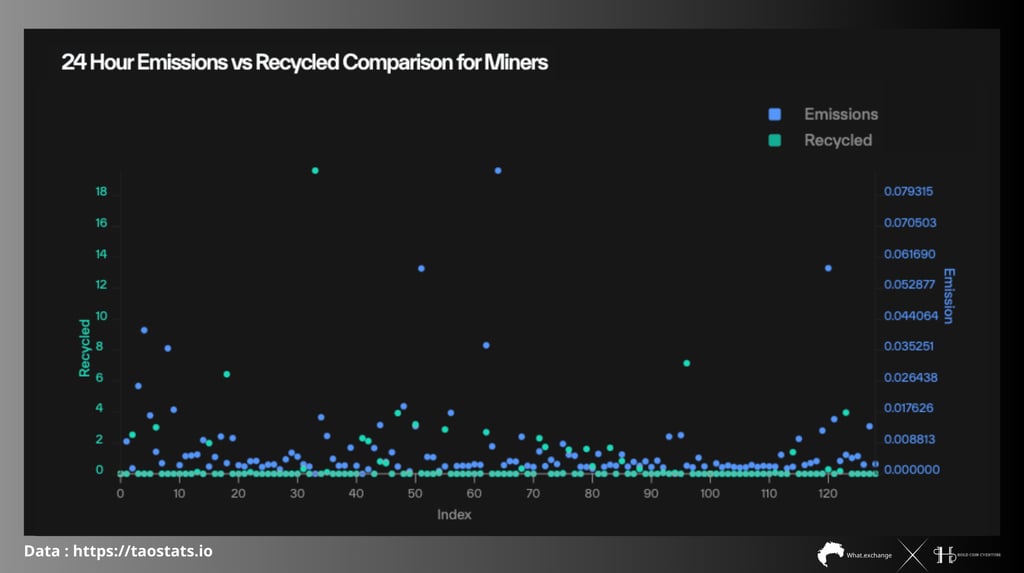
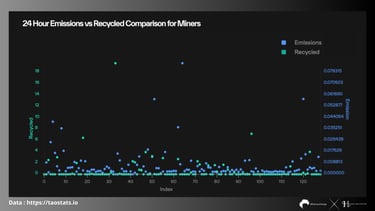
Emissions vs Recycled – Miners (24h) shows the amount of TAO issued (“ Emissions ”, blue) and the amount of TAO “ recycled ” (re- staking/re-locking — green) from miners/hotkeys in a 24h period, which is a key indicator to evaluate the quality of network behavior: how much TAO miners receive → how much is returned to the network ( stake, lock/subnet… ) instead of flowing into the market.
Some index miners have high emissions (blue dot at high level), but also have significant recycling (green dot below/near blue) — this shows they are not selling the entire reward , but re-staking/keeping it in the network .
Most other miners have low emissions and very low recycling (near 0) — indicating small issuance, or they do not participate in staking/recycle — possibly due to small scale or inactivity.
However, there is a clear stratification, a group of “ core miners ” with high emissions and recycling, a group of “ peripheral miners ” with small contributions — consistent with the network model of “ high-quality seeds and the rest distributed ”.
For many miners, recycled amounts represent a significant portion of emissions, suggesting long-term behavior : instead of “ mine and sell ”, they reinvest in staking/subnet. This means that the selling pressure from mining rewards will be limited , reducing the actual new supply flowing into the market — crucial before the halving takes place.
Having a core group of miners that maintain stable emissions & recycling on a daily basis shows that the network is not dependent on short-term/profit-seeking miners , which is a sign of the sustainability and stability of the Bittensor network — a key factor for investors to accept long-term staking, despite the halving.
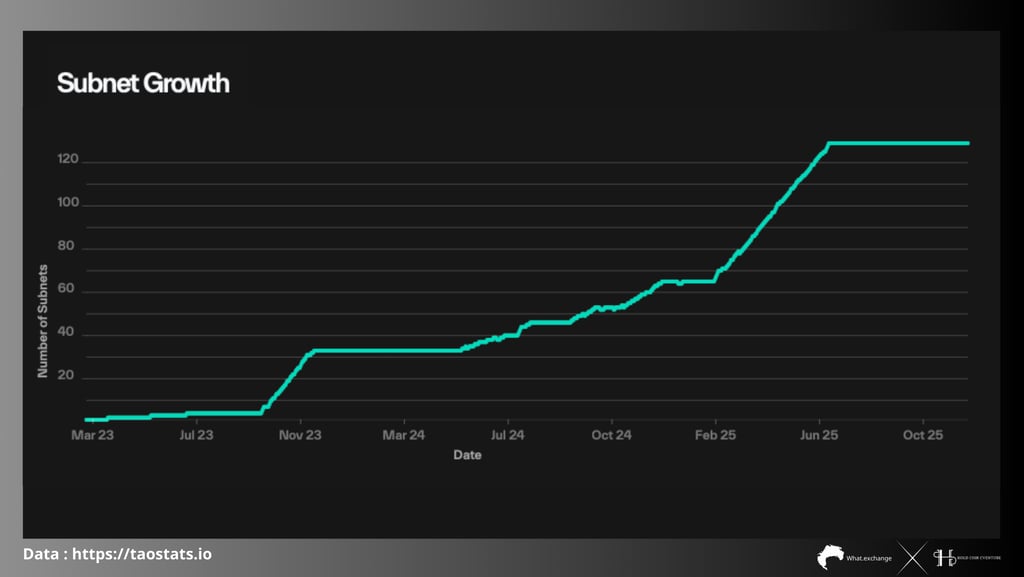
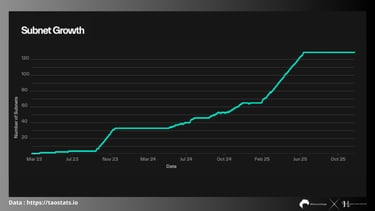
Subnets indicate that Bittensor has entered a step-function expansion phase, reflecting real demand for decentralized AI infrastructure. The sharp increase in subnets right before the halving demonstrates that the network has reached “ infrastructure maturity ” , creating a solid foundation for TAO’s mid- to long-term bullish trend.
Subnets are the most important structural units of Bittensor. Each subnet represents a specialized AI market (inference, embedding, routing, ranking, compute…), requires TAO stakes to be registered and maintained, and creates real value (AI queries, compute, ML models…).
The number of subnets is Bittensor’s most important indicator of network activity and real adoption . Real stakes are needed to open new subnets. Maturity of incentives (scoring model becomes more stable).
When the network quality is high enough, the demand for new subnets increases exponentially. Each subnet requires staking TAO → more subnets → staking demand increases → free-float decreases . Instead of letting TAO flow to exchanges, TAO is locked into subnet registries → reducing the actual circulating TAO.
The strong subnet growth before the halving is a strong indicator that those who know the network best — subnet owners — judge that the post-halving reward is still attractive → meaning that the TAO price must be high enough to offset the reward reduction.
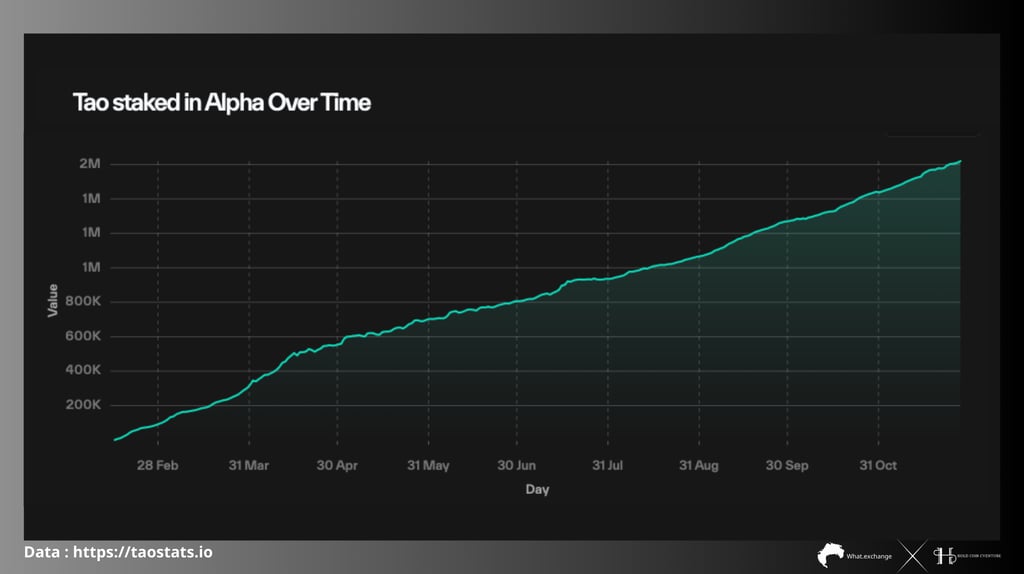
The Alpha subnet is one of Bittensor's most important core subnets, providing an alpha index to measure the contribution efficiency of miners/hotkeys, participating in the network-wide scoring mechanism, and being the place where network operators stake to maintain nodes and improve performance.
Staking in Alpha is not short-term speculative behavior — it is staking for real network operations. Therefore, “TAO staked in Alpha” reflects the internal quality of the system , unaffected by market activity.
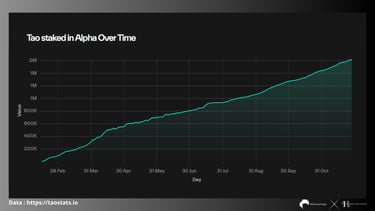
By the end of October – early November, there were over 1,900,000 TAO staked in Alpha. Growth from ~100k to ~1.9M TAO in just about 8 months. A ~19x increase , completely consistent, without any cyclical declines. Staking in Alpha reflects system confidence, not market sentiment.
When the reward decreases, nodes will compete more to be in the effective subnet (Alpha) . Operators are forced to stake more to improve their weight, increasing their chances of receiving rewards. The Halving event pushes the demand for staking in Alpha even higher . They believe that the reward after the halving is still attractive, meaning the price of TAO must increase to compensate for the reduced reward.
Alpha staking data has been consistently increasing, sustainable, and unaffected by price volatility , demonstrating the long-term behavior of the Bittensor ecosystem. The Alpha subnet currently absorbs ~18% of the circulating supply , demonstrating the strength of endogenous staking demand. The sharp increase in staking right before the halving is a clear signal that the ecosystem expects TAO price to adjust upwards to balance the 50% reward reduction.
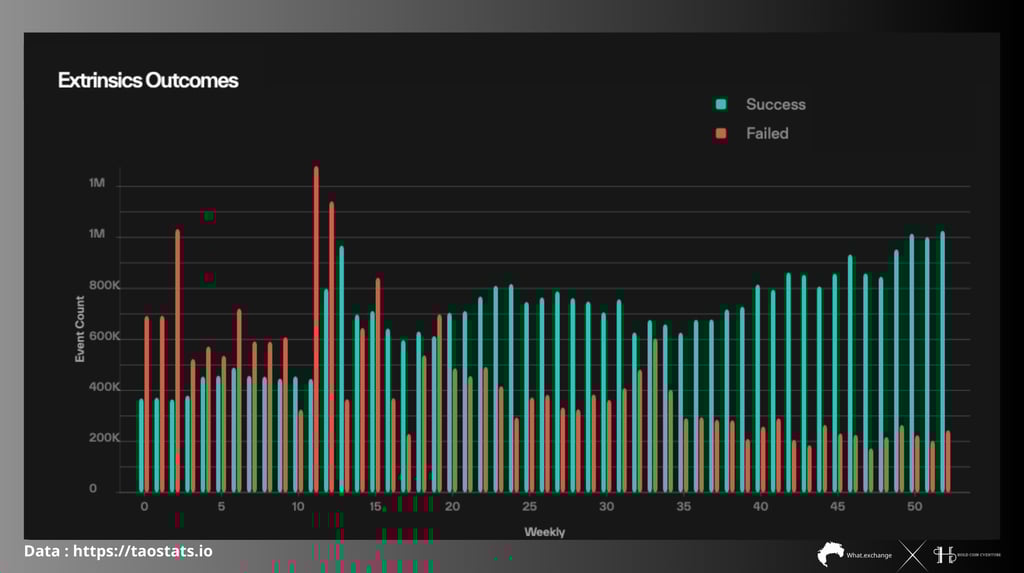
Bittensor's weekly extrinsics data shows a clear increase in network performance, with a trend of a sharp increase in successful transactions and a decrease in failures over time. In the Bittensor ecosystem (based on Substrate), extrinsics are all actions recorded on the blockchain, including: Transactions (transfers), miner registration, weight submission, Delegate/Undelegate, Join/Leave subnet, and validator update tasks.
So, Extrinsics is the economic activity of the whole network . The number of extrinsics reflects the level of usage , real demand , and activity of the Bittensor network. The “Success / Failed” ratio reflects the stability – efficiency – operational health .
Halving only takes effect when there is real demand on the network. More AI resources are used, more subnets are involved in executing tasks. Users and validators compete to infer the case of a vibrant network.
An unstable network cannot handle a 50% drop in reward volatility. Bittensor increases throughput, reduces error rate, and stabilizes the entire subnet. Shown to be a prerequisite before halving.
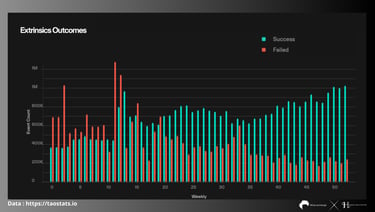
Extrinsics Success increased sharply to over 1 million/week , while Failed decreased to ~200k, reflecting high quality Bittensor performance. High activity often accompanies increased staking, leading to a decrease in circulating supply.
Evaluation and Conclusion
Bittensor is growing in breadth and depth. Alpha staking is booming, Root staking remains high, extrinsic activity is improving significantly, and the number of subnets is expanding rapidly, showing real demand from actors in the system. These are strong signs of endogenous growth, independent of external market fluctuations.
The halving, which reduces TAO issuance to 3,600 tokens/day, will more than halve nominal inflation, while stake demand continues to increase and free float becomes increasingly limited. With such a supply-demand structure, systemic selling pressure is minimized and the economic foundation becomes more sustainable. The emergence of new subnets, reasonable stake distribution, and accelerated transaction processing further strengthen the network's long-term stability.
Overall, TAO is on a clear growth trajectory: strong network activity, increased staking, improved performance, and the upcoming halving tightening supply. The on-chain data is completely consistent and confirms one thing: Bittensor is entering a phase of operational maturity and creating a sustainable economic structure that will serve as a foundation for TAO's growth in the upcoming cycle.
Disclaimer: The information presented in this article is the author's personal opinion in the cryptocurrency field. It is not intended to be financial or investment advice. Any investment decision should be based on careful consideration of your personal portfolio and risk tolerance. The views expressed in this article do not represent the official position of the platform. We recommend that readers conduct their own research and consult with a professional before making any investment decisions.
API & Data: Glassnode
Compiled and analyzed by WHAT Exchange and HCCVenture
Join HCCVenture here: https://link3.to/holdcoincventure
Explore HCCVenture group
HCCVENTURE QUANT JSCO
© 2026 HCCVENTURE. ALL COPYRIGHTS RESERVED.


Connect with us
Popular content
Contact to us
Address: 8th Floor, Bach Dang Complex Building, 50 Bach Dang Street, Hai Chau Ward, Da Nang City, Vietnam.
Phone: 1900 1509
Gmail : sp_contact@hccventure.com
Disclaimer: The information on this website is for informational purposes only and should not be considered investment advice. We are not responsible for any risks or losses arising from investment decisions based on the content here.
TERMS AND CONDITIONS • CUSTOMER PROTECTION POLICY
ANALYTICAL AND NEWS CONTENT IS COMPILED AND PROVIDED BY EXPERTS IN THE FIELD OF DIGITAL FINANCE AND BLOCKCHAIN BELONGING TO HCCVENTURE ORGANIZATION, INCLUDING OWNERSHIP OF THE CONTENT.
RESPONSIBLE FOR MANAGING ALL CONTENT AND ANALYSIS: HCCVENTURE FOUNDER - TRUONG MINH HUY
Read warnings about scams and phishing emails — REPORT A PROBLEM WITH OUR SITE.