

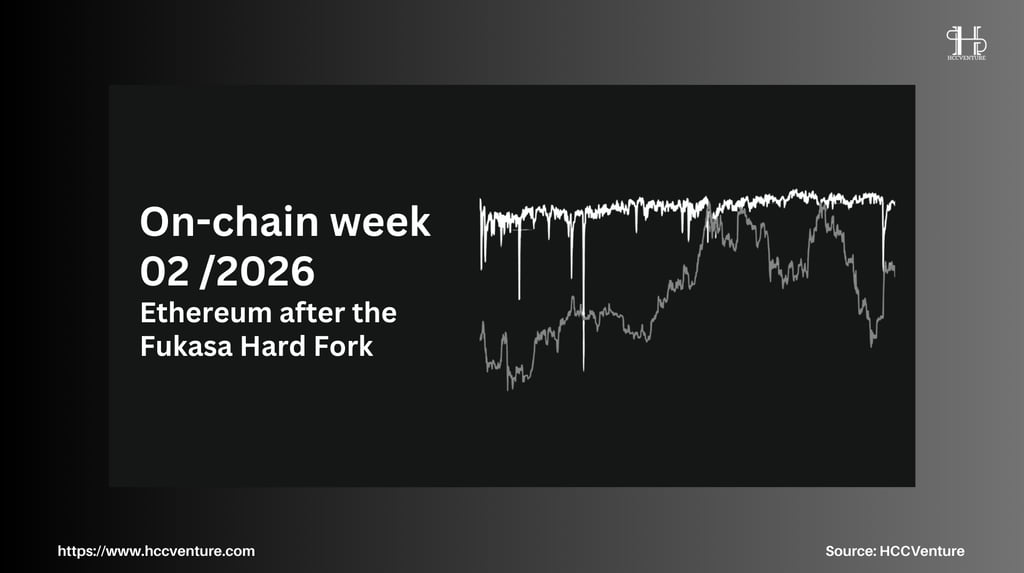
On-chain analysis week 2/2026: Ethereum after the Fusaka Hard Fork
Entering 2026, Ethereum is solidifying its position as a "pillar of digital finance" with explosive growth in both value and technical infrastructure following the significant changes and the launch of the Glamsterdam upgrade roadmap.
1/17/20269 min read
Market Summary
Entering 2026, Ethereum is solidifying its position as a "pillar of digital finance" with explosive growth in both value and technical infrastructure. As of mid-January, ETH consistently maintained a positive trend around $3,300 , driven by massive capital inflows from spot ETFs and record accumulation by major financial institutions.
The total amount of ETH staked has reached an all-time high of 35.9 million ETH (almost 30% of the total supply). The queue to become a validator is currently overloaded with over 2.5 million ETH waiting, causing activation times to extend from 40 to 43 days .
BitMine Immersion Technologies has launched a sensational accumulation campaign, holding over 4.17 million ETH (approximately 3.45% of the total circulating supply). In just the first 8 days of January, they added another 590,000 ETH to their staking to maximize their profits.
Ethereum spot ETFs in the United States recorded massive net inflows, reaching $175 million on January 15 alone , led by BlackRock's iShares Ethereum Trust (ETHA).
Analyzing on-chain metrics
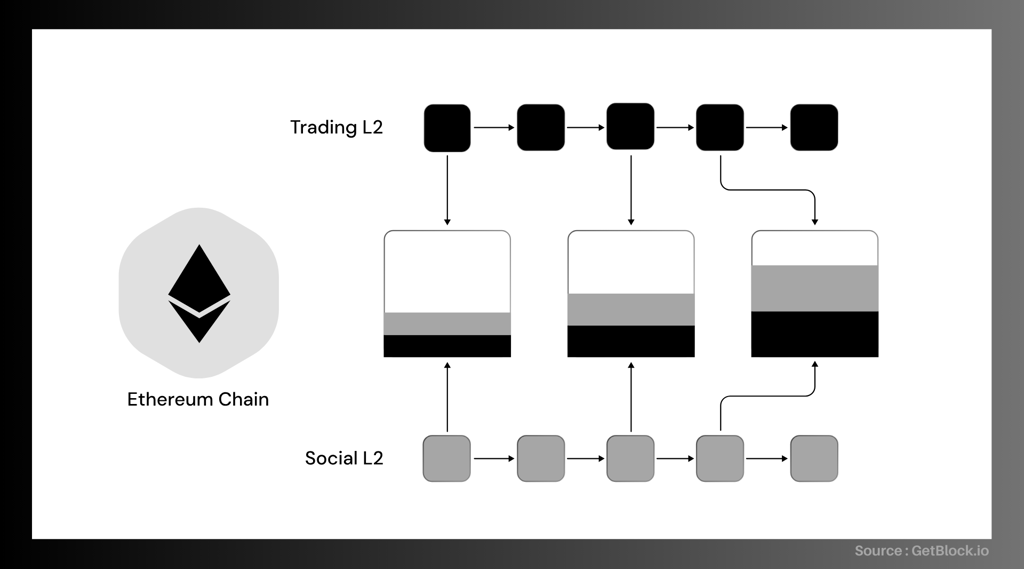
Fusaka, Ethereum's name combining "Fulu" (consensus layer) and "Osaka" (execution layer, reminiscent of the Devcon 2025 governing body), officially migrated to the mainnet with incredible performance. Validators, representing over 99% of the staked ETH (32 million tokens) , synchronized in less than 15 minutes, proving the rigorous testing capabilities of the Holesky (October 1st ), Sepolia (October 14th) , and Hoodi (October 28th) test networks.
The highlight of the upgrade, PeerDAS , is that it allows validators to sample data in " slices " instead of entire data blocks, reducing bandwidth requirements by eightfold and enabling aggregation platforms like Arbitrum and Optimism to handle exponentially increasing transaction volumes with fees under $0.01 . The core EIPs have been deployed:
EIP-7623 (PeerDAS): Expanding data block capacity from 6 to 16 blocks , increasing L2 throughput by 8 times , and reducing costs by 50% – key to achieving ambitions of over 31,000 TPS.
Verkle Tree: Replaces Merkle trees with vector commits, reducing node storage capacity by a factor of 10 , to 100GB , and facilitating delegation of authority to home operators.
EIP-7935 (Increased Gas Limit): Default is 60 million gas per cubic meter ( increased from 45 million since 2021 ), increased capacity by 33%, supports 20-40 TPS on L1.
Once activated, the sub-branches (Blob Parameter Only, BPO) on December 9th and January 7th will gradually increase the blob target to 21, ensuring gradual scalability without overloading.
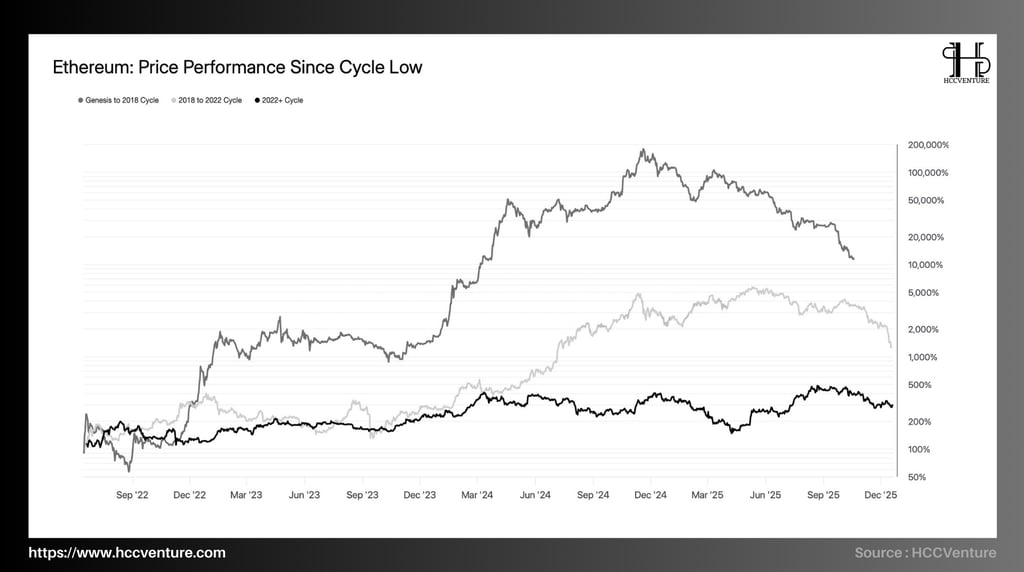
Ethereum enters 2025 in a cyclical growth phase but with relatively declining momentum compared to Bitcoin , clearly reflecting the re-evaluation of ETH's role in the mature crypto ecosystem . As of early 2025, ETH has increased by approximately +350% to +400% from its 2022 cyclical low (~$880–$1,000) , significantly less than:
Cycle 2018–2022: approximately +4,500% increase
Genesis Cycle–2018: Increases by over +100,000%
This disparity is not simply a sign of weakness, but reflects a structural transition : from a technology-driven growth asset to a digital financial and economic infrastructure asset , where the rate of price increase slows but sustainability increases.
In late 2024 – early 2025, the price formed a relatively lower peak compared to the historical trajectory if normalized to the percentage increase from the bottom. The growth rate was compressed, strongly reflecting a larger market capitalization, diversified capital flows into L2, restaking, AI-chain, and ETH is no longer the highest "beta" in the ecosystem.
Over 25–27% of the total ETH supply is currently staked , reducing short-term selling pressure. However, the liquid staking and restaking mechanism means ETH is no longer hard-locked , mitigating the expected "supply shock" effect after The Merge. A large portion of the ETH supply remains in an unrealized interest state , but the profit margins are not as high as in previous cycles, leading to distributed profit-taking pressure over time, rather than a sudden surge.
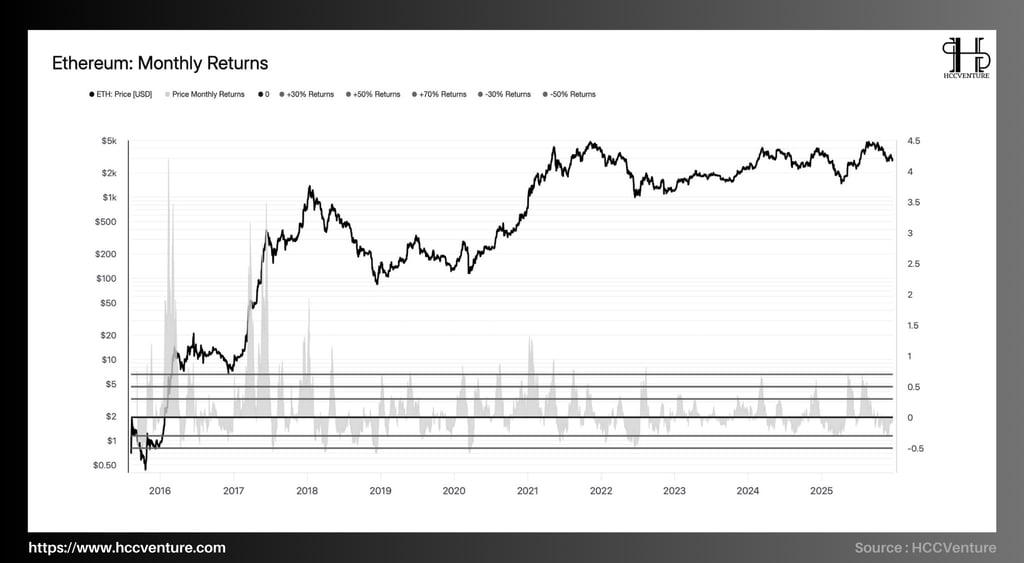
Monthly returns very clearly reflect the structural shift in ETH's yield over the past decade. While the periods of 2016–2018 and 2020–2021 were characterized by months of extreme growth (+50%, +70%, even >+100%), the current cycle (2022–2025) shows that ETH's monthly yields have been heavily compressed , both in the upward and downward directions.
As of early 2025, ETH was trading around $3,000–$3,500 , approximately 3.5–4 times higher than its 2022 cycle low (~$880–$1,000) . However, the monthly yield structure suggests that the Ethereum market is no longer operating in a boom-crash pattern , but is moving toward a more mature financial asset with a narrower and more stable yield distribution.
The chart shows a high frequency of “yield columns” exceeding +50%, particularly during the 2017 bull run. This is characteristic of nascent tech assets , where price is driven more by expectations than by actual cash flow. This was the period when ETH reached its historical peak in yield volatility , before entering a structural correction phase after 2022.
In the current context, ETH no longer fits the expectations of exponential growth , but it plays a central role in the global on-chain financial structure. Profits from ETH in this cycle will come from time, cash flow, and ecosystem growth , rather than extreme monthly price surges.
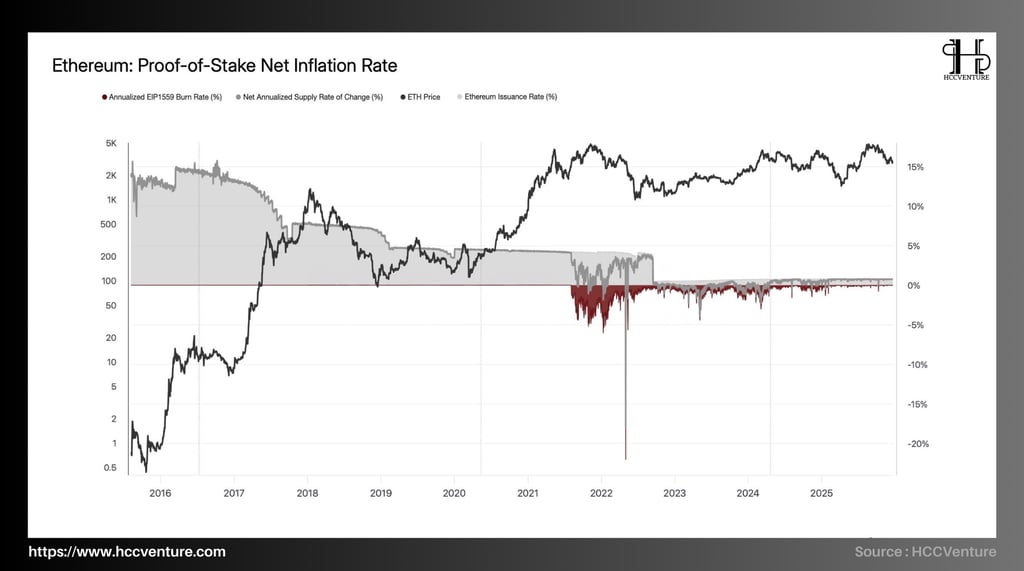
The Proof-of-Stake Net Inflation Rate reflects one of the most profound structural changes in the history of cryptocurrency finance, confirming that Ethereum has completed its transition from a fixed-inflation asset to a monetary system regulated by on-chain economic activity .
Since The Merge (September 2022), Ethereum has no longer been defined by its nominal issuance rate, but by the dynamic difference between staking issuance (issuance) and the EIP-1559 fee burning mechanism . By early 2025, data showed that the net supply growth rate of ETH fluctuated around 0% , with many negative periods, establishing Ethereum's position as a semi-deflationary asset .
Throughout its development, Ethereum has undergone several significant updates:
1/ Proof-of-Work Phase (2015–2022) - High inflation, inflexibility
The rate of ETH issuance is typically at 4–5% per year.
There is no mechanism to regulate supply according to demand.
ETH inflation is "hard," similar to that of mined commodities.
2/ The Merge and EIP-1559 - A turning point in history
Issuance dropped by approximately 88–90%.
ETH chuyển sang Proof-of-Stake
Transaction fees are burned through EIP-1559
The Proof-of-Stake Net Inflation Rate confirms that Ethereum has completed its evolution from a high-inflation asset to a self-regulating, flexible, and sustainable monetary system . Net inflation approaching 0% is not a sign of weakness, but rather the optimal state of a mature network where the money supply accurately reflects real economic demand.
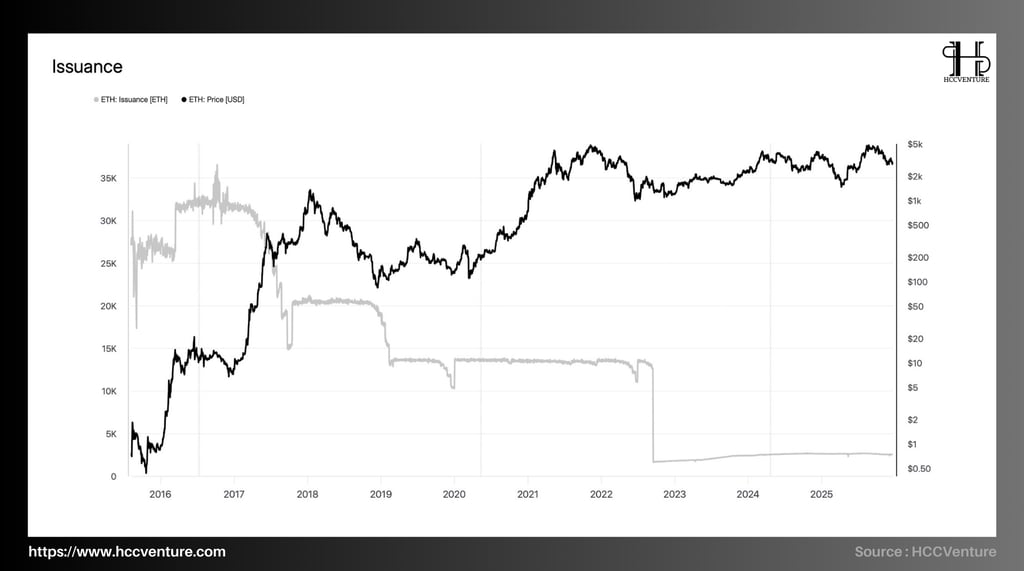
Ethereum is the only blockchain in the large-cap asset class that has experienced “structural deflation” through a change in its issuance mechanism, rather than through a short-term demand shock .
From the Proof-of-Work (PoW) phase with high and rigid issuance, Ethereum has transitioned to Proof-of-Stake (PoS) with minimal, flexible issuance dependent on the level of staking participation , combined with the EIP-1559 fee burning mechanism . As a result, by 2023–2025, the nominal issuance of ETH had decreased by more than 85–90% from its historical peak , placing Ethereum in a completely new monetary status.
During the period of 2023–early 2025, Issuance stabilized at a minimum level, maintaining around 1,700–2,200 ETH/day. The staking rate approached equilibrium, while Validator growth slowed down and the network entered a mature state. More importantly, during many periods, ETH was burned exceeding issuance ; as network activity increased, Ethereum entered a net deflationary state.
Issuance confirms that Ethereum has completed the deepest monetary restructuring in the crypto space. The issuance remaining stable at extremely low levels from 2023 to the present is not a cyclical phenomenon, but rather a new equilibrium state for the system .
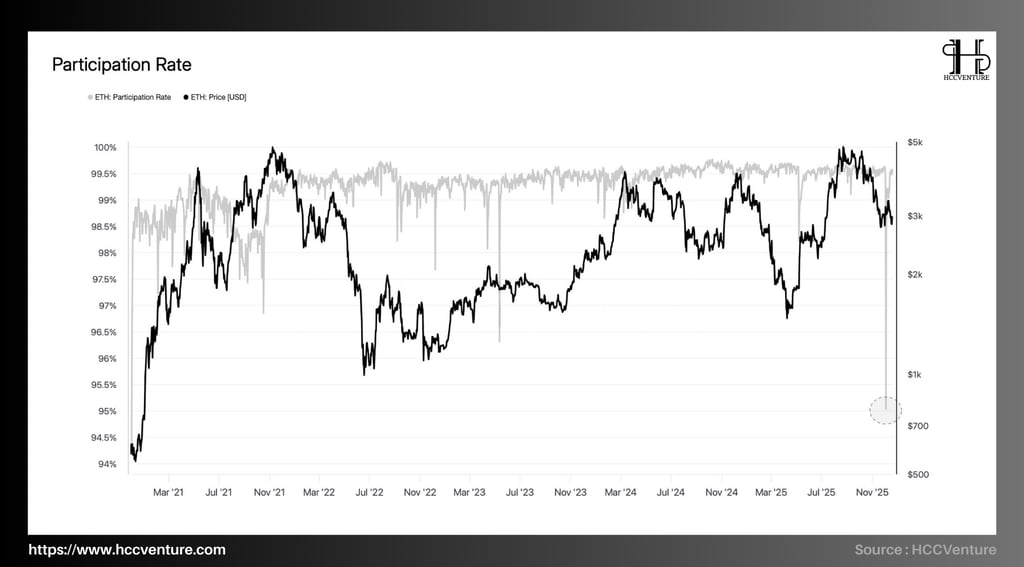
Ethereum has been operating at an extremely high and stable participation rate throughout the 2021–2025 period , despite periods of significant price volatility, including the 2022 crash and the 2024–2025 correction phase.
From 2023 to the end of 2025, the Participation Rate remained stable within the range of 99% – 99.7%, demonstrating very low volatility. Short-term "drops" were only technical (client downtime, isolated events), not systemic. Compared to historical levels, the current level is significantly higher than the initial low of ~94% and approaches the theoretical optimal region for a large-scale PoS network.
A high participation rate means low security risk, extremely high network attack costs, and stable and sustainable staking yields. On the other hand, if Validator considers ETH as productive capital , not a speculative asset.
The Ethereum Participation Rate confirms that Ethereum has entered a stable operational phase at the global financial infrastructure level . The near-absolute participation of validators over many consecutive years, despite price fluctuations and market cycles, demonstrates systemic confidence in Ethereum, that PoS has reached a sustainable equilibrium, and that Ethereum is no longer a "technological experiment," but a functioning financial platform.
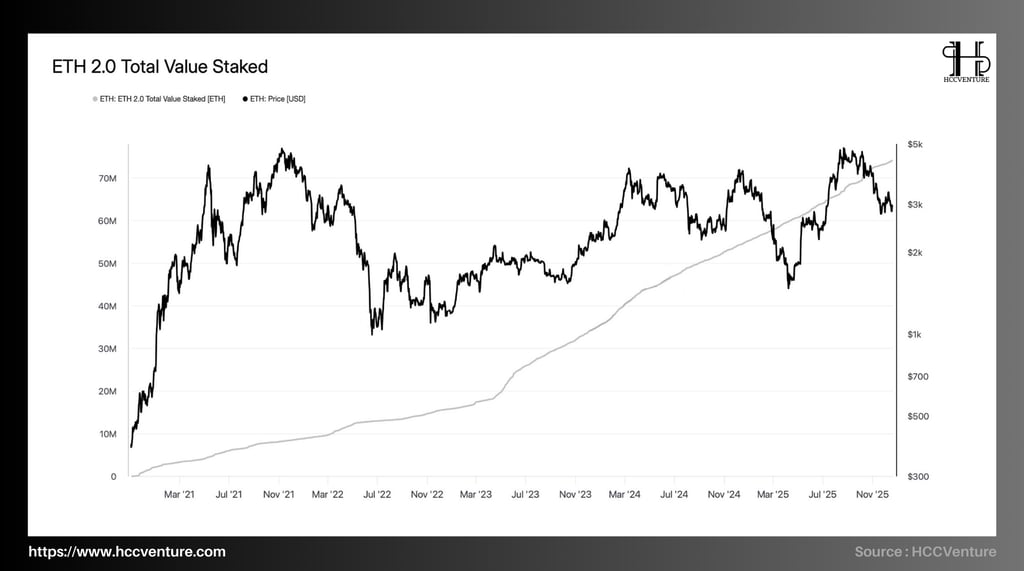
The ETH 2.0 Total Value Staked index reflects the total amount of ETH locked in Ethereum's staking mechanism. It's a key indicator for assessing long-term capital commitment, network security, and the financial maturity of Ethereum as a global Proof-of-Stake system . Unlike short-term trading indices, Total Value Staked is structural , reflecting the long-term capital allocation decisions of investors, institutions, validators, and large financial entities.
Accumulating structural value and achieving financial maturity from 2024 to the present, Total Value Staked has continuously increased from approximately 30 million to over 70 million ETH , with the current level being more than 7 times higher than its historical low . Despite significant price corrections in 2025, the Total Value Staked supply remained largely unaffected by short-term price fluctuations during ETH dips, with staking not declining correspondingly.
Ethereum has completed its transition from a technology asset to a mature Proof-of-Stake financial infrastructure. The continuous increase in total ETH staked, despite price cycles and market shocks, demonstrates systemic confidence in Ethereum. The capital flow into staking is long-term and institutionalized. ETH is becoming a foundational asset in the global digital finance ecosystem.
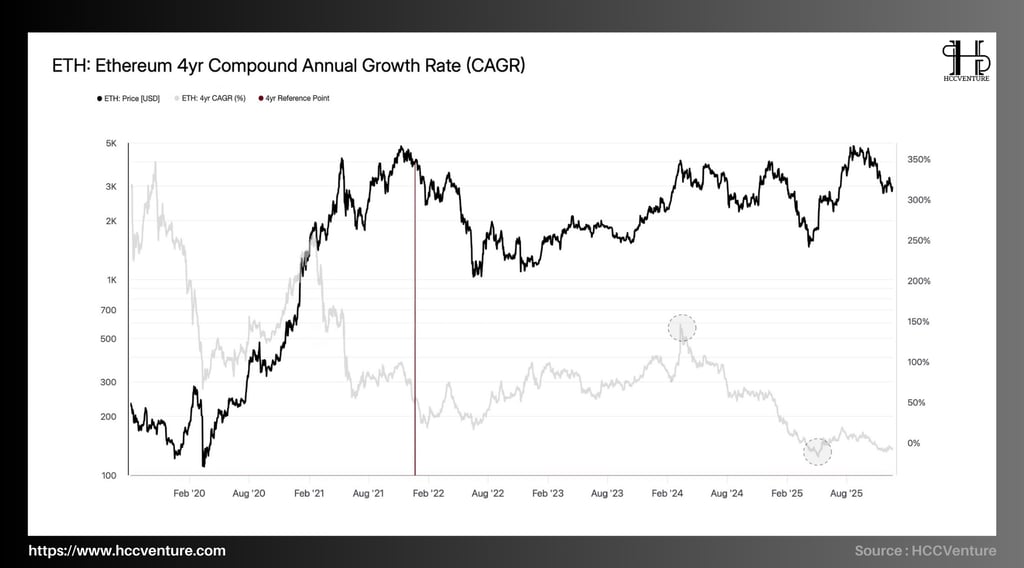
The Ethereum 4-year Compound Annual Growth Rate (CAGR) measures the compound annual growth rate of ETH price over a 4-year cycle, thereby eliminating short-term volatility noise and reflecting the asset's fundamental growth over time .
With CAGR approaching its historical cyclical lows by the end of 2025, ETH's CAGR has fallen to approximately 0%–20% , the lowest level since ETH entered its global bull cycle. The current value is a consequence of the 2021 cycle being incorporated into the CAGR calculation model and the base effect. Low CAGR at the cyclical lows typically precedes a long-term regrowth phase , when the asset enters an accumulation phase.
Ethereum has transitioned from a period of explosive growth to a more mature, stable, and predictable growth phase. ETH hasn't lost its growth momentum; instead, it's laying the groundwork for a new CAGR cycle , one with a lower but more sustainable amplitude. Historically, only truly mature financial systems experience CAGR compression before entering a new, higher-level valuation cycle .
Assessment and Conclusion
Entering the first week of 2026 , Ethereum is no longer operating as a high-growth, cyclical, speculative technology asset, but is clearly demonstrating its role as a systemic digital financial infrastructure . The price of ETH remains stable around $3,200–$3,300 , reflecting a new equilibrium between supply and demand , with circulating supply remaining tightly controlled while demand from financial institutions remains high and sustainable.
Unlike previous cycles, market momentum in this phase does not come from retail cash flow or derivative leverage, but is primarily driven by spot ETFs, large-scale staking, and strategic accumulation by businesses . Ethereum is entering a market phase where price reflects financial structure , rather than speculative expectations.
Ethereum is completing its most significant transformation since switching to Proof-of-Stake: becoming an infrastructure-based pillar of digital finance . The current ETH price doesn't reflect a lack of momentum, but rather a repositioning of the market , where value is built through:
Staking cash flow
Level of supply lockout
A central role in the decentralized finance and digital asset ecosystem.
In this context, short-term corrections – if they occur – are technical and liquidity-related, and do not alter the long-term trend structure. Ethereum is entering a phase where valuation will increasingly be tied to its role in the real economy , rather than speculative growth narratives.
Disclaimer: The information presented in this article is the author's personal opinion in the field of cryptocurrency. This is not financial or investment advice. All investment decisions should be based on careful consideration of your personal portfolio and risk tolerance. The views expressed in this article do not represent the official stance of the platform. We recommend that readers conduct their own research and consult with experts before making any investment decisions.
API & Data : Glassnode
Compiled and analyzed by WHAT Exchange and HCCVenture
Join the HCCVenture organization here: https://link3.to/holdcoincventure
Explore HCCVenture group
HCCVENTURE QUANT JSCO
© 2026 HCCVENTURE. ALL COPYRIGHTS RESERVED.


Connect with us
Popular content
Contact to us
Address: 8th Floor, Bach Dang Complex Building, 50 Bach Dang Street, Hai Chau Ward, Da Nang City, Vietnam.
Phone: 1900 1509
Gmail : sp_contact@hccventure.com
Disclaimer: The information on this website is for informational purposes only and should not be considered investment advice. We are not responsible for any risks or losses arising from investment decisions based on the content here.
TERMS AND CONDITIONS • CUSTOMER PROTECTION POLICY
ANALYTICAL AND NEWS CONTENT IS COMPILED AND PROVIDED BY EXPERTS IN THE FIELD OF DIGITAL FINANCE AND BLOCKCHAIN BELONGING TO HCCVENTURE ORGANIZATION, INCLUDING OWNERSHIP OF THE CONTENT.
RESPONSIBLE FOR MANAGING ALL CONTENT AND ANALYSIS: HCCVENTURE FOUNDER - TRUONG MINH HUY
Read warnings about scams and phishing emails — REPORT A PROBLEM WITH OUR SITE.