

Major European Banks Launch Euro Stablecoin Project Qivalis
A consortium of 10 major European banks, including ING, BNP Paribas, UniCredit, and CaixaBank, has officially formed Qivalis – aiming to launch a euro-pegged stablecoin in the second half of 2026.
12/4/20252 min read
Challenging the dominance of the USD
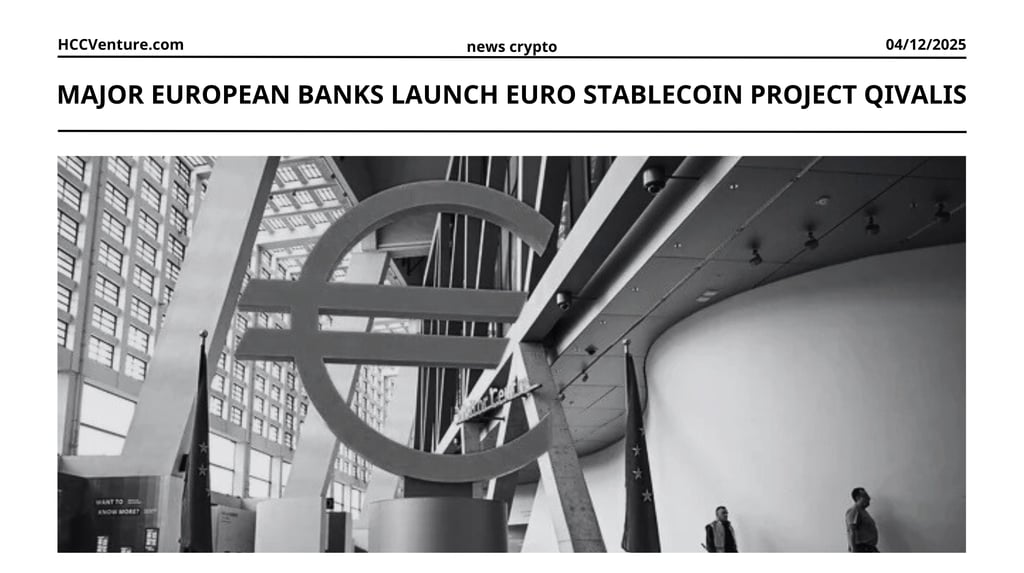
Europe has taken its most decisive step to date in modernizing its monetary infrastructure with the launch of Qivalis, a joint initiative set up by leading European banks to create a regulated euro-denominated stablecoin.
The move marks a strategic shift in Europe’s stance on digital assets, as instead of outsourcing stablecoin liquidity to US institutions like Circle (USDC) and Tether (USDT), European banks are now preparing to issue their own compliant on-chain euro coins – fully supervised under MiCA, the EU’s leading crypto regulatory framework.
The rise of Qivalis signals the beginning of a new phase in the global stablecoin competition, where legal legitimacy, monetary sovereignty, and institutional support become decisive factors.
Moving from dependence to autonomy
For years, the euro has been undervalued in the digital economy. Despite being the world’s second-most used fiat currency, it accounts for less than 1% of on-chain stablecoin volume, leaving Europe structurally dependent on USD-backed tokens for trading, payments, and cross-border flows.
This imbalance has raised concerns from central banks, the European Commission and regional financial institutions. With the growing adoption of tokenized assets and blockchain-based payment systems, reliance on US-issued stablecoins has become strategically unsustainable.
Qivalis is designed to solve this problem — providing a domestic, legally supervised, euro-based digital asset that can support European DeFi, digital commerce, treasury operations, and cross-border payments.
Liquidity and Applicability
Despite strong institutional support, Qivalis still faces significant challenges.
The stablecoin market is dominated by large companies with deep liquidity, exchange integrations, and network effects. For Qivalis to succeed, it must ensure widespread adoption across centralized exchanges, DeFi protocols, fintech wallets, and enterprise blockchains.
Liquidity depth, transaction fees, user experience (UX), and multi-chain usability will determine whether Qivalis becomes a real competitor or just another niche EU financial tool.
Furthermore, such a stablecoin would need to consider political sensitivities, especially as the ECB is exploring its own digital euro (CBDC). The coexistence of a bank-issued stablecoin and a sovereign digital euro could complicate policy debates within the EU.
Our review
The launch of Qivalis marks a major shift in Europe’s digital finance strategy. By launching a bank-managed and supervised euro stablecoin, European institutions are positioning themselves to compete in a landscape previously dominated by U.S. stablecoin issuers.
If successfully deployed, Qivalis could become the backbone of the European blockchain economy — driving tokenization, real-time payments and digital capital markets, while strengthening the euro’s position in a rapidly evolving financial system.
For now, the initiative sends a clear message: “Europe is no longer content to be a spectator in the stablecoin era — it aims to lead.”
Disclaimer: The information presented in this article is the author's personal opinion in the cryptocurrency field. It is not intended to be financial or investment advice. Any investment decision should be based on careful consideration of your personal portfolio and risk tolerance. The views expressed in this article do not represent the official position of the platform. We recommend that readers conduct their own research and consult with a professional before making any investment decisions.
Explore HCCVenture group
HCCVENTURE QUANT JSCO
© 2026 HCCVENTURE. ALL COPYRIGHTS RESERVED.


Connect with us
Popular content
Contact to us
Address: 8th Floor, Bach Dang Complex Building, 50 Bach Dang Street, Hai Chau Ward, Da Nang City, Vietnam.
Phone: 1900 1509
Gmail : sp_contact@hccventure.com
Disclaimer: The information on this website is for informational purposes only and should not be considered investment advice. We are not responsible for any risks or losses arising from investment decisions based on the content here.
TERMS AND CONDITIONS • CUSTOMER PROTECTION POLICY
ANALYTICAL AND NEWS CONTENT IS COMPILED AND PROVIDED BY EXPERTS IN THE FIELD OF DIGITAL FINANCE AND BLOCKCHAIN BELONGING TO HCCVENTURE ORGANIZATION, INCLUDING OWNERSHIP OF THE CONTENT.
RESPONSIBLE FOR MANAGING ALL CONTENT AND ANALYSIS: HCCVENTURE FOUNDER - TRUONG MINH HUY
Read warnings about scams and phishing emails — REPORT A PROBLEM WITH OUR SITE.