


JPMorgan is being sued for allegedly aiding and abetting a Ponzi scheme
A group of investors has filed a lawsuit alleging that JPMorgan Chase facilitated a $328 million cryptocurrency Ponzi scheme involving Goliath Venture.
3/13/20263 min read
Serious accusations on Wall Street
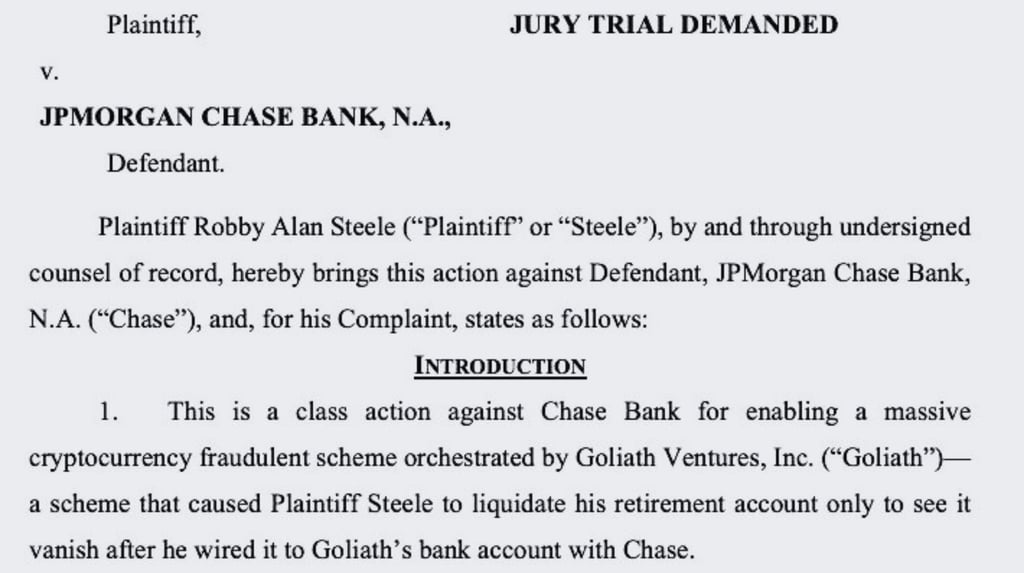
A group of investors has filed a lawsuit in federal court in the Southern District of New York, alleging that JPMorgan Chase & Co. knowingly or negligently facilitated a $328 million cryptocurrency Ponzi scheme operated through accounts linked to Goliath Venture, a digital asset investment firm that went bankrupt in late 2024.
The lawsuit — filed on March 12, 2026, and first reported by Bloomberg Law and CoinDesk — alleges that JPMorgan maintained and failed to properly monitor numerous corporate accounts used by Goliath Venture to receive and distribute investor funds, despite suspicious indications that should have triggered a Suspicious Activity Report (SAR) or closed the accounts under the Bank Secrecy Act and its Anti-Money Laundering (AML) obligations.
JPMorgan's alleged role
Maintain the corporate checking and wire transfer accounts used by Goliath Venture to receive investment funds (via ACH, bank transfers, and stablecoin conversions).
Processing hundreds of millions of dollars in payments to early investors (a typical Ponzi scheme).
Ignoring or failing to conduct a thorough investigation:
High rates of cash inflow/outflow are not consistent with legitimate investment activities.
Numerous customer complaints and refund attempts.
Public warning signs (offering unregistered securities, unrealistic profit promises)
The bank continued its relationship even after internal warnings and outside media reports raised concerns.
Goliath Venture (and its affiliated entities) allegedly solicited investments between 2022 and 2024, promising annual returns of 30–60% through proprietary cryptocurrency trading strategies, arbitrage, and yield farming. The company collapsed in Q4 2024 after failing to fulfill withdrawal requests, resulting in estimated losses of $328–350 million for investors.
How the alleged Ponzi scheme worked
According to the lawsuit, Goliath Venture advertised itself as a high-yield cryptocurrency investment platform, promising large returns to investors from cryptocurrency trading and digital asset strategies.
Investigators believe the scam operated as a classic Ponzi scheme by:
Use money from new investors to pay previous participants.
The unrealistic profit claims associated with cryptocurrency trading.
Use marketing campaigns to attract new deposits.
Transfer money through traditional bank accounts and e-wallets.
Banks are required to monitor financial activities in accordance with anti-money laundering (AML) regulations and report suspicious transactions to authorities.
Investors argue that if the bank had intervened sooner, the alleged fraud could have been stopped before losses reached hundreds of millions of dollars.
The responsibility of banks in financial fraud.
Cases like these raise a broader legal question: to what extent are financial institutions liable for fraud committed through their banking systems?
Although banks are required to comply with anti-money laundering and fraud detection regulations, courts often require clear evidence that the bank intentionally facilitated illegal activity to determine liability.
Financial institutions often defend themselves by arguing that they cannot detect every fraudulent act committed by customers. This case reflects the widespread increase in cryptocurrency-related fraud in recent years. As digital assets become more popular, scammers are increasingly using cryptocurrency narratives to lure investors.
Our review
The Goliath Venture lawsuit against JPMorgan is a prime example of later-stage victims seeking abundant funding at the early stages after a Ponzi scheme collapses. While the $328 million figure is significant, the legal hurdles in proving complicity and aiding and abetting responsibility against a large bank are extremely high—especially in the absence of direct evidence of knowledge or intent.
A motion to dismiss the lawsuit is expected, and a settlement or dismissal is more likely by the end of 2026. Currently, this remains more of a headline attracting legal observers than a fundamental risk to JPMorgan or the cryptocurrency market in general.
Disclaimer: The information presented in this article is the author's personal opinion in the field of cryptocurrency. This is not financial or investment advice. All investment decisions should be based on careful consideration of your personal portfolio and risk tolerance. The views expressed in this article do not represent the official stance of the platform. We recommend that readers conduct their own research and consult with experts before making any investment decisions.
Compiled and analyzed by HCCVenture
Follow HCCVenture here: https://link3.to/holdcoincventure
Explore HCCVenture group
HCCVENTURE QUANT JSCO
© 2026 HCCVENTURE. ALL COPYRIGHTS RESERVED.


Connect with us
Popular content
Contact to us
Address: 8th Floor, Bach Dang Complex Building, 50 Bach Dang Street, Hai Chau Ward, Da Nang City, Vietnam.
Phone: 1900 1509
Gmail : sp_contact@hccventure.com
Disclaimer: The information on this website is for informational purposes only and should not be considered investment advice. We are not responsible for any risks or losses arising from investment decisions based on the content here.
TERMS AND CONDITIONS • CUSTOMER PROTECTION POLICY
ANALYTICAL AND NEWS CONTENT IS COMPILED AND PROVIDED BY EXPERTS IN THE FIELD OF DIGITAL FINANCE AND BLOCKCHAIN BELONGING TO HCCVENTURE ORGANIZATION, INCLUDING OWNERSHIP OF THE CONTENT.
RESPONSIBLE FOR MANAGING ALL CONTENT AND ANALYSIS: HCCVENTURE FOUNDER - TRUONG MINH HUY
Read warnings about scams and phishing emails — REPORT A PROBLEM WITH OUR SITE.