

Japan is launching a $550 billion investment in the US under the new trade agreement
Japan has just announced a commitment to make substantial investments worth $550 billion in the United States as part of a new trade agreement, marking one of the largest bilateral economic commitments in recent years.
2/19/20262 min read
Foreign relations are heating up.
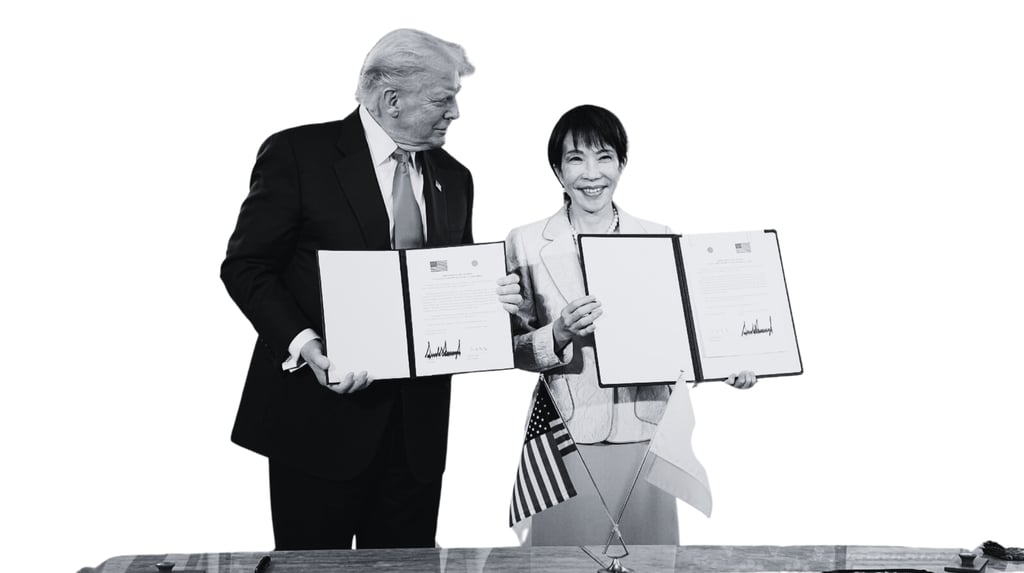
In a significant development underscoring the Trump administration's " America First " trade strategy , Japan has begun implementing the first phase of an unprecedented $550 billion investment commitment in the United States. Announced this week by President Donald Trump and U.S. Commerce Secretary Howard Lutnick , the initial $36 billion investment targets three strategic projects in energy infrastructure , oil exports , and advanced manufacturing – signaling the implementation of a bilateral agreement, to be signed by mid-2025, which links the massive influx of Japanese capital with reduced tariffs on Japanese exports.
This " Strategic Investment Initiative " (as Japanese Prime Minister Sanae Takaichi named it) represents one of the largest foreign investment commitments from a single country in U.S. history.
Scope of investment and operations
This investment comes amid broader efforts to “ redirect supply chains toward friendly countries ”—shifting manufacturing and capital flows toward politically aligned economies. Japan has long been one of the largest foreign investors in the United States, and this expanded commitment reinforces that role.
Although the detailed allocation plan may change, the investment package is expected to focus on:
Advanced semiconductor and chip manufacturing
Electric vehicle ( EV ) manufacturing and battery supply chain
Clean energy and hydrogen infrastructure
Artificial intelligence and digital technology
Advanced manufacturing and key minerals
These sectors align closely with U.S. industrial policy priorities and the strengths of Japanese businesses.
This comes amid rising global instability, record-high global instability indices, and aggressive U.S. tariff policies, positioning the agreement as a pragmatic geopolitical and economic safeguard for both countries.
Implications for the US industry
For the United States, this investment flow supports the revival of domestic manufacturing and technological competitiveness. Japanese companies have historically brought not only capital but also technical expertise and long-term operational discipline. This wave of investment could boost job creation, infrastructure development, and technology transfer across multiple states.
Large-scale bilateral investment agreements increasingly reflect a multipolar trading environment. Instead of relying solely on multilateral frameworks, countries are building strategic partnerships focused on industrial capabilities and supply chain security.
Our review
This massive influx of capital impacts currency markets, bond demand, and cross-border financial structures. Japanese corporations typically finance investments in the United States through a combination of equity, bond issuance, and reinvestment of profits, potentially deepening integration between the two financial systems.
Japan's commitment to invest $550 billion in the United States marks a significant escalation in bilateral economic integration. The scale and sectoral focus reflect a coordinated effort to strengthen industrial resilience, technological leadership, and supply chain stability.
Disclaimer: The information presented in this article is the author's personal opinion in the field of cryptocurrency. This is not financial or investment advice. All investment decisions should be based on careful consideration of your personal portfolio and risk tolerance. The views expressed in this article do not represent the official stance of the platform. We recommend that readers conduct their own research and consult with experts before making any investment decisions.
Compiled and analyzed by HCCVenture
Follow HCCVenture here: https://link3.to/holdcoincventure
Explore HCCVenture group
HCCVENTURE QUANT JSCO
© 2026 HCCVENTURE. ALL COPYRIGHTS RESERVED.


Connect with us
Popular content
Contact to us
Address: 8th Floor, Bach Dang Complex Building, 50 Bach Dang Street, Hai Chau Ward, Da Nang City, Vietnam.
Phone: 1900 1509
Gmail : sp_contact@hccventure.com
Disclaimer: The information on this website is for informational purposes only and should not be considered investment advice. We are not responsible for any risks or losses arising from investment decisions based on the content here.
TERMS AND CONDITIONS • CUSTOMER PROTECTION POLICY
ANALYTICAL AND NEWS CONTENT IS COMPILED AND PROVIDED BY EXPERTS IN THE FIELD OF DIGITAL FINANCE AND BLOCKCHAIN BELONGING TO HCCVENTURE ORGANIZATION, INCLUDING OWNERSHIP OF THE CONTENT.
RESPONSIBLE FOR MANAGING ALL CONTENT AND ANALYSIS: HCCVENTURE FOUNDER - TRUONG MINH HUY
Read warnings about scams and phishing emails — REPORT A PROBLEM WITH OUR SITE.