

Iran's Bitcoin mining footprint highlights a new layer of geopolitical risk
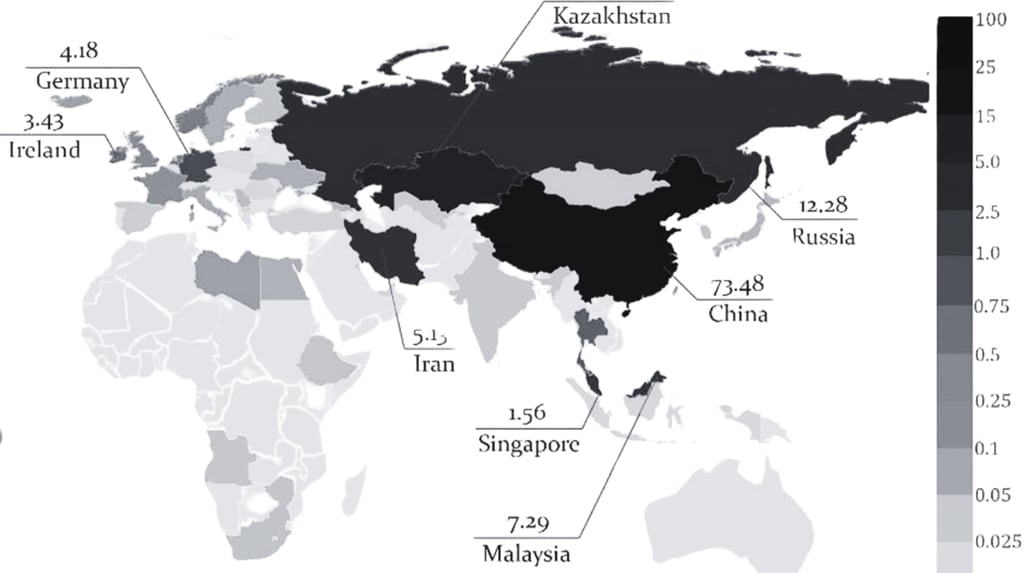
A new estimate from blockchain mining and analytics research firms suggests that Iran currently accounts for 6-8% of the global Bitcoin hashrate.
3/28/20262 min read
The silent miners of Bitcoin
Iran has quietly become one of the more important players in Bitcoin's global infrastructure. It is estimated that Iran accounts for approximately 6-8% of total Bitcoin mining power (around 8-11 EH/s out of the current global hashrate of ~140-150 EH/s).
Approximately 70% of Iran's Bitcoin mining operations are believed to be linked to entities affiliated with the Islamic Revolutionary Guard Corps (IRGC) or other state-linked organizations.
Subsidized, affordable electricity, the need to find alternative income sources due to sanctions, and the ability to convert electricity into a strong currency (Bitcoin) could outweigh traditional financial sanctions.
What stands out is not simply the story of centralized exploitation, but a broader shift in how sovereign entities begin to interact with decentralized financial systems.
Exploitation as an extension of economic strategy
Iran's expansion of Bitcoin mining is best understood in the context of ongoing economic sanctions. Restricted access to the global financial system has forced the country to seek alternative channels for value transfer, and Bitcoin offers a uniquely efficient mechanism.
By transforming subsidized domestic energy into a globally liquid digital asset, Iran is turning electricity into a form of capital that is easily transportable and unaffected by sanctions. This strategy is not new, but its scale has increased significantly over time, supported by structural advantages such as low electricity costs and state-backed coordination.
The economics are very attractive. Estimates suggest that the cost of mining one Bitcoin in Iran may be only a fraction of the global average, creating unusually high profit margins and encouraging continued expansion.
The Influence of the State in Decentralized Networks
Bitcoin's design is based on the assumption of decentralization among independent actors. Iran's mining record reveals a more complex reality.
With up to 8% of the global hashrate, this nation doesn't control the entire network, but its position is no longer insignificant. Roughly speaking, this level of involvement implies that a substantial portion of block output is tied to infrastructure operating within a single geopolitical region.
The composition of that hashrate is just as important as its size. The reported dominance of entities linked to the Islamic Revolutionary Guard Corps suggests that mining operations are not merely commercial, but may be integrated into broader economic and strategic goals of the state.
This blurs the lines between decentralized consensus and centralized influence—not in protocol control, but in the underlying block production process.
Vulnerability of infrastructure and energy constraints
Iran's expansion of oil and gas production has not come without trade-offs. The availability of cheap energy enabling large-scale operations has also put pressure on the domestic power grid. Periodic power outages and government-imposed restrictions on mining operations have highlighted the vulnerability of this model.
Bitcoin mining is inherently energy-intensive, and in Iran's case, it directly competes with domestic consumption. Therefore, the sustainability of the Bitcoin mining industry depends not only on economics, but also on energy stability and political decisions.
Any disruption—whether due to internal policy changes or external conflict—can lead to immediate changes in the global hashrate distribution.
Disclaimer: The information presented in this article is the author's personal opinion in the field of cryptocurrency. This is not financial or investment advice. All investment decisions should be based on careful consideration of your personal portfolio and risk tolerance. The views expressed in this article do not represent the official position of the platform. We advise readers to conduct their own research and consult with experts before making any investment decisions.
Compiled and analyzed by HCC Venture
Follow HCCVenture here: https://link3.to/holdcoincventure
Explore HCCVenture group
HCCVENTURE QUANT JSCO
© 2026 HCCVENTURE. ALL COPYRIGHTS RESERVED.


Connect with us
Popular content
Contact to us
Address: 8th Floor, Bach Dang Complex Building, 50 Bach Dang Street, Hai Chau Ward, Da Nang City, Vietnam.
Phone: 1900 1509
Gmail : sp_contact@hccventure.com
Disclaimer: The information on this website is for informational purposes only and should not be considered investment advice. We are not responsible for any risks or losses arising from investment decisions based on the content here.
TERMS AND CONDITIONS • CUSTOMER PROTECTION POLICY
ANALYTICAL AND NEWS CONTENT IS COMPILED AND PROVIDED BY EXPERTS IN THE FIELD OF DIGITAL FINANCE AND BLOCKCHAIN BELONGING TO HCCVENTURE ORGANIZATION, INCLUDING OWNERSHIP OF THE CONTENT.
RESPONSIBLE FOR MANAGING ALL CONTENT AND ANALYSIS: HCCVENTURE FOUNDER - TRUONG MINH HUY
Read warnings about scams and phishing emails — REPORT A PROBLEM WITH OUR SITE.