

Institutional investment in crypto is at its lowest level in five years
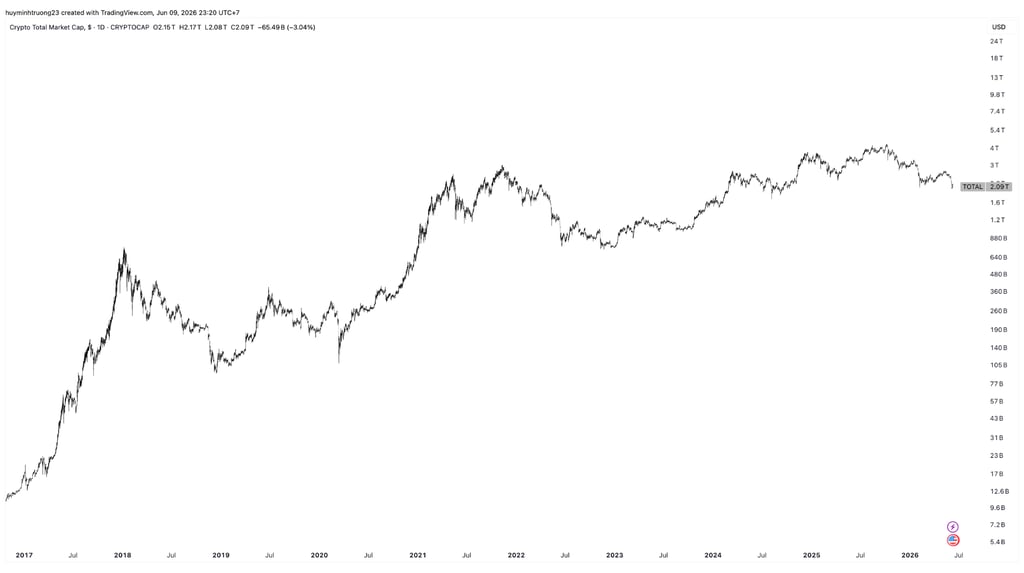
Venture capital investment in the cryptocurrency sector declined sharply throughout May, setting the lowest trading volume in five years as institutional capital shifted significantly.
6/9/20264 min read
Investment flows are shifting away from crypto.
The scale of investment reallocation into artificial intelligence has reached levels far exceeding that of the cryptocurrency sector, with AI companies globally attracting approximately $242 billion, accounting for 80% of total venture capital deployed in the early part of 2026. Mega-tech companies like Microsoft and Meta have committed a combined total of over $300 billion in AI infrastructure investment spending in just one year, setting a scale of spending incomparable to the entire annual cryptocurrency venture capital ecosystem.
Silicon Valley Bank's 2026 cryptocurrency outlook described a fundamental shift in which capital allocation decisions increasingly prioritize infrastructure layers that generate immediate cash flow and demonstrate sustainable revenue over speculative blockchain initiatives dependent on public adoption and cryptocurrency price appreciation.
This shift reflects the realization among institutional venture investors that sustainable business models require a identifiable customer base, measurable unit economic efficiency, and differentiated technical capabilities compared to competitors, rather than relying on network effects and speculative positioning.
Venture capital investment in cryptocurrencies in the United States reached $7.9 billion in 2025, representing an annual growth of 44%, but still represents only a tiny fraction of the $193 billion in global venture capital investment in artificial intelligence, creating a competitive disadvantage as cryptocurrency startups compete for the remaining scarce venture capital amid a shift toward more profitable AI opportunities.
Cryptocurrency IPO roadmap stalled and valuations narrowed.
The reallocation of institutional capital into artificial intelligence is simultaneously disrupting the IPO preparations of cryptocurrency exchanges, with major exchanges including Kraken (Payward) and Ledger indefinitely postponing their planned US public offerings in the first half of 2026. Kraken's parent company, Payward, filed a confidential S-1 application in November 2025 in preparation for an early 2026 IPO, then paused its IPO preparations in March 2026, coinciding with a weakening cryptocurrency market and a sharp increase in the value of artificial intelligence.
The postponement of the IPO due to a parallel secondary share sale to Deutsche Börse in April 2026 valued Kraken at $13.3 billion, representing a decrease of approximately 33% from the previous funding round that established a valuation of $20 billion just months earlier. This valuation decline reflects investors reassessing the sustainability of the exchange business model amid declining cryptocurrency trading volumes and competitive pressure from centralized exchanges managing cryptocurrency custody functions with minimal operating costs.
Ledger, a manufacturer of cryptocurrency hardware wallets, also postponed its planned US public listing in mid-May 2026, despite previously partnering with Goldman Sachs, Jefferies, and Barclays as IPO underwriters, targeting a public valuation of over four billion dollars. Ledger subsequently opted for a modest $50 million private placement of secondary shares instead of pursuing a public offering, highlighting a clear discrepancy between its earlier IPO goals and actual market demand for ownership in its cryptocurrency infrastructure.
The driving force behind the concentration of institutional investment capital.
Comments from venture capital analysts have established a consensus that the focus of capital on proven teams and established projects reflects institutional investors' adaptation to a competitive environment where traditional investment arguments based on performance stories are less effective than evaluation of the underlying business model. Anthony Vassallo, senior vice president of cryptocurrency at Silicon Valley Bank, described the institutional adoption trend as follows: "As institutional adoption accelerates, driving larger venture investments, we expect continued concentration of capital in fewer companies, with investors prioritizing higher-quality projects and subsequent investments in proven teams."
This focused argument suggests that the future cryptocurrency venture capital market will resemble institutional venture capital in general, where established companies with proven execution capabilities attract a disproportionate share of funding, while emerging teams struggle to attract venture capital interest regardless of their technological innovation potential. This model mirrors the dynamics of venture capital in other technology sectors, where institutional investors focus capital on proven managers rather than allocating it to emerging opportunities.
Assessment and Conclusion
The scarcity of venture capital in the cryptocurrency sector and the decline in valuations affecting projects unrelated to artificial intelligence have created a clear market signal that institutional investor confidence in non-AI-based cryptocurrencies has significantly diminished compared to previous bull market phases. This reallocation of capital reflects market participants' perception that the creation of cryptocurrency value increasingly depends on integration with artificial intelligence rather than standalone blockchain applications.
For cryptocurrency entrepreneurs and development teams, this environment has created a challenging fundraising landscape where traditional cryptocurrency projects face systemic skepticism from investors unless they explicitly integrate artificial intelligence components. This competitive disadvantage for non-AI-based cryptocurrency projects has pressured them to either shift toward AI integration or accept reduced venture capital funding, hindering growth and talent retention.
For institutional investors, the concentration of capital in a few AI-based cryptocurrency projects has created concentration risk, where the entire cryptocurrency allocation depends on the successful implementation of a handful of protocols. This concentration creates a scenario where protocol-level failures or technical issues affecting large investments could cause a sharp decline in the portfolio despite generally positive cryptocurrency market conditions.
Disclaimer: The information presented in this article is the author's personal opinion in the field of cryptocurrencies. This is not financial or investment advice at all. Every investment decision should be based on careful consideration of your personal portfolio and risk tolerance. The opinion in the article does not represent the official position of the platform. We recommend that readers do their own research and consult experts before making any investment decisions.
Synthesized and analyzed by HCCVenture
Follow HCCVenture organization here: https://link3.to/holdcoincventure
Explore HCCVenture group
HCCVENTURE QUANT JSCO
© 2026 HCCVENTURE. ALL COPYRIGHTS RESERVED.


Connect with us
Popular content
Contact to us
Address: 8th Floor, Bach Dang Complex Building, 50 Bach Dang Street, Hai Chau Ward, Da Nang City, Vietnam.
Phone: 1900 1509
Gmail : sp_contact@hccventure.com
Disclaimer: The information on this website is for informational purposes only and should not be considered investment advice. We are not responsible for any risks or losses arising from investment decisions based on the content here.
TERMS AND CONDITIONS • CUSTOMER PROTECTION POLICY
ANALYTICAL AND NEWS CONTENT IS COMPILED AND PROVIDED BY EXPERTS IN THE FIELD OF DIGITAL FINANCE AND BLOCKCHAIN BELONGING TO HCCVENTURE ORGANIZATION, INCLUDING OWNERSHIP OF THE CONTENT.
RESPONSIBLE FOR MANAGING ALL CONTENT AND ANALYSIS: HCCVENTURE FOUNDER - TRUONG MINH HUY
Read warnings about scams and phishing emails — REPORT A PROBLEM WITH OUR SITE.