

Hyperliquid leads Blockchain fee revenue in 24 hours - surpassing Tron and Solana
Hyperliquid recorded about 2.3 million USD in charge revenue in 24 hours, far surpassing Tron with about 1.2 million USD and leading the entire blockchain market according to data from Artemis.
5/23/20264 min read
Hyperliquid is becoming the "transaction layer" of cryptocurrency
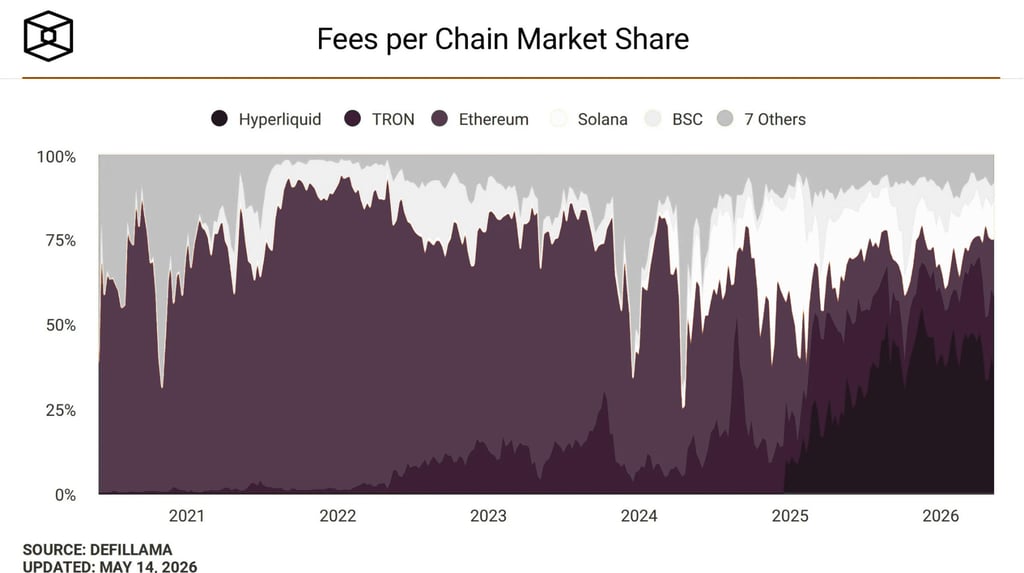
According to the Artemis chain analysis platform, Hyperliquid has generated $2.3 million in fee revenue in the past 24 hours, holding the leading position among all blockchains and far ahead of the second place is Tron with 1.2 million dollars. This data highlights Hyperliquid's growing dominance in decentralized perpetual contract trading and its ability to capture significant value from high-volume, leveraged trading.
The strong performance of Hyperliquid stems from some structural advantages:
Eternal contract specialization: As a leading decentralized perpetual contract exchange, Hyperliquid benefits from high trading frequency, leverage (usually 10-20 times) and open trading volume that creates stable fees.
Growth of risky assets (RWA) and crypto assets: This platform has expanded to crypto real assets and commodity perpetual contracts, attracting professional traders and organizations seeking 24/7 access.
Effective design: Low latency, high throughput and capital-saving transaction mechanism help users always interact and transaction fees increase rapidly.
In contrast, the second position of Tron mainly comes from stablecoin transfer transactions and high-volume, low-value transactions, while Solana and Ethereum generate fees from more diverse types of transactions such as DeFi, NFT and general operations. Hyperliquid's blue bar stands out more than its competitors, followed by Tron (red), Solana, edgeX, Ethereum, BNB Chain, Bitcoin, Base and a series of other smaller coins.
The Numbers Reshaping The Blockchain Economy
Artemis's data tracking total blockchain revenue as of mid-May 2026 shows that Hyperliquid leads all chains with $1.16 billion in cumulative revenue since its public launch in November 2023, a figure surpassing Solana with $532.3 million, Tron with $471.2 million and Ethereum with $425.6 million in the same period. This ranking represents a fundamental reversal of the traditional blockchain hierarchy, where Ethereum previously dominated fee generation through its position as the payment layer for decentralized financial operations, while newer Layer 1 networks compete for market share through lower costs and higher throughput.
Recent 24-hour snapshots illustrate Hyperliquid's consistently charge lead over multiple measurement periods. In early January 2026, Artemis recorded about $964,700 in fees compared to $690,000 on Tron and $506,000 on Solana in the same 24 hours. By mid-February, Hyperliquid's daily transaction fees had increased to $1.4 million, supported by a continuous trading volume of $7.4 billion. April saw the platform generate $2 million in transaction fees within 24 hours, more than twice as much as Tron's $1.2 million in the same period. The consistency between these indicators shows that the revenue model is sustainable rather than a temporary spike due to unsustainable promotion or subsidy activities.
The thesis of dedicated Blockchain is attested
The way Matt Hougan sees the success of Hyperliquid as a confirmation of the "revenuation chain era" reflects the broader argument that specialized blockchains optimized for narrow use cases can outperform versatile platforms when the unit economy prioritizes specialization. Ethereum and Solana strive to support unlimited applications through a flexible smart contract environment, accepting trade-ons on performance and user experience to maintain generality. Hyperliquid sacrifices generality to optimize performance, especially around permanent derivatives, implementing consensus mechanisms, state machines and network layers designed exclusively to support order matching and high throughput order book settlement.
The dedicated architecture allows possibilities that would be impossible or economically impossible on the multi-purpose blockchain. Hyperliquid processes thousands of order book updates per second with a delay of less than one second, maintaining a complex order matching tool logic naturally instead of in smart contracts and paying transactions atomically without many transaction confirmations. Professional trading companies require these characteristics and will pay higher fees through higher trading volumes when the quality of execution meets their requirements. Multi-purpose blockchains that operate permanent exchanges through smart contracts cannot achieve the same performance without affecting the ability to support other applications, creating a limit on the amount of professional trading activity they can capture.
Sustainability issues and competitive response
Hyperliquid's current fee dominance raises questions about long-term sustainability as competitors react and market conditions change. The success of this platform has not been ignored, with long-standing derivatives exchanges such as dYdX and new joining units such as Vertex Protocol developing similar high-performance order book models. As competition grows fierce, fee reductions can reduce Hyperliquid's revenue even if trading volume remains stable or grows, reflecting the move in the traditional financial sector, where competition has pushed the commission rate to almost zero in the retail brokerage and ETF industry.
The market structure of this platform also focuses on risk in ways that versatile blockchains avoid through diversification. A significant part of Hyperliquid's trading volume and fees may come from a relatively small number of large trading companies and market makers, whose participation depends on ongoing profits and favorable market conditions. If some major participants withdraw due to regulatory concerns, changes in trading strategies, or the launch of competitive locations, the impact on fees can be huge and immediate. Multi-purpose blockchains support thousands of applications that face the same risks as individual protocols, but benefit from diversification across different fields, which rarely have a perfect correlation.
Evaluation and conclusion
The broader meaning is to recognize that "versatile blockchain" may not be the inevitable final state that many industry participants have assumed in previous cycles. The argument that one or two platforms will capture most of blockchain activities through network effects and ecosystem advantages is based on the assumption that versatility will not cause significant performance or economic disadvantages. Hyperliquid demonstrates that for some applications, dedicated infrastructure can overcome the disadvantages of newcomers through unit economic efficiency and superior user experience, showing persistent fragmentation on vertical specialized chains rather than consolidation around horizontal platforms. Whether this model will expand beyond derivatives to other major cryptocurrency use cases remains to be seen, but the pattern now exists for groups considering the decision to build on L1 versus developing their own chain.
Disclaimer: The information presented in this article is the author's personal opinion in the field of cryptocurrencies. This is not financial or investment advice at all. Every investment decision should be based on careful consideration of your personal portfolio and risk tolerance. The opinion in the article does not represent the official position of the platform. We recommend that readers do their own research and consult experts before making any investment decisions.
Synthesized and analyzed by HCCVenture
Follow HCCVenture organization here: https://link3.to/holdcoincventure
Explore HCCVenture group
HCCVENTURE QUANT JSCO
© 2026 HCCVENTURE. ALL COPYRIGHTS RESERVED.


Connect with us
Popular content
Contact to us
Address: 8th Floor, Bach Dang Complex Building, 50 Bach Dang Street, Hai Chau Ward, Da Nang City, Vietnam.
Phone: 1900 1509
Gmail : sp_contact@hccventure.com
Disclaimer: The information on this website is for informational purposes only and should not be considered investment advice. We are not responsible for any risks or losses arising from investment decisions based on the content here.
TERMS AND CONDITIONS • CUSTOMER PROTECTION POLICY
ANALYTICAL AND NEWS CONTENT IS COMPILED AND PROVIDED BY EXPERTS IN THE FIELD OF DIGITAL FINANCE AND BLOCKCHAIN BELONGING TO HCCVENTURE ORGANIZATION, INCLUDING OWNERSHIP OF THE CONTENT.
RESPONSIBLE FOR MANAGING ALL CONTENT AND ANALYSIS: HCCVENTURE FOUNDER - TRUONG MINH HUY
Read warnings about scams and phishing emails — REPORT A PROBLEM WITH OUR SITE.