

Hyerliquid whales are ready to spend big on oil futures contracts
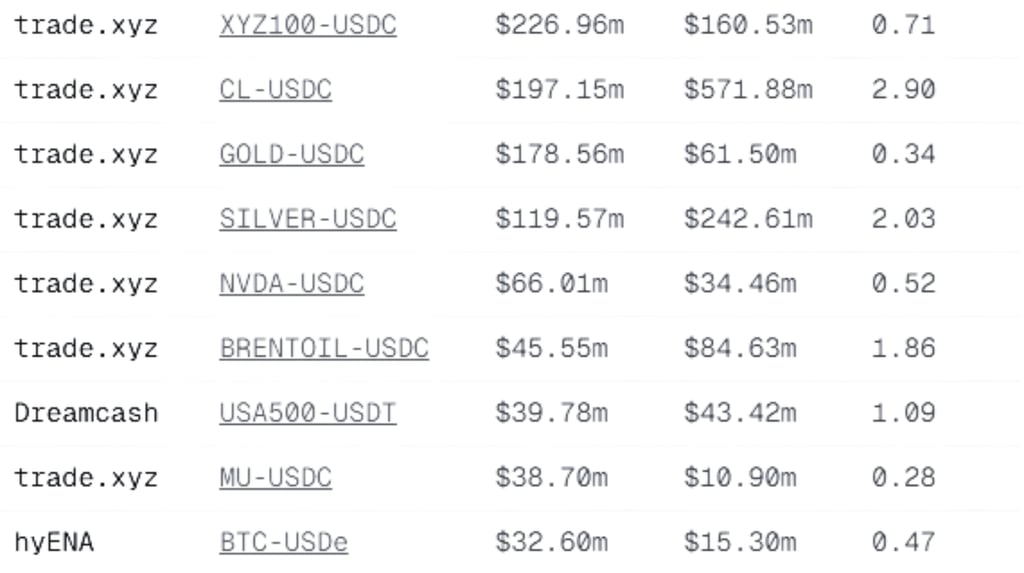
According to sources, major traders on Hyperliquid have begun shifting significant amounts of capital into oil futures positions, signaling growing interest in derivative products.
3/10/20263 min read
Are whales moving away from crypto, ignoring crypto?
On-chain analytics and order book data from Hyperliquid—a leading decentralized perpetual futures exchange—show that several large wallets (often referred to as “whales”) have significantly increased their holdings of oil futures contracts over the past 3-4 weeks. This shift comes amid renewed volatility in the global energy market following escalations in the Middle East, Qatar’s liquefied natural gas (LNG) production shutdowns, and uncertainty surrounding flows through the Strait of Hormuz.
Total accumulated notional value: Whales have opened or moved into new WTI and Brent crude oil futures positions with an estimated total notional value of $180-220 million since mid-February 2026.
The majority were long positions (bets on higher oil prices), with average entry prices ranging from $82-88 for WTI and $86-92 for Brent.
Top wallets involved (spoofing addresses tracked via Hyperliquid Explorer and Arkham Intelligence):
0x…a7f9 → Nominal WTI long position of approximately $68 million USD (largest position)
0x…c2e1 → Long position on Brent + WTI price difference of approximately $45 million USD
A group of 4-6 smaller whales (each worth approximately $15-25 million) are building correlated long positions.
The leverage was primarily 5-10 times, with some positions reaching 15-20 times during periods of high intraday volatility. Hyperliquid oil futures contracts have recorded consistently positive funding rates (long positions paying short positions) averaging 0.015-0.035% per hour in recent days — indicating a concentration of long positions.
The DeFi derivatives market is expanding.
Hyperliquid has become one of the fastest-growing decentralized derivatives platforms, offering perpetual futures trading with ample liquidity and high leverage. Traditionally, decentralized exchanges have focused primarily on cryptocurrency assets like Bitcoin and Ethereum, but newer platforms are beginning to introduce markets tied to broader macro assets.
Oil futures contracts allow traders to speculate on the future price of crude oil without holding the physical commodity. By integrating such markets, decentralized platforms are expanding into areas previously dominated by traditional commodity exchanges.
The rise of macro trading in cryptocurrencies
The shift toward commodity derivatives reflects a broader evolution in cryptocurrency trading culture. More and more cryptocurrency traders are adopting macro trading strategies that integrate traditional asset classes such as commodities, interest rates, and foreign exchange.
This convergence is gradually blurring the lines between decentralized finance and traditional financial markets. Platforms capable of offering both cryptocurrencies and macro derivatives could attract a new generation of traders seeking diversification through blockchain-based infrastructure.
Risks of leveraged commodity trading
Despite potential opportunities, commodity derivatives still carry significant risks—especially when combined with leverage. The oil futures market is notoriously volatile, and price fluctuations can lead to rapid liquidation for traders holding highly leveraged positions.
Decentralized derivatives platforms often offer high leverage ratios, which can amplify both profits and losses. Market participants must carefully manage the level of risk when trading macro assets on DeFi platforms.
Our review
The shift of large investors on Hyperliquid to trading oil futures contracts demonstrates the increasing sophistication of trading strategies in the decentralized finance (DFI) sector. As DeFi platforms expand beyond pure cryptocurrency assets into commodities and macro markets, they are beginning to resemble large-scale global derivatives exchanges operating on blockchain infrastructure.
This development could represent the next phase of DeFi evolution—where decentralized platforms offer a range of traditional financial markets previously only accessible to centralized institutions.
Disclaimer: The information presented in this article is the author's personal opinion in the field of cryptocurrency. This is not financial or investment advice. All investment decisions should be based on careful consideration of your personal portfolio and risk tolerance. The views expressed in this article do not represent the official stance of the platform. We recommend that readers conduct their own research and consult with experts before making any investment decisions.
Compiled and analyzed by HCCVenture
Follow HCCVenture here: https://link3.to/holdcoincventure
Explore HCCVenture group
HCCVENTURE QUANT JSCO
© 2026 HCCVENTURE. ALL COPYRIGHTS RESERVED.


Connect with us
Popular content
Contact to us
Address: 8th Floor, Bach Dang Complex Building, 50 Bach Dang Street, Hai Chau Ward, Da Nang City, Vietnam.
Phone: 1900 1509
Gmail : sp_contact@hccventure.com
Disclaimer: The information on this website is for informational purposes only and should not be considered investment advice. We are not responsible for any risks or losses arising from investment decisions based on the content here.
TERMS AND CONDITIONS • CUSTOMER PROTECTION POLICY
ANALYTICAL AND NEWS CONTENT IS COMPILED AND PROVIDED BY EXPERTS IN THE FIELD OF DIGITAL FINANCE AND BLOCKCHAIN BELONGING TO HCCVENTURE ORGANIZATION, INCLUDING OWNERSHIP OF THE CONTENT.
RESPONSIBLE FOR MANAGING ALL CONTENT AND ANALYSIS: HCCVENTURE FOUNDER - TRUONG MINH HUY
Read warnings about scams and phishing emails — REPORT A PROBLEM WITH OUR SITE.