

Global instability index breaks record - Surpassing past volatility peaks
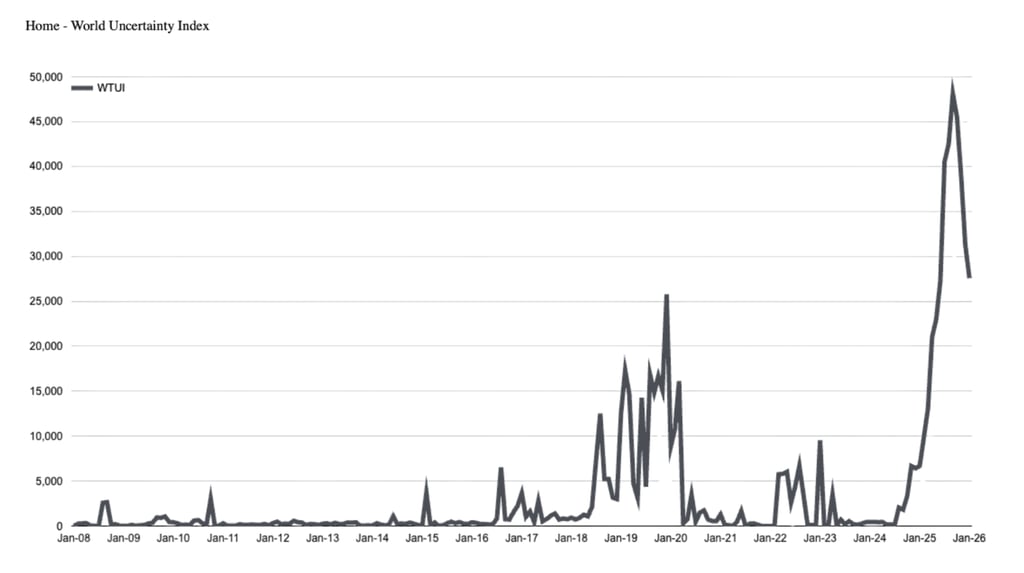
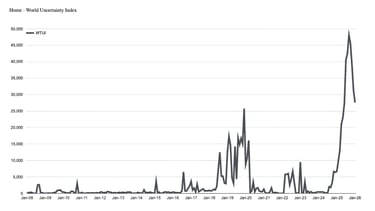
The World Uncertainty Index (WUI) is believed to have reached a record high, surpassing levels recorded during the COVID-19 pandemic, the 2008 global financial crisis, and the collapse of the dot-com bubble.
2/19/20263 min read
What's happening globally ?
The World Uncertainty Index (WUI) is believed to have reached a record high, surpassing levels seen during the COVID-19 pandemic, the 2008 global financial crisis, and the collapse of the dot-com bubble. This milestone signals an exceptional level of macroeconomic and geopolitical uncertainty – which may be reshaping capital allocation, policy decisions, and investor sentiment worldwide. Unlike past localized crises, the current instability appears multifaceted and persistent.
The Global Uncertainty Index tracks the frequency with which the term “ uncertainty ” appears in the Economist Intelligence Unit’s national reports around the globe. It serves as an indirect measure of how often governments, analysts, and policymakers describe their environment as unpredictable.
The record levels indicate that economic actors – governments , institutions , and markets – are facing unprecedented uncertainty on multiple variables simultaneously.
A complete picture of history
To understand the severity of the current index , consider WUI 's behavior in past fluctuations. The index typically surges in the face of shocks but rarely sustains such high levels without a catalytic event. History shows:
Dot-Com Bubble (2000-2002): Overvaluation and bursting of technology stocks.
The 9/11 Attacks (2001): Terrorism and Security Shocks
Iraq War (2003): Geopolitical Invasion and Oil Price Volatility
Global Financial Crisis (2008): Housing bubble, bank failures, credit freeze.
COVID-19 Pandemic (2020): Health Crisis, Lockdowns, Supply Chain Disruptions
This escalation is not just about quantity; it's also about quality. Previous spikes were often linked to remedial causes , allowing for targeted policy responses. Today's record reflects " double instability ," where risks are linked and amplify each other.
The reasons for the current increase.
The surge in the WUI index to record levels in early 2026 stems from a toxic combination of factors, not a single culprit but a network of interconnected pressures. According to the World Economic Forum's 2026 Global Risks Report, geoeconomic conflict tops the list of short-term threats, driven by high debt burdens, volatile markets, and concerns about rising inflation.
The volatility of trade policy: US tariffs under the Trump administration's " Liberation Day " initiative, announced in 2025, have reignited global trade wars. These measures, aimed at protecting domestic industries , have disrupted supply chains, increased costs, and led to retaliatory actions from partners such as China and the EU. Analysts predict that these policies could reduce global GDP growth by 0.5% while increasing US revenue by $170 billion – a risky trade-off that creates instability.
Geopolitical tensions: Ongoing conflicts in Russia and Ukraine, escalating tensions between the US and Iran, and hotspots between China and Taiwan create a " no-win " scenario. These issues are not isolated; they spill over into energy markets , commodity prices , and migration flows , exacerbating economic fragmentation.
Monetary and fiscal pressures: The weakening US dollar amid budget deficits and de-dollarization efforts by BRICS countries increases risks, pushing investors toward tangible assets. This multi-crisis dynamic—described by the IMF as overlapping crises—makes resolution difficult, as addressing one issue (e.g., trade agreements) can exacerbate others (e.g., inflation).
Our review
The record high of the WUI index is not a passing phenomenon but a signal of structural shifts in the global order. As geopolitical rifts deepen and trade is exploited as a weapon, instability could persist, testing resilience. However, crises create opportunities – past crises have spawned innovations such as the rise of blockchain after 2008.
Investors who anticipate policy responses and diversify their portfolios wisely are likely to succeed. As the IMF rightly pointed out, while uncertainty increases, economic resilience remains. In an era of the unknown, vigilance is key.
Disclaimer: The information presented in this article is the author's personal opinion in the field of cryptocurrency. This is not financial or investment advice. All investment decisions should be based on careful consideration of your personal portfolio and risk tolerance. The views expressed in this article do not represent the official stance of the platform. We recommend that readers conduct their own research and consult with experts before making any investment decisions.
Compiled and analyzed by HCCVenture
Follow HCCVenture here: https://link3.to/holdcoincventure
Explore HCCVenture group
HCCVENTURE QUANT JSCO
© 2026 HCCVENTURE. ALL COPYRIGHTS RESERVED.


Connect with us
Popular content
Contact to us
Address: 8th Floor, Bach Dang Complex Building, 50 Bach Dang Street, Hai Chau Ward, Da Nang City, Vietnam.
Phone: 1900 1509
Gmail : sp_contact@hccventure.com
Disclaimer: The information on this website is for informational purposes only and should not be considered investment advice. We are not responsible for any risks or losses arising from investment decisions based on the content here.
TERMS AND CONDITIONS • CUSTOMER PROTECTION POLICY
ANALYTICAL AND NEWS CONTENT IS COMPILED AND PROVIDED BY EXPERTS IN THE FIELD OF DIGITAL FINANCE AND BLOCKCHAIN BELONGING TO HCCVENTURE ORGANIZATION, INCLUDING OWNERSHIP OF THE CONTENT.
RESPONSIBLE FOR MANAGING ALL CONTENT AND ANALYSIS: HCCVENTURE FOUNDER - TRUONG MINH HUY
Read warnings about scams and phishing emails — REPORT A PROBLEM WITH OUR SITE.