

Georgia Tests Hedera Real Estate on Blockchain
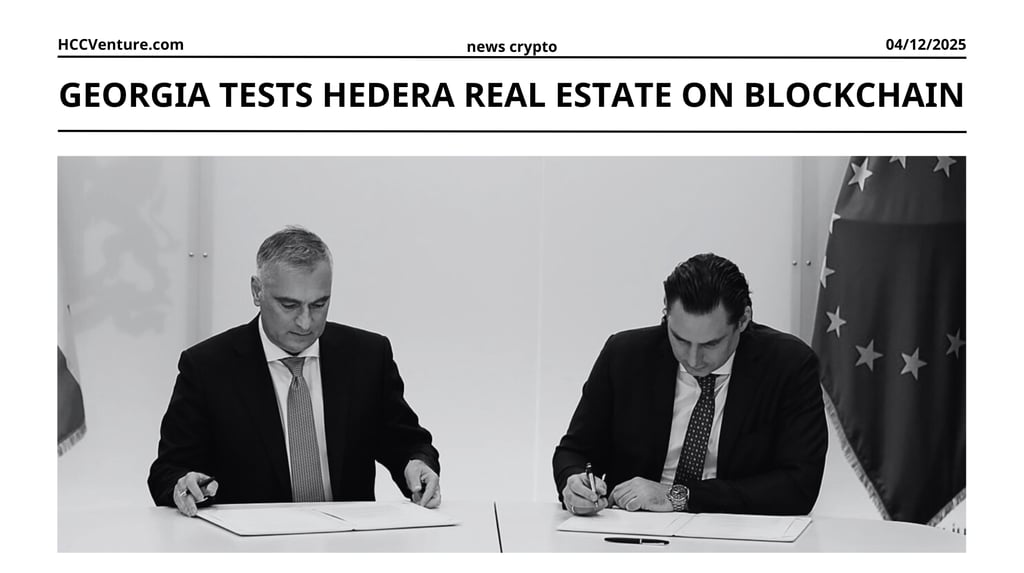
Georgia, the Caucasus nation that has long been a pioneer in blockchain adoption, has taken a bold step forward by signing a Memorandum of Understanding (MoU) with Hedera – potentially allowing real estate to be tokenized.
12/4/20252 min read
Hedera for the Georgia Public Registry
The Republic of Georgia is accelerating its digital transformation agenda by partnering with Hedera, one of the world's leading enterprise-grade distributed ledger networks, to pilot a blockchain-based national property registry.
Through a newly signed memorandum of understanding (MoU) between the Ministry of Justice and the Hedera ecosystem, Georgia becomes one of the first countries in Eastern Europe to explore decentralized technology to secure, authenticate, and transfer land ownership records.
The initiative builds on Georgia’s long-standing ambitions to modernize its government infrastructure and position itself as a regional tech hub — but the choice of Hedera, rather than a traditional blockchain like Ethereum, signals a strategic interest in high-throughput, low-latency, permission-ready networks optimized for government use cases.
Bitcoin Pioneers Come to Hedera Hub
Georgia began adopting blockchain in 2017, when it partnered with Bitfury to verify real estate transactions on Bitcoin, processing over 100,000 records in months—a move that reduced fraud by 90% and inspired global partners like Sweden and the US state of Georgia.
The 2021 upgrade of the National Public Registry incorporated blockchain for land titles, but scalability limitations prompted Hedera’s involvement. Its hashgraph consensus mechanism offers 10,000 transactions per second (TPS) with fees below 1 cent, making it ideal for high-volume public records.
The memorandum aligns with Georgia's Digital Georgia Strategy 2024, which targets 80% digital public services by 2027, and complements the country's crypto-friendly stance—a low 15% corporate tax and 0% VAT on blockchain exports.
With annual FDI inflows of $2 billion, tokenized real estate could attract an additional $1 billion, PwC estimates, while also boosting EU integration prospects. Hedera’s enterprise focus—backed by Google, IBM, and Boeing—ensures compliance, with permissioned nodes mitigating the centralization risks that plagued early pilots.
Our review
Georgia’s pilot of a Hedera-based real estate registration system marks a significant milestone in the practical application of blockchain. More than just a technological experiment, it reflects Georgia’s ambition to modernize governance, combat corruption, and enhance public trust through transparent, tamper-proof digital infrastructure.
If the pilot is successful, Georgia could become one of the first countries to anchor its national land registry system on a decentralized network — setting a precedent for governments around the world. For Hedera, this is another step toward establishing itself as the go-to platform for digital transformation at the government level.
Disclaimer: The information presented in this article is the author's personal opinion in the cryptocurrency field. It is not intended to be financial or investment advice. Any investment decision should be based on careful consideration of your personal portfolio and risk tolerance. The views expressed in this article do not represent the official position of the platform. We recommend that readers conduct their own research and consult with a professional before making any investment decisions.
Explore HCCVenture group
HCCVENTURE QUANT JSCO
© 2026 HCCVENTURE. ALL COPYRIGHTS RESERVED.


Connect with us
Popular content
Contact to us
Address: 8th Floor, Bach Dang Complex Building, 50 Bach Dang Street, Hai Chau Ward, Da Nang City, Vietnam.
Phone: 1900 1509
Gmail : sp_contact@hccventure.com
Disclaimer: The information on this website is for informational purposes only and should not be considered investment advice. We are not responsible for any risks or losses arising from investment decisions based on the content here.
TERMS AND CONDITIONS • CUSTOMER PROTECTION POLICY
ANALYTICAL AND NEWS CONTENT IS COMPILED AND PROVIDED BY EXPERTS IN THE FIELD OF DIGITAL FINANCE AND BLOCKCHAIN BELONGING TO HCCVENTURE ORGANIZATION, INCLUDING OWNERSHIP OF THE CONTENT.
RESPONSIBLE FOR MANAGING ALL CONTENT AND ANALYSIS: HCCVENTURE FOUNDER - TRUONG MINH HUY
Read warnings about scams and phishing emails — REPORT A PROBLEM WITH OUR SITE.