

ETHGas Launches “Open Gas Initiative” — Aiming to Eliminate Ethereum Gas Fees
ETHGas, a pioneering project in the Ethereum ecosystem, has just announced the launch of the Open Gas Initiative – an open-source toolkit that aims to completely eliminate gas fees for end users.
12/6/20252 min read
Core Message and Promise
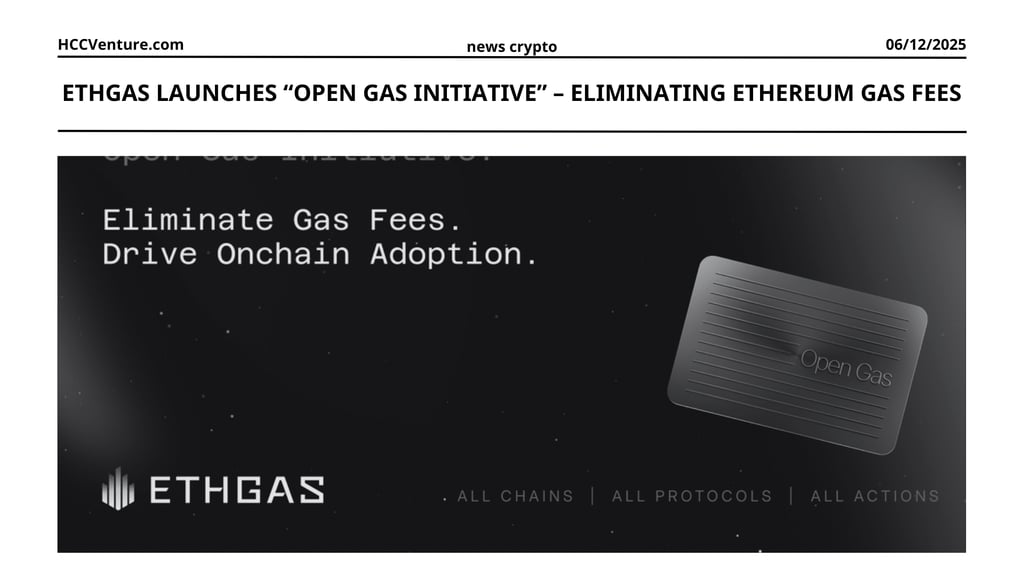
ETHGas has officially launched the Open Gas Initiative, unveiling its vision to “ remove gas fees from the end-user experience ” and push Ethereum towards a frictionless, real-time on-chain economy.
Under the initiative, decentralized applications (dApps) and protocols will be able to subsidize gas fees on behalf of users — thereby removing one of the main barriers to widespread on-chain adoption. ETHGas says the program is currently live on the Ethereum mainnet, with plans to expand support to major Layer 2 and EVM-compatible chains.
Specifically, when a user interacts with a partner dApp, the gas cost will be covered by the protocol — allowing users to enjoy a “ gas-free ” experience while the protocol still maintains the ability to manage the underlying gas economy through ETHGas’s blockspace marketplace and refund tools.
Overcoming Historical UX Barriers
For years, unpredictable and often high gas fees have been a core disadvantage for Ethereum — especially for new users, small users, or frequent users of DeFi, NFTs, or microtransactions. Gas fees act as a “ hidden tax ” on the user experience and are a major psychological and economic barrier to mainstream Web3 adoption.
By creating a model where dApps can absorb or subsidize gas costs, ETHGas aims to completely eliminate that barrier. This could significantly lower the barrier to use for everyday users — increasing on-chain activity, driving adoption, and bringing Ethereum closer to a world where blockchain interactions are as easy as using a web application.
In that sense, Open Gas acts as a gas abstraction layer, turning “ gas costs ” from an unavoidable burden into a manageable ancillary cost—handled by protocols rather than end users.
How Open Gas Works
Open Gas is not a single feature, but a set of tools and mechanisms designed to support gas abstraction and blockspace risk management across the Ethereum ecosystem:
Protocols can subsidize user gas fees without writing additional code — ETHGas provides a “ no-code ” integration layer.
Gas rebate structures allow protocols to provide monthly rebates (in ETH or protocol tokens) to users who transact through them. This helps offset gas costs while giving protocols flexibility in using coupons and incentives.
Refunds and subsidies turn gas from a pain point into a growth driver — protocols use it to attract new users, incentivize desired behaviors (liquidity provision, staking, usage), and increase retention.
On the platform side, ETHGas also offers hedging and blockspace trading tools. By structuring blockspace as a tradable commodity, ETHGas enables advanced risk management for protocols, ensuring fee coverage even during periods of volatile fees.
Gas-free future
The Open Gas Initiative is one of the boldest infrastructure investments in Ethereum in 2025. By reimagining gas fees not as a burden but as a platform cost that is abstracted, subsidized, or hedged, ETHGas aims to usher in a gasless, user-friendly, and growth-oriented Ethereum — a network where transaction friction disappears and on-chain adoption becomes seamless.
If successful, the implications will go far beyond cheaper transactions. We could see a DeFi paradigm shift, dApps and Web3 services become more accessible to mainstream users, global liquidity flows are eased, and Ethereum solidifies its position as the leading blockchain for real-time, user-centric financial infrastructure.
Disclaimer: The information presented in this article is the author's personal opinion on the cryptocurrency field. It is not intended to be financial or investment advice. Any investment decision should be based on careful consideration of your personal portfolio and risk tolerance. The views expressed in this article do not represent the official position of the platform. We recommend that readers conduct their own research and consult with a professional before making any investment decisions.
Explore HCCVenture group
HCCVENTURE QUANT JSCO
© 2026 HCCVENTURE. ALL COPYRIGHTS RESERVED.


Connect with us
Popular content
Contact to us
Address: 8th Floor, Bach Dang Complex Building, 50 Bach Dang Street, Hai Chau Ward, Da Nang City, Vietnam.
Phone: 1900 1509
Gmail : sp_contact@hccventure.com
Disclaimer: The information on this website is for informational purposes only and should not be considered investment advice. We are not responsible for any risks or losses arising from investment decisions based on the content here.
TERMS AND CONDITIONS • CUSTOMER PROTECTION POLICY
ANALYTICAL AND NEWS CONTENT IS COMPILED AND PROVIDED BY EXPERTS IN THE FIELD OF DIGITAL FINANCE AND BLOCKCHAIN BELONGING TO HCCVENTURE ORGANIZATION, INCLUDING OWNERSHIP OF THE CONTENT.
RESPONSIBLE FOR MANAGING ALL CONTENT AND ANALYSIS: HCCVENTURE FOUNDER - TRUONG MINH HUY
Read warnings about scams and phishing emails — REPORT A PROBLEM WITH OUR SITE.