

Ethereum Launches Fusaka Upgrade - Breaking the Scalability World
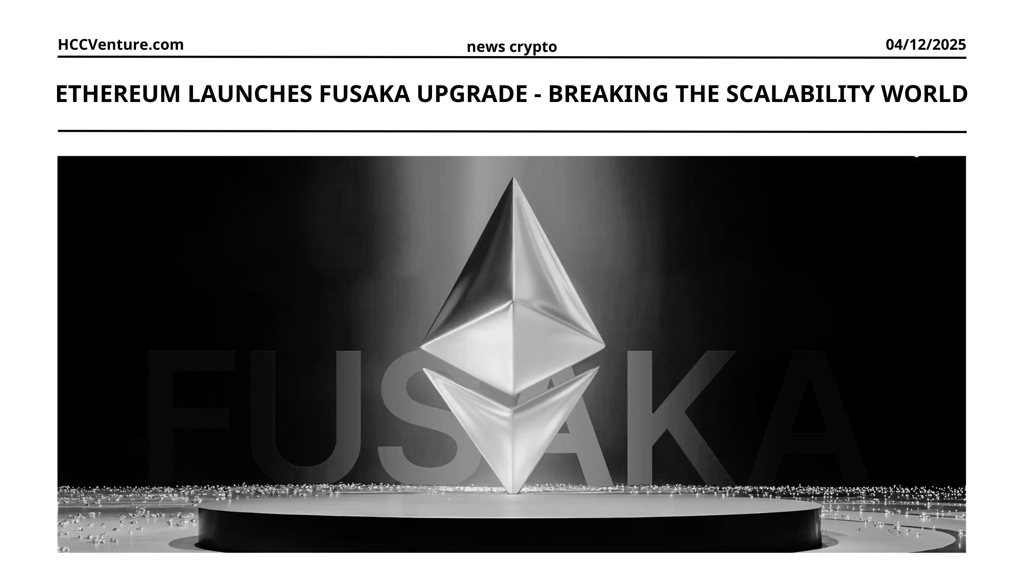
Ethereum has successfully deployed its 17th major upgrade, Fusaka, to the mainnet, activating at slot 13,164,544, a process that took just 15 minutes to achieve full network convergence across validators.
12/4/20252 min read
Mainnet Magic in 15 Minutes
Fusaka, Ethereum's name combining " Fulu " (consensus layer) and " Osaka " ( execution layer, reminiscent of the governing body of Devcon 2025 ), has moved to mainnet with incredible performance. Validators, comprising over 99% of staked ETH ( 32 million tokens ), synchronized in less than 15 minutes, demonstrating rigorous testing on the Holesky testnet (October 1), Sepolia (October 14), and Hoodi (October 28).
The highlight of the upgrade, PeerDAS, allows validators to sample data in “slices” instead of the entire blob, reducing bandwidth requirements by 8x and allowing roll-up platforms like Arbitrum and Optimism to process exponentially increasing transaction volumes for fees under $0.01. Core EIPs implemented:
EIP-7623 (PeerDAS): Expand blob capacity from 6 to 16 per block, increase L2 throughput by 8x, and cut costs by 50% - key to the ambition of reaching over 31,000 TPS.
Verkle Trees: Replace Merkle trees with vector commits, reducing node storage by a factor of 10, down to 100GB, and facilitating decentralization to home-based operators.
EIP-7935 (Gas Limit Increase): Defaults to 60 million gas per block (up from 45 million since 2021), 33% capacity increase, supports 20-40 TPS on L1.
Once activated, the small branches (Blob Parameter Only, BPO) on December 9 and January 7 will gradually increase the blob target to 21, ensuring gradual scaling without overloading.
Proof of Ethereum's maturity
The speed with which the upgrade was completed shocked even veteran researchers. Despite its wide scope—both in terms of execution and consensus logic—the rollout did not experience any network instability, no stalled validators, and no chain splits.
This smooth implementation was made possible by months of coordinated network testing exercises across:
Holesky (October 1)
Sepolia (October 14)
Hoodi (October 28)
Each phase stresses the network with high blob throughput, accelerated block production, and simulated validator load. Mainnet convergence in 15 minutes is now considered the benchmark for blockchain governance and upgrade engineering.
A Turning Point for Ethereum's Roadmap
Ethereum has signaled that it can scale in real time, at production scale, without destabilizing the chain. That’s a foundational achievement that few blockchains have demonstrated. Fusaka is the most important upgrade since the merger because it simultaneously strengthens:
Scalability through PeerDAS
Decentralization through Verkle Trees
Throughput through higher gas limits
Economic Rollup via blob is cheaper
Validator accessibility through reduced node storage
Together, these advances move Ethereum closer to a “modular future” — where L1 acts as a secure, capital-efficient settlement layer and L2 provides the mass-market transaction capacity needed for consumer applications.
Our review
The Fusaka upgrade marks a historic milestone for Ethereum, setting new standards in network performance, validator coordination, and upgrade engineering. With activation times under 15 minutes, an 8x increase in L2 capacity, significantly reduced storage requirements, and a higher L1 gas ceiling, Ethereum has taken a significant step forward on its path to becoming the infrastructure backbone of global digital finance.
With additional BPO upgrades rolling out over the next two months, Ethereum’s scalability will continue to expand — marking 2025 as the year Ethereum’s long-promised modular architecture becomes a reality.
Disclaimer: The information presented in this article is the author's personal opinion in the cryptocurrency field. It is not intended to be financial or investment advice. Any investment decision should be based on careful consideration of your personal portfolio and risk tolerance. The views expressed in this article do not represent the official position of the platform. We recommend that readers conduct their own research and consult with a professional before making any investment decisions.
Explore HCCVenture group
HCCVENTURE QUANT JSCO
© 2026 HCCVENTURE. ALL COPYRIGHTS RESERVED.


Connect with us
Popular content
Contact to us
Address: 8th Floor, Bach Dang Complex Building, 50 Bach Dang Street, Hai Chau Ward, Da Nang City, Vietnam.
Phone: 1900 1509
Gmail : sp_contact@hccventure.com
Disclaimer: The information on this website is for informational purposes only and should not be considered investment advice. We are not responsible for any risks or losses arising from investment decisions based on the content here.
TERMS AND CONDITIONS • CUSTOMER PROTECTION POLICY
ANALYTICAL AND NEWS CONTENT IS COMPILED AND PROVIDED BY EXPERTS IN THE FIELD OF DIGITAL FINANCE AND BLOCKCHAIN BELONGING TO HCCVENTURE ORGANIZATION, INCLUDING OWNERSHIP OF THE CONTENT.
RESPONSIBLE FOR MANAGING ALL CONTENT AND ANALYSIS: HCCVENTURE FOUNDER - TRUONG MINH HUY
Read warnings about scams and phishing emails — REPORT A PROBLEM WITH OUR SITE.