

$6.1 trillion. UBS and five Swiss banks have tested a national stablecoin
These five banks, representing a total of $6.1 trillion in assets under management, are partnering with Swiss Stablecoin AG to explore practical use cases for a tightly regulated CHF stablecoin.
4/9/20263 min read
Controlled real-world testing environment
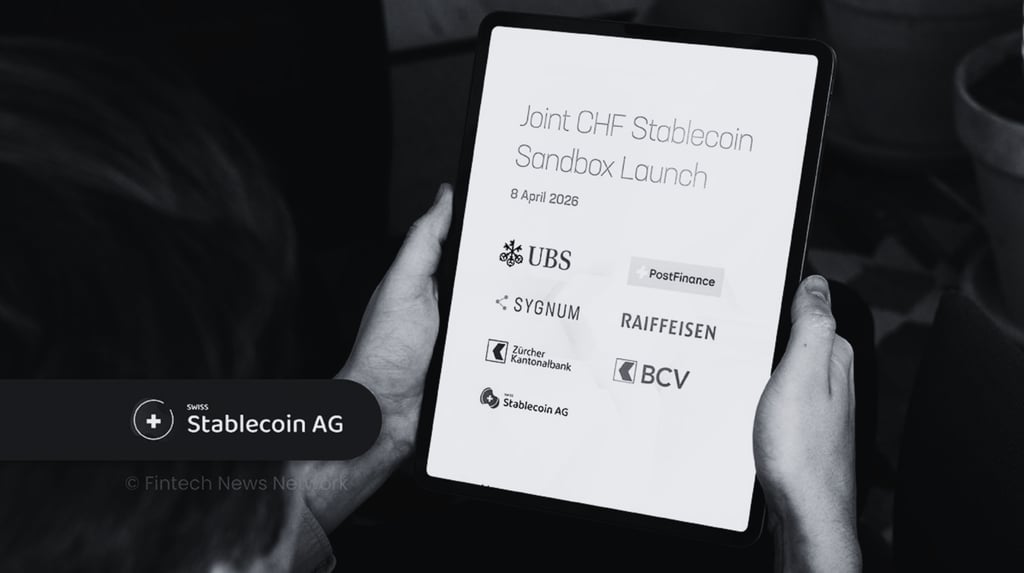
UBS and five other Swiss banks have agreed to test a Swiss franc stablecoin in a tightly regulated test environment, a step that shows how far bank-led digital currency trials have progressed from theory to market practice.
This initiative establishes a secure, “ real-world ” digital testing environment (testing environment) where participants can test the issuance and use of a stablecoin pegged to the CHF . Swiss Stablecoin AG will provide the technical infrastructure for the issuance.
The participating institutions are UBS , PostFinance , Sygnum , Raiffeisen , Zürcher Kantonalbank (ZKB) , and Banque Cantonale Vaudoise (BCV) . This pilot environment is open to other banks, companies, and organizations wishing to contribute to the development of the CHF stablecoin ecosystem .
Connecting blockchain applications with the Swiss franc can lead to more efficient processes.
The test use cases focused on interbank payments, tokenized assets, cross-border payments, and treasury management.
Delivering tangible benefits to customers through faster payment processing times, reduced costs, and improved operational efficiency.
Strengthening Switzerland's overall cryptocurrency ecosystem and maintaining the country's position as a leading global financial center.
The project remains tightly controlled, with trading limits and closed testing to minimize any potential liquidity or systemic risks during the pilot phase. There are currently no plans for a full public launch; results from the 2026 pilot phase will inform potential future regulatory and operational frameworks.
Switzerland's answer to the stablecoin race.
The timing is crucial because stablecoins are no longer just a utility of the cryptocurrency market. Major banks are increasingly viewing them as a competitive issue in payments, settlements, and the management of encrypted cash. Reuters reported in October that ten prominent banks, including UBS , have been researching stablecoins pegged to G7 currencies, while European banks are also developing a euro-denominated alternative. In that sense, the Swiss franc pilot program is part of a broader institutional response to the growing dominance of privately issued digital dollars.
For UBS, this move also aligns with a broader strategic model. The bank said it managed $6.1 trillion in investment assets by the end of 2024, and later indicated that those assets would exceed $7 trillion by 2025. That scale gives UBS a practical reason to be interested in digital settlement infrastructure: if money is to be moved on the chain, large asset and wealth managers will want a say in the design.
What the pilot program is actually testing
The cautious language surrounding this initiative is understandable. Sygnum says the team is building a “ secure digital environment ,” while Reuters describes it as a testbed to explore how blockchain applications can integrate with the Swiss franc. This is crucial because the project is not simply about issuing a token; it's about testing whether a bank-issued and regulated stablecoin can function within the existing compliance, custody, and payment framework without disrupting the foundations that built the trust in the Swiss banking system in the first place.
Furthermore, there is a structural gap that the alliance is trying to fill. Reuters notes that Switzerland currently lacks a regulated Swiss franc stablecoin with widespread domestic application. This absence is significant in a country with a sophisticated banking system and a long history of fintech. This pilot project is essentially a response to that gap, and to the risk that Switzerland could fall behind if encrypted cash systems thrive elsewhere first.
Our review
Switzerland has long positioned itself as a leader in blockchain technology and digital asset innovation, with established cryptocurrency-friendly regulations and a thriving ecosystem centered in the “ Zug Valley” (Crypto Valley ). However, unlike the US dollar (the dominant currency for stablecoins like USDT and USDC ), the Swiss franc lacks a widely regulated and used blockchain-based cryptocurrency equivalent.
The effort led by this alliance mirrors similar moves by European banks in researching euro stablecoins and demonstrates a growing recognition among institutions that encrypted and programmable currencies can enhance the traditional banking system without disrupting core stability. The involvement of both traditional giants ( UBS , PostFinance , Raiffeisen ) and emerging cryptocurrency firms ( Sygnum ) underscores a unified approach, combining long-standing expertise with blockchain innovation.
In a global landscape where stablecoin volumes continue to surge and tokenized risk assets (RWAs) are gaining increasing popularity, a reliable and tightly regulated CHF option would fill a crucial gap in the digital currency landscape. Swiss banks are not merely observing the cryptocurrency revolution but are actively shaping its domestic chapter. The 2026 CHF stablecoin pilot program could mark the beginning of a new era for programmable Swiss currency, combining the renowned stability of the franc with the efficiency of blockchain technology.
Disclaimer: The information presented in this article is the author's personal opinion in the field of cryptocurrency. This is not financial or investment advice. All investment decisions should be based on careful consideration of your personal portfolio and risk tolerance. The views expressed in this article do not represent the official stance of the platform. We recommend that readers conduct their own research and consult with experts before making any investment decisions.
Compiled and analyzed by HCCVenture
Follow HCCVenture here: https://link3.to/holdcoincventure
Explore HCCVenture group
HCCVENTURE QUANT JSCO
© 2026 HCCVENTURE. ALL COPYRIGHTS RESERVED.


Connect with us
Popular content
Contact to us
Address: 8th Floor, Bach Dang Complex Building, 50 Bach Dang Street, Hai Chau Ward, Da Nang City, Vietnam.
Phone: 1900 1509
Gmail : sp_contact@hccventure.com
Disclaimer: The information on this website is for informational purposes only and should not be considered investment advice. We are not responsible for any risks or losses arising from investment decisions based on the content here.
TERMS AND CONDITIONS • CUSTOMER PROTECTION POLICY
ANALYTICAL AND NEWS CONTENT IS COMPILED AND PROVIDED BY EXPERTS IN THE FIELD OF DIGITAL FINANCE AND BLOCKCHAIN BELONGING TO HCCVENTURE ORGANIZATION, INCLUDING OWNERSHIP OF THE CONTENT.
RESPONSIBLE FOR MANAGING ALL CONTENT AND ANALYSIS: HCCVENTURE FOUNDER - TRUONG MINH HUY
Read warnings about scams and phishing emails — REPORT A PROBLEM WITH OUR SITE.