

Do Kwon was sentenced to 15 years in prison - The LUNA empire comes to an end
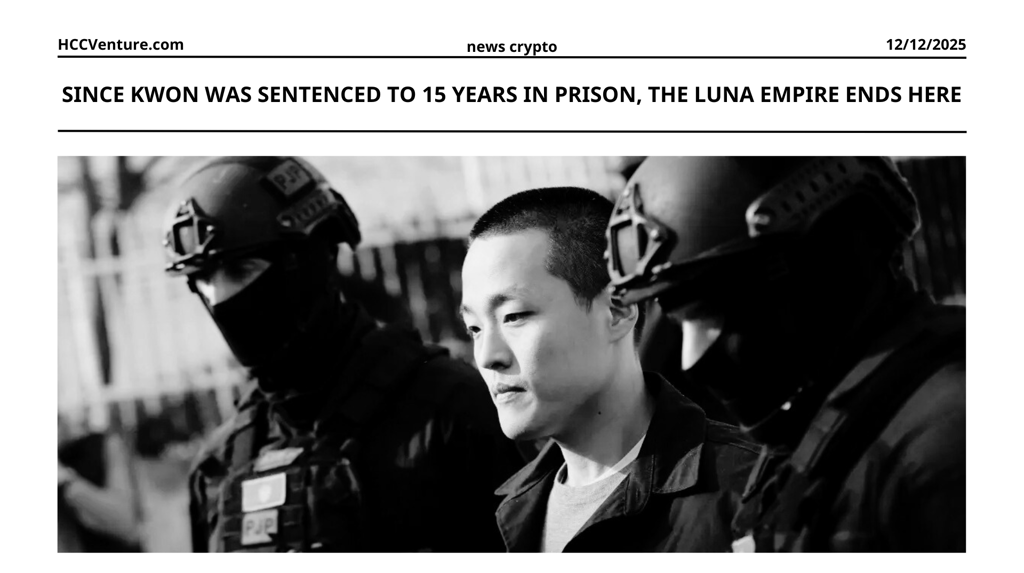
Do Kwon, the founder of Terraform Labs, was sentenced to 15 years in prison by a Manhattan Federal Court for fraud related to the 2022 collapse of the TerraUSD/Luna ecosystem, which caused $40 billion in losses.
12/12/20252 min read
The court exceeded the prosecution's request.
In a landmark ruling that underscored the severity of the Terra ecosystem collapse, the court sentenced Terraform Labs founder Do Kwon to 15 years in prison—a sentence exceeding the prosecution's 12-year recommendation. This ruling represents one of the harshest criminal sentences ever handed down in a major cryptocurrency case, reflecting the unprecedented financial damage caused by the 2022 collapse of UST and LUNA.
It is very rare for a judge to hand down a harsher sentence than the prosecution requested, especially in complex financial cases. However, the court did exactly that – increasing the sentence from the requested 12 years to 15 years.
This decision reflects the court's conclusion that:
The economic damage caused by the collapse of Terra was enormous, wiping out tens of billions of dollars and affecting millions of investors worldwide.
Kwon's behavior during and after the collapse – including fleeing abroad and using forged documents – shows awareness and avoidance rather than responsibility.
Terra's structural risks were known internally but downplayed publicly, further increasing awareness of reckless or misleading behavior.
By exceeding the prosecution's requirements, this ruling establishes a much higher threshold of accountability for cryptocurrency founders overseeing financial systems operating on a global scale.
Enforcing Crypto Law
The collapse of Terra remains one of the main catalysts for the enactment of stablecoin legislation worldwide. This harsh verdict reinforces the determination of regulators to prevent algorithmic stablecoins from re-entering the market without strict controls.
Cryptocurrency founders can no longer easily rely on claims of decentralization or experimental technology. Courts now consider large cryptocurrency ecosystems as financial institutions, not "projects."
Extradition battles involving Montenegro, South Korea, and the United States have demonstrated that cryptocurrency law enforcement is becoming multinational, rather than confined to individual jurisdictions.
Projects that build fundamental financial principles — stablecoins, lending systems, synthetic assets — will face higher requirements for transparency, auditing, and risk disclosure.
Assessment and Conclusion
The 15-year prison sentence for Do Kwon, even exceeding the 12 years the prosecution had requested, marks a turning point in the handling of large-scale cryptocurrency scandals. It underscores the judicial system's willingness to impose harsh penalties when digital financial systems cause real economic damage – and signals a maturing legal and regulatory environment that no longer views cryptocurrencies as too new or experimental to warrant accountability.
Disclaimer: The information presented in this article is the author's personal opinion in the field of cryptocurrency. This is not financial or investment advice. All investment decisions should be based on careful consideration of your personal portfolio and risk tolerance. The views expressed in this article do not represent the official stance of the platform. We recommend that readers conduct their own research and consult with experts before making any investment decisions.
Compiled and analyzed by HCCVenture
Follow HCCVenture here: https://link3.to/holdcoincventure
Explore HCCVenture group
HCCVENTURE QUANT JSCO
© 2026 HCCVENTURE. ALL COPYRIGHTS RESERVED.


Connect with us
Popular content
Contact to us
Address: 8th Floor, Bach Dang Complex Building, 50 Bach Dang Street, Hai Chau Ward, Da Nang City, Vietnam.
Phone: 1900 1509
Gmail : sp_contact@hccventure.com
Disclaimer: The information on this website is for informational purposes only and should not be considered investment advice. We are not responsible for any risks or losses arising from investment decisions based on the content here.
TERMS AND CONDITIONS • CUSTOMER PROTECTION POLICY
ANALYTICAL AND NEWS CONTENT IS COMPILED AND PROVIDED BY EXPERTS IN THE FIELD OF DIGITAL FINANCE AND BLOCKCHAIN BELONGING TO HCCVENTURE ORGANIZATION, INCLUDING OWNERSHIP OF THE CONTENT.
RESPONSIBLE FOR MANAGING ALL CONTENT AND ANALYSIS: HCCVENTURE FOUNDER - TRUONG MINH HUY
Read warnings about scams and phishing emails — REPORT A PROBLEM WITH OUR SITE.