

Crypto & Blockchain Venture Capital Flows Report – 2026
Venture Capital (VC) flows updated to Q3/2026 show that VC investment activity continues to maintain a positive state after the recovery phase that began in 2024, with current disbursement levels far exceeding the market bottom.
INSIGHTS
7/24/202618 min read


Crypto & Blockchain Venture Capital Flows Report – 2026
Venture Capital (VC) flows updated to Q3/2026 show that VC investment activity continues to maintain a positive state after the recovery phase that began in 2024, with current disbursement levels far exceeding the market bottom.
Analysis • 24 July, 2026


Report Summary
Venture investors poured approximately $4 billion into 355 cryptocurrency and blockchain deals in Q1 2026 , and compared to Q4 2025, total investment decreased by almost 50% . We observed that the number of deals only decreased by about 16%, a significant difference because when investment capital drops but trading activity remains virtually unchanged, you not only see investors fleeing the market, but also see massive funding rounds disappear. The fourth quarter of 2025 was filled with massive investments worth hundreds of millions of dollars that distorted things, and once those are removed, the pace of basic investment looks remarkably stable, to the point that, calculated at current rates, 2026 would reach approximately $16 billion , lower than the nearly $20 billion of 2025, but higher than most years during the challenging 2023-2024 period, suggesting the industry is not contracting but is gradually stabilizing after an unusual quarter.
Approximately 57% of total investment went to later-stage companies, while early-stage companies accounted for the remaining 43%, an allocation that shows venture investors have clearly shifted toward businesses that can demonstrate tangible revenue, reliable operating models, and a credible roadmap for expansion , while the era of funding a prospectus and a dream is pausing. However, what is often overlooked is: the number of seed and pre-seed stage investments remains stable, meaning founders are still receiving early-stage funding , just with smaller investment amounts and a more rigorous due diligence process. So, the supply of innovation isn't drying up, it's simply being more intensely filtered, and frankly, that's better for everyone.
Trading, exchanges, investments, and lending attracted approximately $2.6 billion, equivalent to nearly 65% of total investment, along with 74 market-leading deals—the highest industry concentration we've seen in several quarters—and the logic behind that is simple: because these businesses generate revenue today through fees, spreads, and interest—cash flows that you can actually model. Infrastructure, e-wallets, tokenization, artificial intelligence, payments, Web3 gaming, DeFi, and privacy all maintained the number of deals but attracted far less capital per deal.
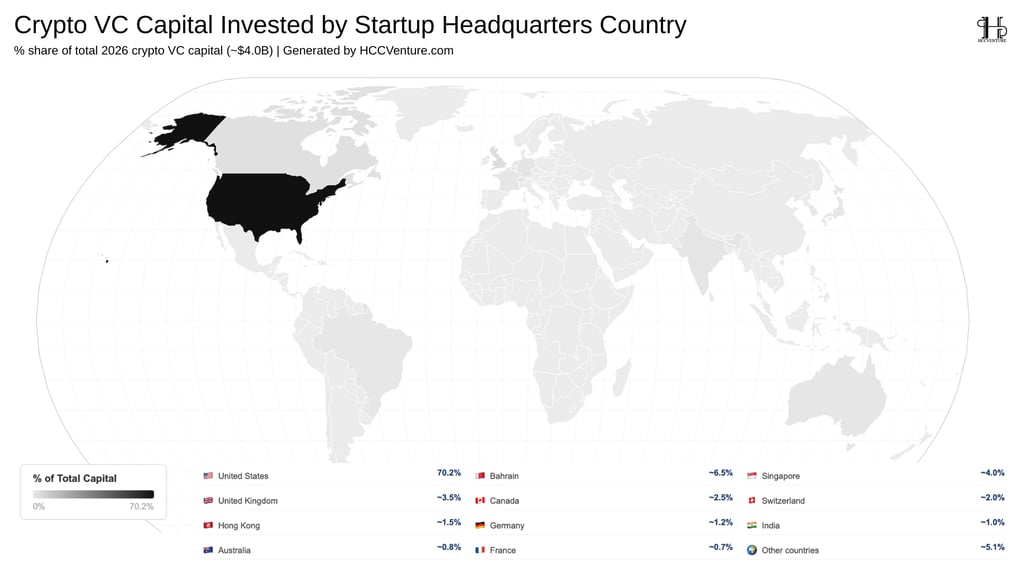
US-based startups accounted for 70.2% of total funding and 43.5% of completed deals , the highest percentage in the US since the 2021 boom, and regulatory clarity is unfolding as expected, because as institutions finally see the rules of the game, they will focus their investments on places with clear regulations, and as this asset class becomes institutionalized, jurisdictions with ambiguous legal frameworks are gradually being phased out of the capital flow.
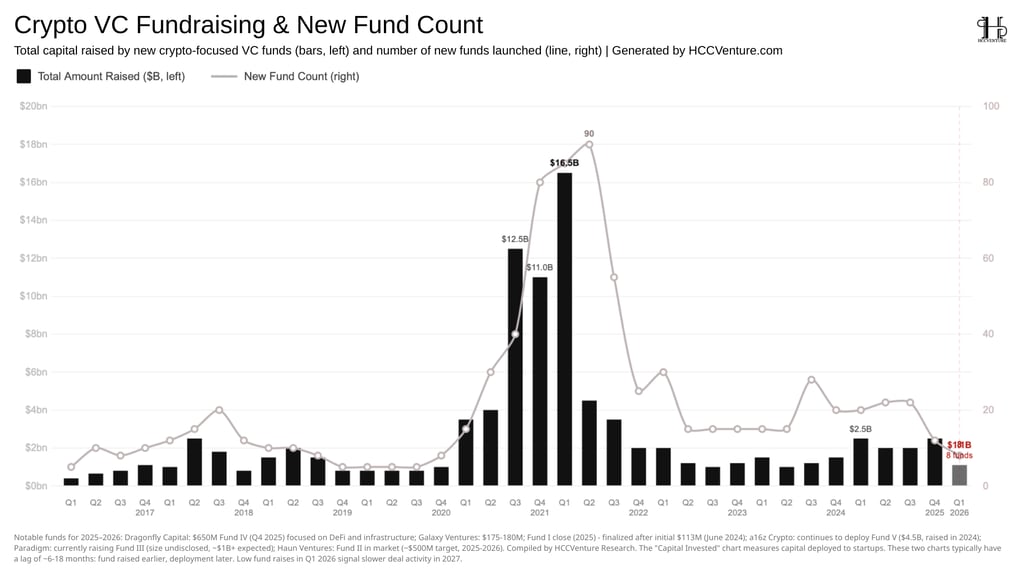
While investment in startups remains stable, venture capital funds themselves are struggling to raise capital, with only about $1.1 billion flowing into eight new funds in Q1 2026—the fewest new funds launched since Q3 2020. It's understandable why investors are hesitant, as cryptocurrency venture capital funds are now competing for funding with spot Bitcoin ETFs, digital asset managers, and the allure of AI funds. Fairly speaking, this reflects a funding cycle that hasn't fully shifted, rather than venture investors pulling out, as there's still a significant amount of unused capital from previous funding rounds. However, if new fund creation remains weak over the next few quarters, it will eventually reduce the capital available to founders from 2027 onwards, making this the most closely watched factor on the chart.
Venture Capital Index in Crypto
Venture capital (VC) flows are one of the indicators reflecting the long-term expectations of institutional money flows into the blockchain and digital asset industry. Unlike ETF flows or trading on the secondary market, which are heavily influenced by short-term price fluctuations, VC investments are typically deployed over multi-year cycles to finance infrastructure development, protocol development, and ecosystem expansion.
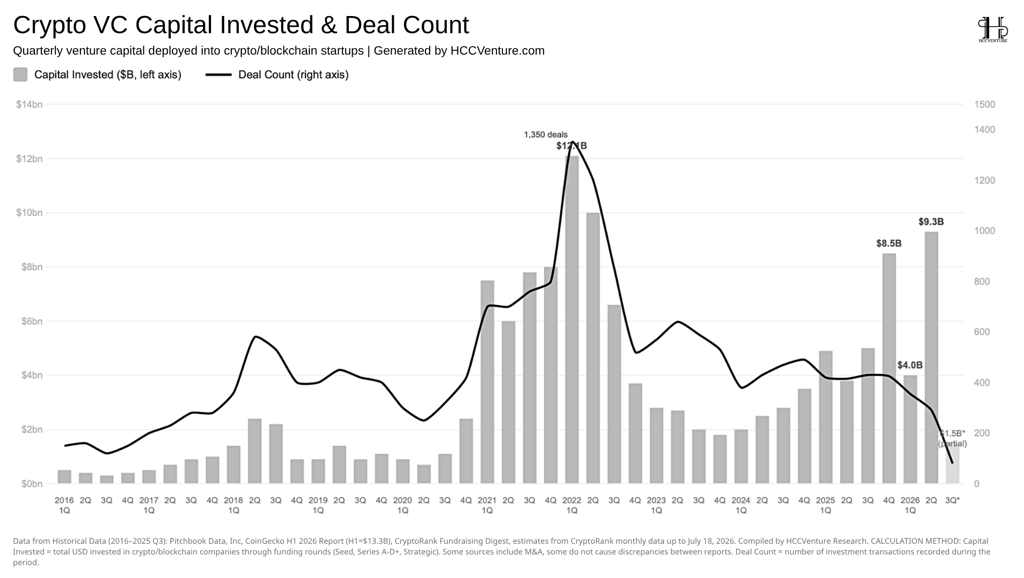
Data updated to Q3/2026 shows that VC investment activity continues to maintain a positive state after the recovery phase that began in 2024. Although not yet returning to the boom levels of the 2021–2022 growth cycle, the current disbursement volume has far exceeded the bottom of the 2023–2024 bear market, reflecting a significant improvement in liquidity as well as the risk appetite of institutional investors.
Total investment in Q1 2026 is expected to reach approximately $4.0 billion , nearly half the amount in Q4 2025. However, this adjustment is primarily due to the absence of very large-scale deals rather than a weakening of the entire blockchain startup ecosystem. By Q2 2026 , capital flows are projected to increase again to approximately $9.3 billion , surpassing all quarters in the 2023–2025 period and only slightly below the historical peak of 2022.
Instead of allocating capital to a large number of early-stage startups as in previous cycles, funds now tend to focus resources on a few businesses that have demonstrated operational capabilities, revenue, or scalability. The size of each deal has therefore increased significantly, reflecting a more selective investment strategy and higher capital efficiency. Professional investment funds no longer pursue a mass investment strategy but focus on businesses with clear competitive advantages, mature technological infrastructure, and the ability to generate sustainable cash flow.
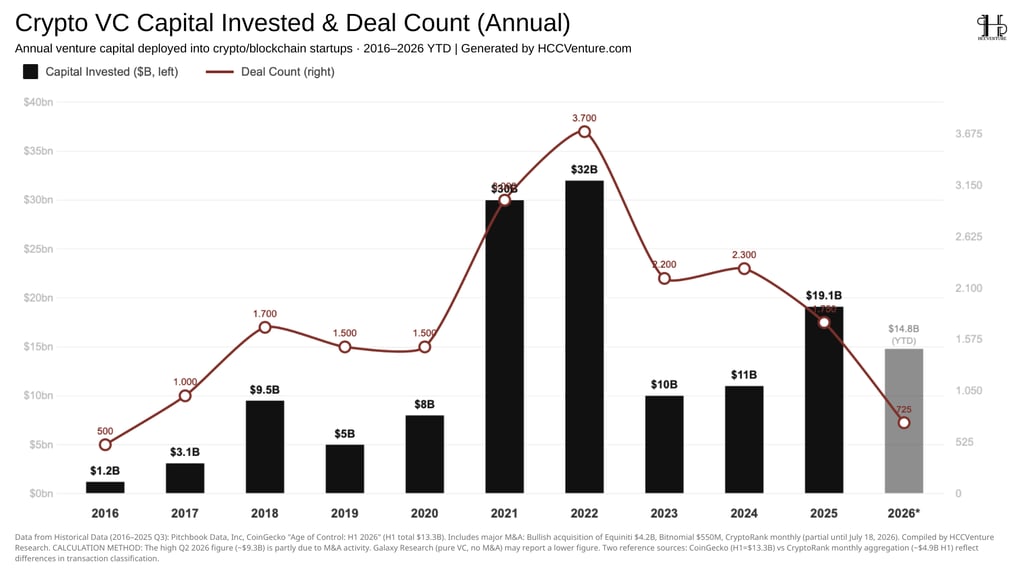
Venture capital (VC) flows are a key indicator reflecting the level of confidence financial institutions have in the long-term growth prospects of the blockchain industry. Unlike speculative capital flows in the spot or derivatives markets, VC funds are typically disbursed over several years to build infrastructure, develop technology, and expand blockchain businesses.
Data from 2016–2026 (YTD) shows that the venture capital cycle of the crypto market has completed a relatively clear cycle. After a period of strong growth in the 2020–2022 cycle, the market entered a deep correction in 2023 before recovering significantly from 2024 and continuing to expand in 2025–2026.
Year -to-date (YTD) data for 2026 further reinforces this trend. Total investment reached approximately $14.8 billion in the first half of the year alone, equivalent to about 77% of the total for 2025. If the current disbursement rate is maintained in the remaining quarters, total investment in 2026 has the potential to surpass $25 billion , moving closer to the peak of the 2021–2022 cycle. Meanwhile, the number of new transactions reached only about 725 deals , the lowest in the entire data series since 2016. Compared to the peak of 3,700 transactions in 2022, the number of deals has decreased by more than 80% , but the scale of investment capital remains very high.
More importantly, this increase doesn't come from expanding the number of funded projects, but rather from increasing the scale of investment per deal. This is a characteristic often seen in the mature stage of the investment cycle, when institutional funds prioritize businesses with the ability to generate cash flow, possess core technology, and have clear competitive advantages, rather than investing broadly in idea-stage startups.
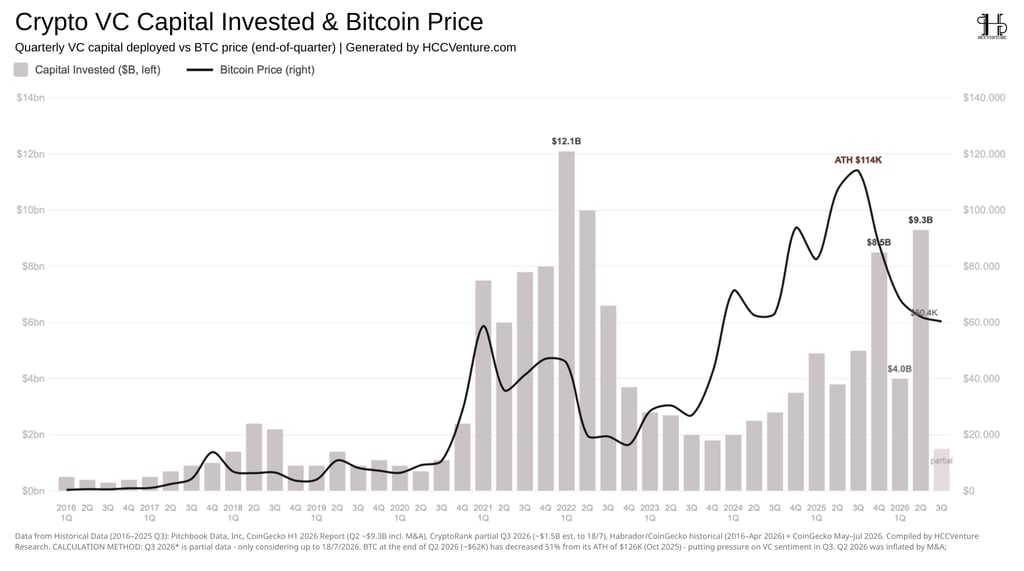
The relationship between venture capital (VC) flows and Bitcoin price is one of the indicators reflecting the long-term expectations of institutions for the digital asset industry. While Bitcoin price fluctuations are heavily influenced by market liquidity and short-term investor sentiment, VC investment typically reflects multi-year capital allocation decisions focused on building blockchain infrastructure, protocols, and businesses.
Entering Q1/2026 , VC investment activity adjusted downwards to approximately $4.0 billion , while Bitcoin began a correction phase after setting a new peak. However, after just one quarter, total investment capital recovered strongly to approximately $9.3 billion in Q2/2026 , becoming the second highest level of disbursement since 2022. During the same period, the price of Bitcoin fell to around $60,400 , equivalent to a correction of nearly 47% from its peak of approximately $114,000 in the previous cycle.
While Bitcoin's price is under pressure due to profit-taking and short-term liquidity fluctuations, professional investment funds continue to increase their allocation to the primary market, indicating that institutions do not view the price correction as a sign of industry weakness but rather as an opportune time to invest in businesses with sustainable technology foundations and business models. The fact that VC capital remains very high during Bitcoin's sharp price correction also shows that long-term confidence in blockchain remains intact.
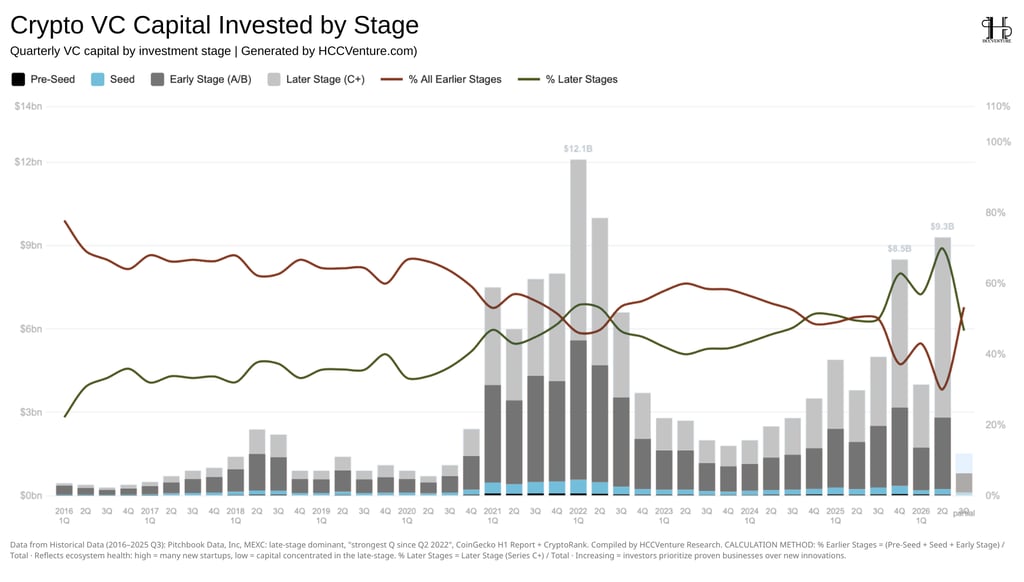
The investment stage allocation structure is one of the indicators reflecting the quality and maturity of the venture capital cycle in the blockchain industry. It not only shows the scale of capital disbursed but also reflects the risk appetite of investment funds through the proportion of capital allocated to early-stage businesses (Pre-Seed, Seed, Early Stage) compared to developed businesses (Later Stage). When the capital allocation shifts towards the Later Stage, it reflects that organizations are prioritizing businesses that have proven their business models and cash flow capabilities, rather than accepting the high risks of newly established startups.
In Q4 2025 , total investment reached approximately $8.5 billion , with the majority allocated to the Later Stage group . By Q2 2026 , investment continued to increase to approximately $9.3 billion , while the proportion of capital allocated to the Later Stage group reached approximately 65-70 % , the highest level since the 2022 cycle. Conversely, the proportion allocated to early-stage businesses decreased to only about 30-35% , the lowest in the entire data chain.
Notably, although the proportion of investment in early-stage businesses has declined, the absolute value of capital flows to this group has remained stable thanks to the increase in the overall market capitalization. Meanwhile, the majority of the increase in total investment capital comes from large-scale deals in Series C and above, strategic funding rounds, and mergers and acquisitions (M&A) activities.
Capital flows are no longer allocated according to a strategy of expanding the number of projects as in previous cycles, but are increasingly focused on businesses that have moved beyond the startup phase and entered the growth cycle. The continuous increase in the proportion of capital allocated to the Later Stage group, along with the recovery in disbursement to the highest level since 2022, shows that investment funds are pursuing a strategy of optimizing capital utilization efficiency and minimizing risk.
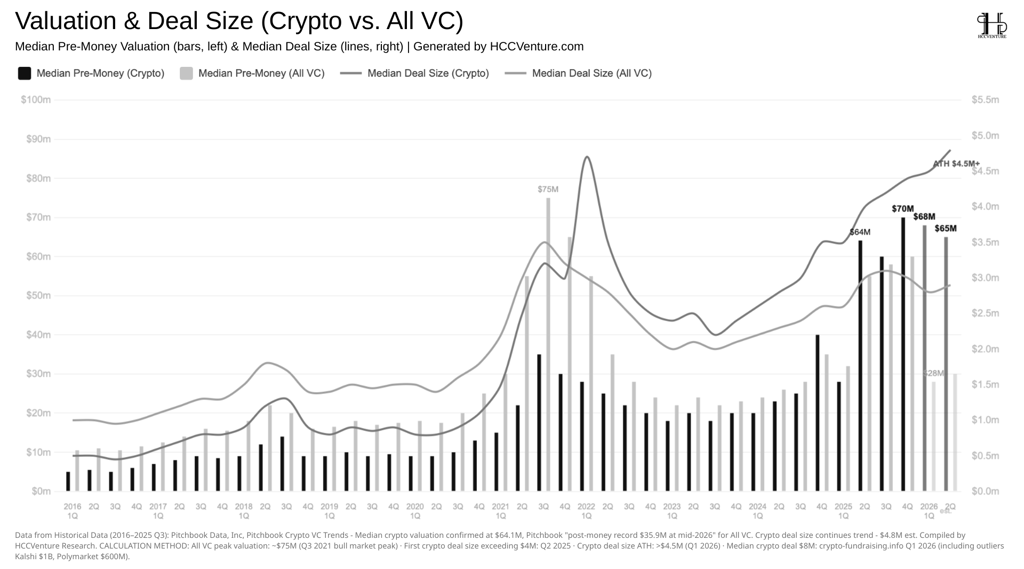
Pre-Money Valuation and Median Deal Size are two indicators that directly reflect the risk-taking willingness of venture capital. While the size of investment indicates the amount of money being allocated to the market, valuation and the value of each deal reflect the level of competition among investors for high-quality blockchain businesses. When both indicators increase simultaneously, it suggests that investment funds have improved confidence in the long-term prospects of the industry and that leading businesses are able to raise capital at increasingly higher valuations.
From 2024 onwards , a clear recovery trend began to emerge. Blockchain business valuations continuously expanded following the recovery of Bitcoin and the increase in institutional capital flows into the digital asset market. By Q2 2025 , for the first time in history, the median transaction size of Crypto exceeded $4 million , marking a strong return of large-scale deals. This upward trend continued into 2026, with the Median Deal Size reaching over $4.5 million , setting the highest level since data began to be recorded.
Simultaneously, the median pre-money valuation of crypto businesses is also entering a strong growth cycle. Data shows valuations reaching approximately $64 million in 2025, continuing to rise to around $70 million by the end of the year before slightly adjusting to $68 million and currently maintaining around $65 million in Q2/2026.
While the median valuation of the entire VC market currently hovers around $28-30 million , significantly lower than its historical peak, blockchain businesses maintain valuations above $65 million . This gap reflects the willingness of institutional capital to pay significantly higher valuations for businesses operating in the digital asset sector, particularly those with blockchain infrastructure, stablecoins, tokenization, blockchain-integrated AI, and trading platforms with clear revenue models.
The fact that business valuations remain high while median transaction sizes continue to reach new highs indicates that the venture capital market is not only recovering in terms of capital but also significantly improving in quality. Investment funds are no longer allocating capital towards expanding the number of startups as in previous cycles, but are focusing on businesses with the potential to generate cash flow, high growth rates, and a clear competitive position.
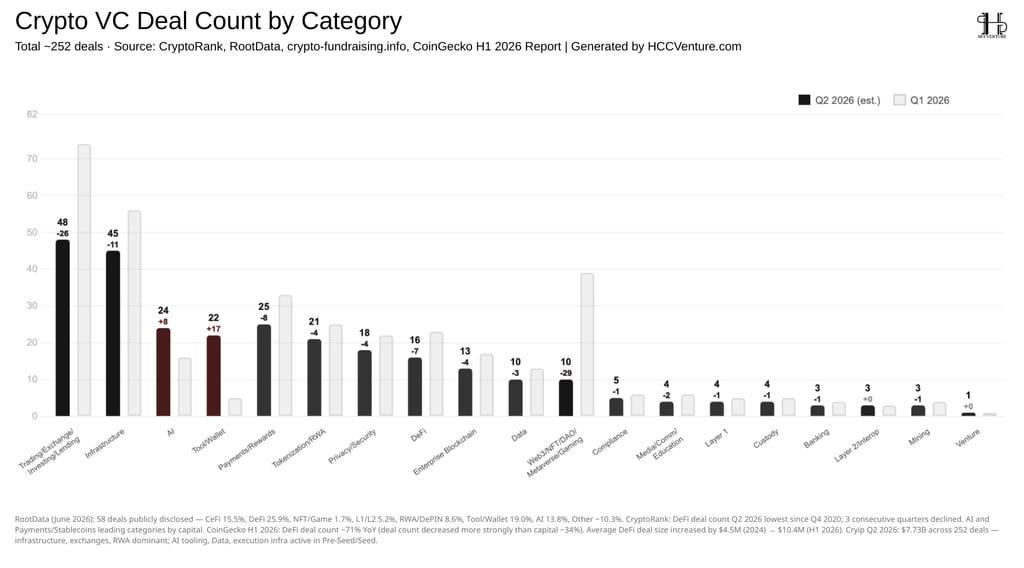
The number of investment deals by category (Deal Count by Category) is an indicator that directly reflects the direction of venture capital flows within the blockchain ecosystem. Data from Q2/2026 recorded approximately 252 investment deals , lower than Q1/2026, reflecting a trend where investment funds continue to narrow the number of transactions but raise their criteria for selecting businesses. Despite the decline in the total number of deals, the allocation structure still shows that capital continues to focus on sectors with high commercialization potential, core infrastructure, and technologies supporting the institutionalization of the digital asset market.
The Trading, Exchange, Investing, and Lending sector continued to lead with 48 deals , although this was a decrease of approximately 26 transactions compared to Q1/2026. This remains the largest investment group in the entire market, reflecting the continued preference of investment funds for businesses with clear revenue models, the ability to generate stable cash flow, and those that directly benefit from the increased liquidity of the cryptocurrency market. The decrease in the number of deals mainly reflects a process of screening for quality businesses rather than a decline in confidence in the digital asset trading sector.
Compared to Q1/2026, the current investment structure shows a clear shift in the capital allocation strategy of venture capital funds. Capital is moving away from cyclical and speculative sectors such as NFTs, Metaverse, and Gaming to focus more heavily on AI , Infrastructure , Trading , Wallets , Payments , and Tokenization. This shift reflects the restructuring of the blockchain industry, where businesses capable of creating real economic value, serving infrastructure, and meeting the needs of financial institutions are becoming the center of investment attraction.
Research and Analysis
Market Summary
Venture Capital Index in Crypto
Venture capital (VC) flows
The relationship between venture capital (VC) flows and Bitcoin price
Capital allocation structure by investment stage.
Pre-Money Valuation
Number of investment deals by sector (Deal Count by Category)
Capital allocation structure by investment phase in each sector
Crypto VC Capital Invested & Deal Count by Year Startup Was Founded
Allocation of venture capital flows by country
Crypto VC Fundraising & New Fund Count
Our assessment and conclusions
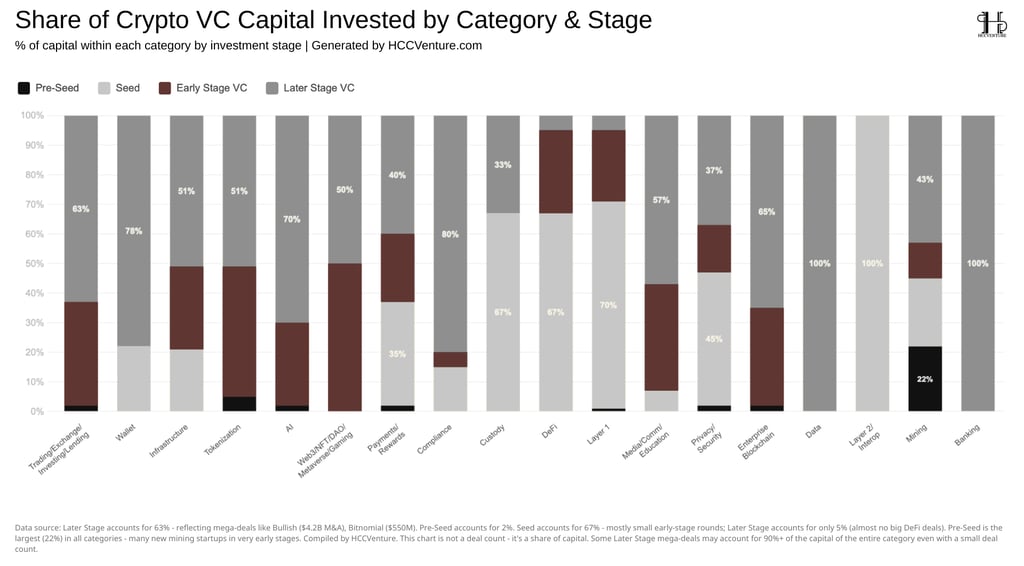
The structure of capital allocation by investment stage in each sector (Share of Crypto VC Capital Invested by Category & Stage) is a key indicator reflecting the risk allocation strategy of venture capital funds for each segment of the blockchain industry. Data updated to Q2/2026 shows that the majority of venture capital flows in the blockchain ecosystem are shifting strongly towards Later Stage businesses (Series C and above) . This is a prominent feature of the current cycle, as investment funds are no longer expanding their portfolios by funding a large number of newly established startups but are focusing on businesses that have proven their business models, cash flow capabilities, and competitive position. This trend reflects the maturity of the blockchain investment market as well as a change in the risk appetite of institutions.
Compared to previous bull market phases, the current capital allocation structure reflects a clear shift from an expectation-based investment strategy to a performance-based investment strategy. Sectors that have proven real value, such as trading, infrastructure, AI, blockchain businesses, data, and digital banking, are attracting the majority of later-stage capital. Meanwhile, emerging technology segments continue to receive investment, but primarily on a smaller scale and focused on businesses with long-term growth potential.
Venture capital flows are no longer spread thinly across the entire market but are concentrated in businesses that have moved beyond the startup phase and demonstrated the ability to create sustainable economic value. At the same time, the fact that certain sectors such as AI, Layer 2, Payments, and Mining still maintain a significant proportion of investment in the early stages shows that the blockchain ecosystem continues to foster technological innovation. The current capital structure therefore not only reflects the recovery of investment activity but also confirms the improving quality of institutional capital flows, creating a solid foundation for the long-term growth cycle of the digital asset market.
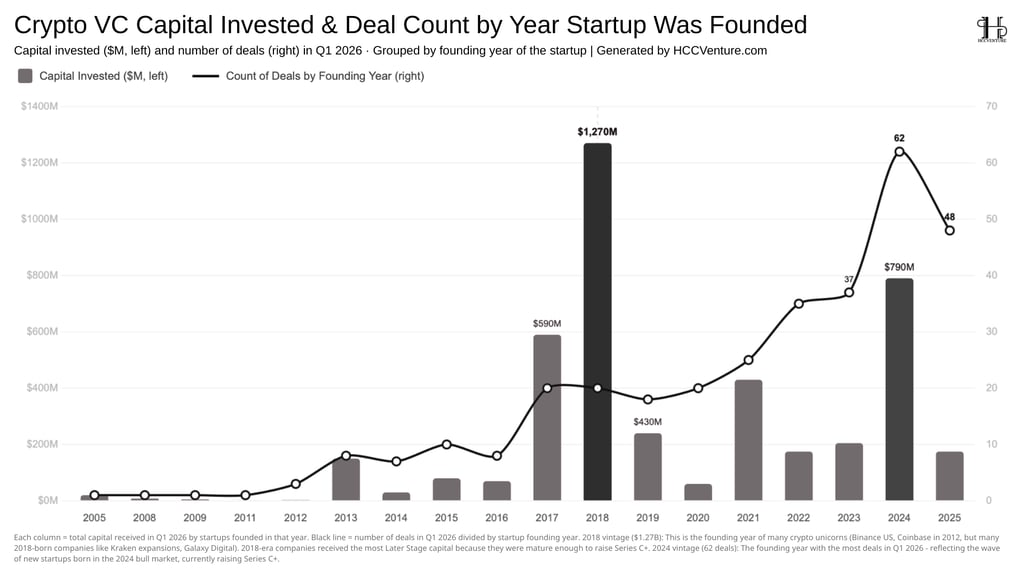
The founding year of a business receiving investment is a crucial indicator reflecting venture capital funds' strategies for allocating capital throughout its lifecycle. Instead of simply assessing capital size or the number of deals, this indicator shows which stages of startup development are receiving funding, thereby evaluating the maturity of the blockchain ecosystem and its potential to generate the next generation of businesses to lead the growth cycle.
Compared to businesses established before 2015 , the difference becomes even clearer. Startups founded between 2005 and 2012 have virtually no significant fundraising activity, neither in terms of capital size nor the number of deals. This reflects the natural characteristics of the Venture Capital cycle, where businesses mature, have completed expansion, or have moved to other forms of fundraising such as IPOs, M&A, or financing through traditional capital markets. Meanwhile, startups established after 2020 are gradually becoming a source of new businesses for the current investment cycle.
Crypto VC Capital's Invested & Deal Count by Year Startup Was Founded reflects an evolving investment ecosystem that strikes a balance between expansion and succession. Large-scale capital flows continue to focus on businesses established between 2017 and 2019, as these companies have reached sufficient scale to undertake large funding rounds. Simultaneously, the sharp increase in deals among startups established from 2023 onwards indicates a rapidly emerging new generation of blockchain businesses, becoming a source of projects for the next investment cycle.
The allocation of venture capital by the country where startups are headquartered is one of the key indicators reflecting the shift in innovation centers within the blockchain industry. The structure of investment by country not only reflects the blockchain ecosystem's ability to attract capital but also demonstrates the attractiveness of the legal environment, technological innovation potential, and market size in each region. Instead of evenly distributing capital across many countries as in the early stages of the industry, investment funds now prioritize regions with mature business ecosystems, stable legal environments, and the potential for global technology commercialization.
Compared to the early stages of the blockchain market, the concentration of capital has increased significantly. In the current development cycle, investment funds no longer prioritize expanding their portfolios across various jurisdictions but instead focus on countries that can provide a stable business environment, a high-quality workforce, and a sufficiently large business ecosystem to facilitate multi-million dollar deals.
The dominance of the United States also reflects the impact of the institutionalization of the digital asset market in recent years. The increased involvement of spot Bitcoin ETFs, listed companies owning Bitcoin, and traditional financial institutions has facilitated the continued rapid expansion of the blockchain ecosystem in the United States compared to other regions. Simultaneously, the concentration of capital in US businesses indicates that institutional investors are prioritizing markets with access to large-scale capital and opportunities for listing on international stock exchanges.
Crypto VC Fundraising & New Fund Count indicates that the venture capital market is undergoing a correction phase after the historic growth cycle of 2021–2022. While both the size of funding and the number of new funds have declined sharply from their peaks, current fundraising levels remain significantly higher than in the early stages of the market, reflecting a restructuring towards quality rather than quantity. The fact that fewer new funds are being established, but with larger scale, greater capacity, and clearer investment strategies, suggests that the blockchain venture capital industry is entering a mature phase where efficient capital allocation is paramount.
In Q1 2026 , new investment funds raised approximately $1 billion through eight funds , marking the lowest number of new funds since 2020. Compared to the peak of $16.5 billion and 90 funds in Q1 2022, total capital raised decreased by about 94% , while the number of new funds decreased by more than 91% . However, this decline does not reflect a withdrawal of capital from the blockchain industry but mainly indicates that the fundraising cycle is entering a more selective phase. Institutional investors are now prioritizing allocating capital to funds with a history of successful investments, reputable management teams, and clear investment strategies, rather than expanding into many new funds as during the boom period.
As global liquidity conditions continue to improve and demand for investment in digital assets increases, the capital accumulating in existing funds will continue to play a crucial role in financing the next generation of blockchain businesses, laying the foundation for a sustainable growth cycle of the digital asset ecosystem in the coming years.
Our assessment and conclusions
Crypto Venture Capital has moved past the deep correction phase of the 2022–2023 cycle and is shifting to a selective recovery. Although total investment in Q1/2026 decreased significantly compared to the boom of Q4/2025, the disbursement volume remains significantly higher than the bottom of the bear market. Institutional capital has not abandoned the blockchain industry but is restructuring towards prioritizing business quality, capital efficiency, and cash flow generation capabilities, rather than mass investment expansion as in previous cycles.
A prominent feature of the current cycle is the marked maturation of the blockchain ecosystem . Approximately 57% of total investment continues to be allocated to businesses in the Later Stage , while business valuations and median transaction sizes remain near historical highs. Investment funds are focusing on expanding businesses that have proven business models, revenue, and growth potential, rather than accepting the high risks of newly established startups.
The investment structure by sector also shows a significant shift in capital allocation strategy. Capital continues to flow into Infrastructure, Trading, Exchange, Payments, AI, Wallets, and Tokenization , while sectors that led the previous cycle, such as NFTs, Metaverse, and Gaming, continue to experience a sharp decline in the number of deals. Despite this, venture capital funds themselves are still facing many challenges. The first quarter of 2026 saw only about $1.1 billion raised through eight new funds , marking one of the lowest levels in recent years.
Besides macroeconomic factors, the Venture Capital market is also facing increasing competition from new investment channels. The rapid growth of Bitcoin Spot ETFs , Digital Asset Treasury (DAT) companies , and listed digital asset investment products has opened up higher liquidity options for institutional investors. Instead of participating in Venture Capital investments with long holding periods and high risk levels, a portion of current capital flows is shifting towards listed investment products.
Geographically, the United States continues to solidify its central position in the global blockchain ecosystem, accounting for 70.2% of total investment and 43.5% of total transactions in Q1 2026. The significant gap between the US and other countries reflects its superior advantages in terms of legal environment, capital markets, high-quality human resources, and a mature blockchain business ecosystem. This increasing concentration of capital in the US also indicates that investment funds are prioritizing regions with high transparency and commercialization potential for technology as the digital asset market enters a phase of institutionalization.
Although the fundraising environment remains challenging and capital flows face competition from products like Spot ETFs and Digital Asset Treasury Companies, current data does not reflect a decline in institutional confidence in blockchain. On the contrary, the fact that investment capital remains significantly higher than during the bear market, firm valuations continue to be high, and capital flows are concentrated in mature businesses suggests that professional investors maintain a positive view of the industry's long-term prospects.
Disclaimer
This report was prepared by HCCVenture Research with the aim of providing information, research, and market analysis. The entire content of the report is based on publicly available data, on-chain data, market data, venture capital (Venture Capital) data, macroeconomic data, and HCCVenture's internal research methodologies at the time of publication. Data sources are compiled from numerous reputable research platforms and organizations, including but not limited to Glassnode, CoinGecko, TradingView, Dune Analytics, CoinGlass, CryptoRank, RootData, PitchBook, DefiLlama, CryptoQuant, Messari, Token Terminal, Artemis, CoinMarketCap , public blockchain data, reports from financial institutions, investment funds, blockchain companies, and other publicly available information sources. HCCVenture strives to select reliable data sources and applies a verification and cross-checking process throughout its research. However, HCCVenture does not guarantee the completeness, accuracy, timeliness, or error-free nature of all data due to differences in statistical methods, data collection scope, update times, or adjustments from data providers.
All opinions, assessments, valuation models, cyclical analysis, on-chain data, capital flow analysis, Venture Capital activity, ETFs, Digital Asset Treasury Companies (DATs), technical indicators, macroeconomic indicators, and scenarios presented in this report reflect only the research views of HCCVenture Research at the time of publication, based on available assumptions and data. These contents are not investment advice, financial advice, legal advice, accounting advice, tax advice, brokerage advice, portfolio management advice, or recommendations to buy, sell, or hold any digital asset, security, financial product, investment fund, blockchain protocol, or business. The digital asset and blockchain markets are highly volatile and are influenced by global liquidity, monetary policy, regulatory regulations, macroeconomic conditions, and many other unpredictable factors. Therefore, the trends, patterns, correlations, or historical cycles mentioned in this report are not guaranteed to repeat in the future and should not be considered reliable predictions of market developments. Readers should conduct their own independent research ( DYOR – Do Your Own Research ) and consult with qualified financial, legal, tax, or investment professionals before making any decisions. Any investment decisions or actions arising from the use of information in this report are the sole responsibility of the reader.
HCCVenture, its affiliates, research team, personnel, or related parties may own or will own digital assets, invest in blockchain projects, investment funds, technology companies, or maintain commercial, research, media, consulting, or collaborative relationships with the organizations, protocols, businesses, or platforms mentioned in this report. These relationships may create actual or potential conflicts of interest, although HCCVenture always applies internal research standards to maintain objectivity and independence in its analysis. Nothing in this report is construed as an offering, brokerage, promotion, fundraising, or provision of investment services as regulated by any country or territory. The entire content of this report is protected under intellectual property and copyright law. It is strictly prohibited to copy, modify, reproduce, distribute, or use all or part of this report for commercial purposes in any form without the written consent of HCCVenture. Accessing, using, or quoting this report signifies that the reader has understood, accepted, and agreed to the entire content of this disclaimer.
Explore HCCVenture group
HCCVENTURE QUANT JSCO
© 2026 HCCVENTURE. ALL COPYRIGHTS RESERVED.


Connect with us
Popular content
Contact to us
Address: 8th Floor, Bach Dang Complex Building, 50 Bach Dang Street, Hai Chau Ward, Da Nang City, Vietnam.
Phone: 1900 1509
Gmail : sp_contact@hccventure.com
Disclaimer: The information on this website is for informational purposes only and should not be considered investment advice. We are not responsible for any risks or losses arising from investment decisions based on the content here.
TERMS AND CONDITIONS • CUSTOMER PROTECTION POLICY
ANALYTICAL AND NEWS CONTENT IS COMPILED AND PROVIDED BY EXPERTS IN THE FIELD OF DIGITAL FINANCE AND BLOCKCHAIN BELONGING TO HCCVENTURE ORGANIZATION, INCLUDING OWNERSHIP OF THE CONTENT.
RESPONSIBLE FOR MANAGING ALL CONTENT AND ANALYSIS: HCCVENTURE FOUNDER - TRUONG MINH HUY
Read warnings about scams and phishing emails — REPORT A PROBLEM WITH OUR SITE.