

Circle put Zama's secret USDC contract on the blacklist
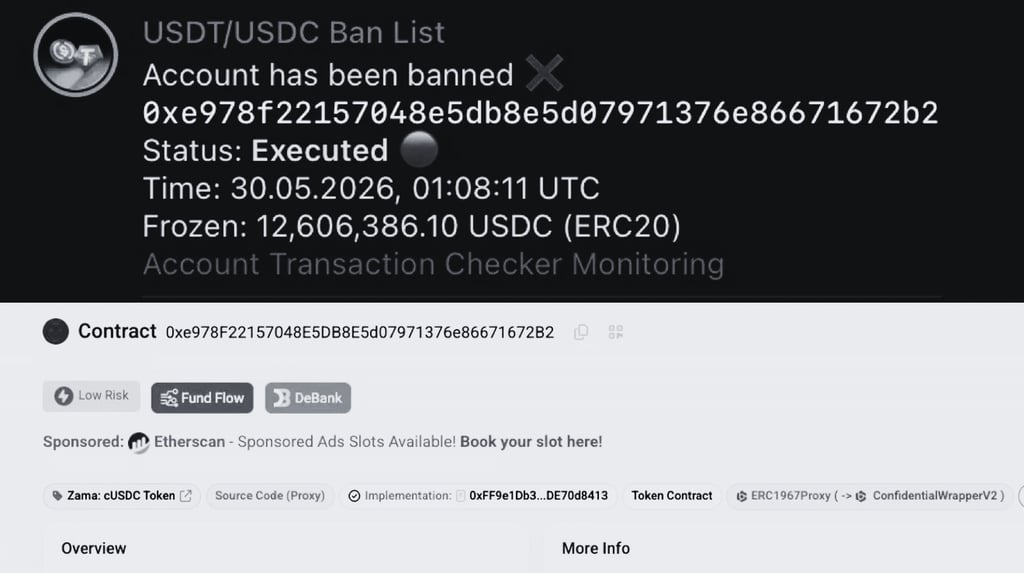
Circle Internet Financial has implemented a ban on the Ethereum smart contract of the Zama protocol labeled "Zama: cUSDC Token", freezing about 12.6 million USD USDC deposits.
6/2/20264 min read
The Mechanism of Court Order and Promulgating Temporary Ban
The collective lawsuit Newton AC/DC Fund LP and other parties v. Maxim Ermilov and other parties, filed on May 28, 2026 in the US federal court, alleges that the founder and administrator of Overnight Finance, Ermilov, intentionally transferred about $15 million from the protocol's treasury into Zama's secret USDC shell to hide the fund's location and prevent community governance token holders from accessing or recovering appropriated assets.
The plaintiffs combined a civil lawsuit with an urgent petition requesting the court to allow Circle to blacklist the allegedly appropriated property, directly deliver legal proceedings via email and Discord communication channels, and freeze the property to prevent the defection of the perpetrator's capital while the lawsuit is ongoing.
United States District Court Judge P. Casey Pitts issued a temporary injunction only on writing on May 29, directing Circle to enforce the asset blacklist of USDC holdings believed to be related to the disputed Ermilov transfer. This order establishes the operational time frame required for Circle to perform within the specified period of time, and sets a full hearing on the injunction on June 1, allowing the defendant to appear and consider the judicial consideration of the appropriateness of the temporary freeze.
The temporary ban mechanism allows for the rapid invalidation of assets pending more complete proceedings, and establishes a legal framework that allows stablecoin issuers to unilaterally enforce blacklists based on court directives instead of requiring formal trial procedures to determine the ultimate ownership of the property.
Circle's enforcement of the blacklist order on the evening of May 30 Eastern time shows the ability to operate to enforce the seizure of assets under the court's directive through stablecoin infrastructure freeze mechanisms that the issuer maintains despite arguments about blockchain decentralization showing that financial settlement is immutable. The execution time frame of only a few hours between the issuance of the order and the enforcement of the blacklist demonstrated an operational readiness to quickly neutralize assets when the court order allowed enforcement action, setting a precedent for integrating the judicial system with stablecoin freezing infrastructure, allowing for rapid seizure of assets.
Vulnerability in ZAMA's cUSDC architecture
Zama's USDC security code (cUSDC) acts as a smart contract using fully uniform encryption technology, allowing users to package regular USDC tokens into a secure format, hiding personal balance information while maintaining underlying asset support through general reserves.
This secure code architecture merges the deposits of many users into a unified smart contract, in which FHE encryption hides the specific amount belonging to each depositor while maintaining the cryptographic guarantee that the total supply of cUSDC tokens corresponds to the equivalent amount of USDC support, theoretically allowing secret transactions without revealing the identity of participants or the transaction amount.
The common fund structure characteristic of security codes creates a loophole in which assets from a high-risk depositor can trigger a freeze at the contract level, affecting unrelated users, causing their deposits to be locked along with flagged assets in the same smart contract infrastructure.
The architectural decision to implement a joint custody mechanism instead of an individual custody mechanism has maximized the benefits of privacy, allowing the consolidation balance to be hidden, but at the same time creating a risk of unexpected damage, in which legal or regulatory actions targeting the assets of a single depositor can freeze the entire contract balance regardless of the allocation of fund ownership.
No prior notice and concern about transparency
According to the report, Zama did not receive any advance notice from Circle before implementing the ban, the group discovered that the freezing of cUSDC contracts through reports from the community rather than direct communication from Circle, raising concerns about the transparency obligations of stablecoin issuers and notification protocols when implementing asset confiscation affects a large number of innocent users.
The lack of prior notice prevented Zama from taking emergency safeguards or notifying the community to explain the asset lock, instead forcing it to give an explanation after the freeze occurred and the damage to credibility shown through the drop in token prices.
Circle's wallet freezing campaign in March 2026 previously affected more than sixteen accounts without any public explanation of the enforcement reasons or legal basis established in relation to the model by which stablecoin issuers carried out asset forfeition while keeping quiet in public about the reasons or identities of the affected parties.
Past precedents of unexplained freezes show that Circle maintains a policy of implementing bans without prior notice to parties or publicizing the implementation reasons, creating an environment where protocol developers and users detect freezes in response through blockchain monitoring and market impact instead of receiving communications from official channels.
Evaluation and conclusion
The Zama case set a precedent that privacy-focused smart contract protocols, which combine crypto asset management with a centralized dependence on stablecoins, will face significant legal and regulatory risks, including potential asset foreclosures that affect more users outside of direct stakeholders. The case shows that protocols that pursue security goals through centralized stablecoin infrastructure need to accept the risk of unintended damage, in which innocent users may face asset freezing stemming from the legal troubles of a single depositor.
This precedent also further demonstrates that smart contract protocols cannot practically maintain technically decentralized arguments while at the same time relying on centralized financial infrastructure operators to maintain the right to freeze and blacklist and blacklist unilaterally. The governance model actually recognizes that dependence on stablecoins creates execution leverage that allows outside parties to manipulate the protocol's function through asset control at the issuer level, as opposed to the rhetoric of blockchain technology that allows financial infrastructure to be unlicensed and uncensored.
Disclaimer: The information presented in this article is the author's personal opinion in the field of cryptocurrencies. This is not financial or investment advice at all. Every investment decision should be based on careful consideration of your personal portfolio and risk tolerance. The opinion in the article does not represent the official position of the platform. We recommend that readers do their own research and consult experts before making any investment decisions.
Synthesized and analyzed by HCCVenture
Follow HCCVenture organization here: https://link3.to/holdcoincventure
Explore HCCVenture group
HCCVENTURE QUANT JSCO
© 2026 HCCVENTURE. ALL COPYRIGHTS RESERVED.


Connect with us
Popular content
Contact to us
Address: 8th Floor, Bach Dang Complex Building, 50 Bach Dang Street, Hai Chau Ward, Da Nang City, Vietnam.
Phone: 1900 1509
Gmail : sp_contact@hccventure.com
Disclaimer: The information on this website is for informational purposes only and should not be considered investment advice. We are not responsible for any risks or losses arising from investment decisions based on the content here.
TERMS AND CONDITIONS • CUSTOMER PROTECTION POLICY
ANALYTICAL AND NEWS CONTENT IS COMPILED AND PROVIDED BY EXPERTS IN THE FIELD OF DIGITAL FINANCE AND BLOCKCHAIN BELONGING TO HCCVENTURE ORGANIZATION, INCLUDING OWNERSHIP OF THE CONTENT.
RESPONSIBLE FOR MANAGING ALL CONTENT AND ANALYSIS: HCCVENTURE FOUNDER - TRUONG MINH HUY
Read warnings about scams and phishing emails — REPORT A PROBLEM WITH OUR SITE.