

Circle outlines a quantum-resistant future for the ARC blockchain
Circle, the issuer of USDC, has officially announced a comprehensive roadmap to combat quantum attacks for Arc, their proprietary Layer-1 blockchain currently under development.
4/7/20262 min read
Quantum topics in Web 3.0
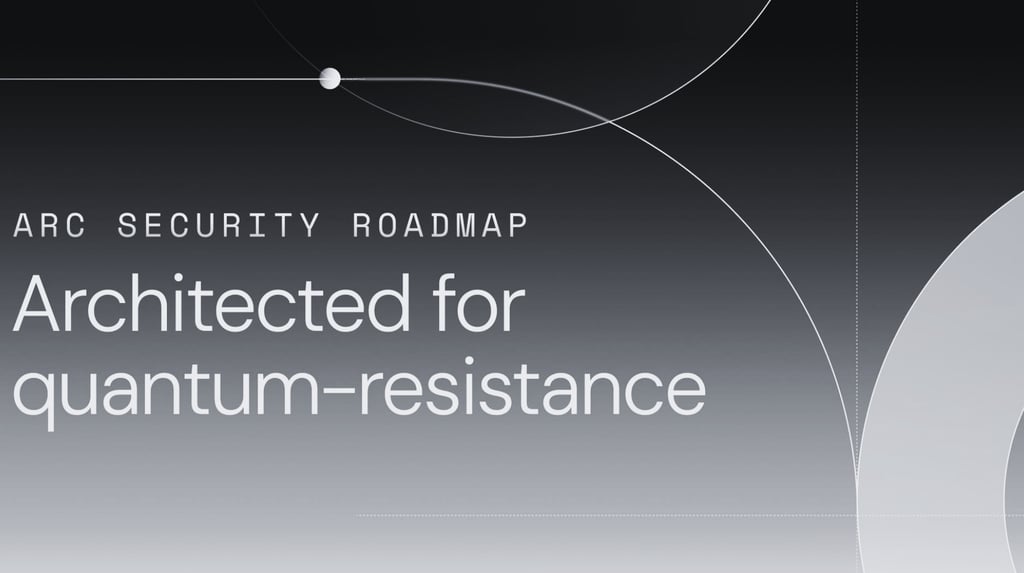
Circle has announced a roadmap to make its Layer 1 blockchain, ARC, resilient to quantum attacks, positioning the network for a future where advances in computing could challenge the cryptographic foundations of current digital assets.
This move is more forward-looking than reactive. Quantum computing isn't yet a short-term threat to blockchain security, but Circle's decision signals a shift in how major infrastructure providers are thinking about time horizons—designing systems not just for the next cycle, but for the next decade.
Security transcends the current cycle
Most blockchains today are based on elliptic curve cryptography, which remains secure against classical computers but, in theory, could be broken by sufficiently advanced quantum machines.
Circle's ARC roadmap focuses on transitioning to post-quantum cryptographic standards, including novel signature schemes designed to resist quantum attacks. This approach is expected to be gradual, incorporating hybrid systems that allow both legacy and anti-quantum methods to coexist during the transition.
This reflects a key limitation: blockchain systems cannot be easily overhauled. Security upgrades must be implemented without disrupting existing assets, users, or applications.
From Theoretical Risk to Strategic Priorities
For years, quantum risk was considered abstract—acknowledged but delayed. Circle's announcement suggests this is beginning to change. The reason is simple. If blockchain infrastructure is expected to support it:
Stable currencies and payments
Tokenized financial assets
Institutional capital flows
Its security assumptions must be maintained over the long term. Even a low-probability vulnerability becomes critical when systems are designed to store value for decades. In that context, quantum resilience shifts from an academic concern to an infrastructure requirement.
ARC as Organizational-Level Infrastructure
The roadmap also provides insight into how Circle positions ARC; rather than competing purely on throughput or cost, ARC appears to be designed as infrastructure for organizations where reliability, compliance, and longevity are central. Quantum resilience fits into that framework as a differentiating factor—especially for organizations requiring assurance of long-term asset security.
This aligns with Circle's broader strategy of building a financial platform around USDC, where trust and stability are more important than experimentation.
Our review
Circle's move could spur similar efforts across the industry. If major infrastructure providers begin integrating quantum-resistant frameworks, it could redefine fundamental expectations about blockchain security.
Circle's quantum defense roadmap for ARC focuses not only on immediate threats but also on protecting future financial infrastructure. As blockchain systems become increasingly prevalent in mainstream finance, their design constraints are beginning to resemble those of traditional systems – where resilience is measured in decades, not years.
Disclaimer: The information presented in this article is the author's personal opinion in the field of cryptocurrency. This is not financial or investment advice. All investment decisions should be based on careful consideration of your personal portfolio and risk tolerance. The views expressed in this article do not represent the official stance of the platform. We recommend that readers conduct their own research and consult with experts before making any investment decisions.
Compiled and analyzed by HCCVenture
Follow HCCVenture here: https://link3.to/holdcoincventure
Explore HCCVenture group
HCCVENTURE QUANT JSCO
© 2026 HCCVENTURE. ALL COPYRIGHTS RESERVED.


Connect with us
Popular content
Contact to us
Address: 8th Floor, Bach Dang Complex Building, 50 Bach Dang Street, Hai Chau Ward, Da Nang City, Vietnam.
Phone: 1900 1509
Gmail : sp_contact@hccventure.com
Disclaimer: The information on this website is for informational purposes only and should not be considered investment advice. We are not responsible for any risks or losses arising from investment decisions based on the content here.
TERMS AND CONDITIONS • CUSTOMER PROTECTION POLICY
ANALYTICAL AND NEWS CONTENT IS COMPILED AND PROVIDED BY EXPERTS IN THE FIELD OF DIGITAL FINANCE AND BLOCKCHAIN BELONGING TO HCCVENTURE ORGANIZATION, INCLUDING OWNERSHIP OF THE CONTENT.
RESPONSIBLE FOR MANAGING ALL CONTENT AND ANALYSIS: HCCVENTURE FOUNDER - TRUONG MINH HUY
Read warnings about scams and phishing emails — REPORT A PROBLEM WITH OUR SITE.